Aston Martin Racing will make its global rally-raid debut at the 2027 Dakar with three Dreadnought prototypes built and run by Prodrive. Fernando Alonso, Sébastien Loeb and Lucas Moraes are the confirmed drivers. Lance Stroll is not part of the Dakar line-up, despite remaining Alonso's Aston Martin Formula One team-mate in 2027.
Three crews with different forms of experience
Alonso will reunite with Marc Coma. The Spanish crew contested Dakar 2020 together and finished 13th overall, recording the second-fastest time on stage eight. Coma had previously won the motorcycle category five times before moving into co-driving and sporting-management roles.
The January event will come before Alonso begins a 24-round Formula One season that includes ten Sprint races, according to Aston Martin's published calendar summary. Alonso says Formula One remains his priority. Circuit experience and adaptability are relevant, but they do not replace rally-raid navigation, long-distance vehicle management or the testing needed for a new prototype.
Loeb will be paired with Fabian Lurquin. The nine-time World Rally champion is still seeking his first outright Dakar victory. Aston Martin credits him with 28 stage wins, five podium finishes and three runner-up results across ten starts, seven of which he completed. He brings the most extensive Dakar record of the three drivers, while also taking on the uncertainty of a car making its competition debut.
Moraes will compete with Pablo Moreno. The Brazilian finished third on his first Dakar in 2023 and won the 2025 FIA World Rally-Raid Championship. His recent experience in the current W2RC environment complements Loeb's long record and Alonso's cross-discipline programme. The announcement does not assign a lead-car hierarchy among them.
Dreadnought's digital origin does not define its technical package
The Dreadnought name first appeared on a digital military-specification vehicle created by Aston Martin for Call of Duty: Modern Warfare 4. The Dakar entry is not simply that virtual design reproduced without change. Prodrive has developed a purpose-built physical rally raider whose body and identity draw on the game project.
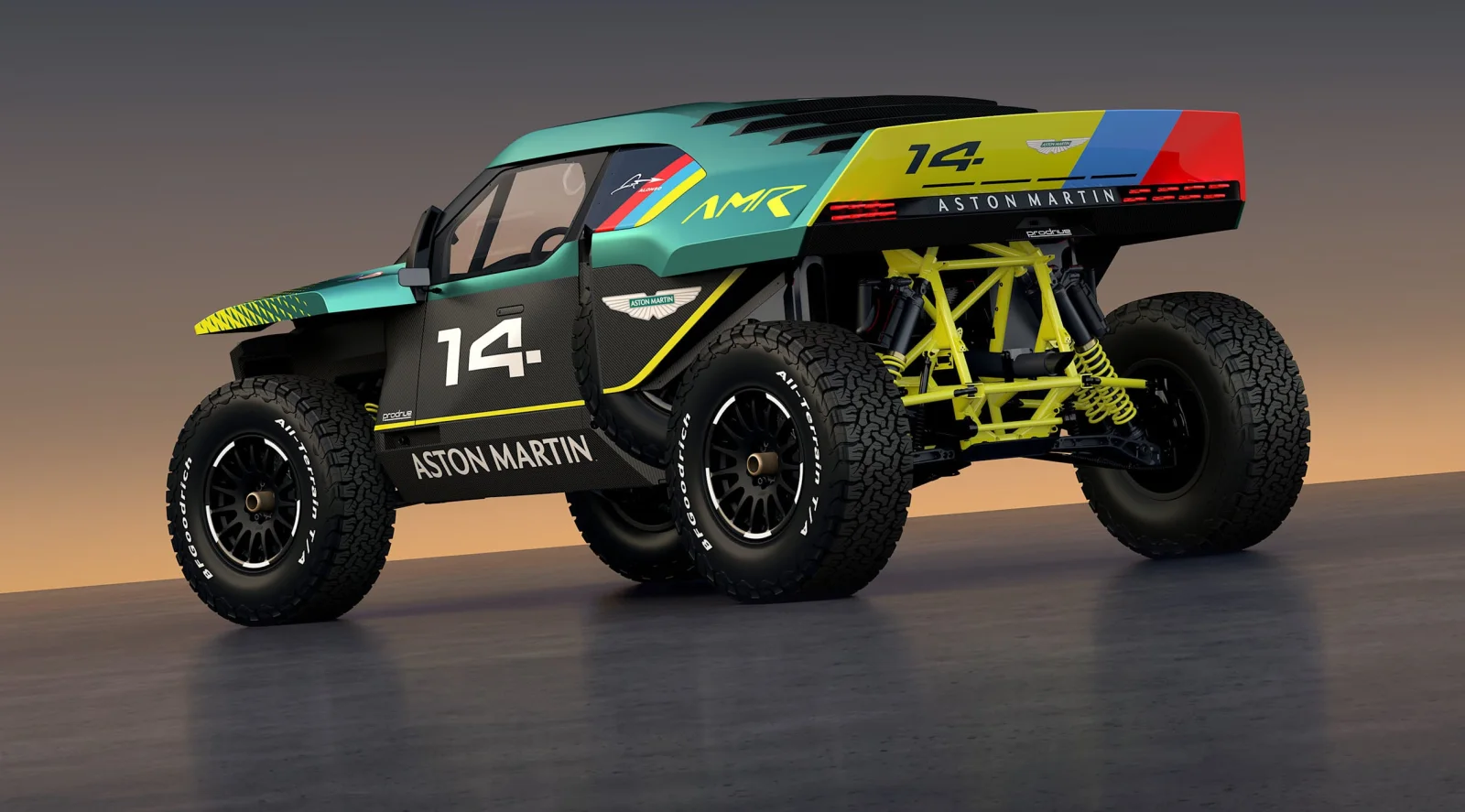
Aston Martin has not released a full specification. Its announcement does not state engine configuration, output, transmission, weight, dimensions, suspension travel or the precise FIA homologation category. The official rendering shows a closed cockpit, large rally-raid tyres and exposed long-travel rear suspension, but visible details are not a substitute for a technical sheet. No direct mechanical relationship to an Aston Martin road car has been confirmed.
Prodrive developed and built all three cars and will operate them exclusively on the event. The British engineering company is Aston Martin Racing's long-standing GT partner and has four decades of rally and prototype experience. Aston Martin says Prodrive has taken three Dakar podiums in the past five editions and won the 2026 event with a car of its own design and manufacture.
That background supplies an established competition operation, not proof that a new vehicle will be reliable immediately. Cooling, service access, suspension durability, sand performance and crew integration still need validation. Aston Martin and Prodrive describe the aim as competing at the front; it remains a target until the Dreadnought produces results against homologated rivals.
The 2027 Dakar moves to Portugal and Morocco
The 49th Dakar is scheduled for 9–23 January 2027. Organiser A.S.O. has moved the event from Saudi Arabia to Portugal and Morocco for one edition, with a Saudi return planned for the 50th running in 2028. The FIA says the relocation remains subject to World Motor Sport Council approval.
The organiser's route contains a prologue and 12 stages over 7,824 km, including 4,341 km of timed special stages. Loulé-Faro hosts the start. After the 9 January prologue and the first special on 10 January, the field crosses the Mediterranean towards Nador. The route then uses bivouacs around Bouarfa, Zagora and Agadir, where the rest day is set for 17 January, before exploring southern Morocco and finishing in Marrakech.
These official route numbers matter because the final paragraph of Aston Martin's announcement gives a different summary: 11 stages and 6,805 km. Carboratory uses the Dakar organiser's prologue-plus-12-stage, 7,824 km total as the route reference. Aston Martin remains the primary source for its entry, its crews and Prodrive's role.
A first for the brand, not for its engineering partner
Aston Martin describes this as its first global rally-raid campaign. That claim should be separated from Prodrive's prior Dakar activity. The engineering company has already designed and operated cars in the event; Aston Martin branding and the Dreadnought programme are the new elements for 2027.
The project connects three different parts of the organisation's public identity. Alonso continues in the Formula One team, Prodrive carries the established competition engineering, and Dreadnought transfers a name and visual concept from a digital entertainment collaboration into a physical race car. None of those links supplies the missing technical specification, so performance comparisons would be premature.
Testing and homologation information will determine how closely the final competition car resembles the released rendering. The published image even carries Alonso's number 14, but the Dakar organiser has not yet supplied a final entry list in the cited material. Numbers, class designation and the full mechanical package should therefore be treated as pending unless separately confirmed.
What is settled is the scale of the programme: three cars, three decorated crews and exclusive Prodrive operation. Aston Martin is not entering merely for a demonstration run; its stated goal is to contest the front positions. Dakar's long stages and service constraints will decide whether that goal is realistic.