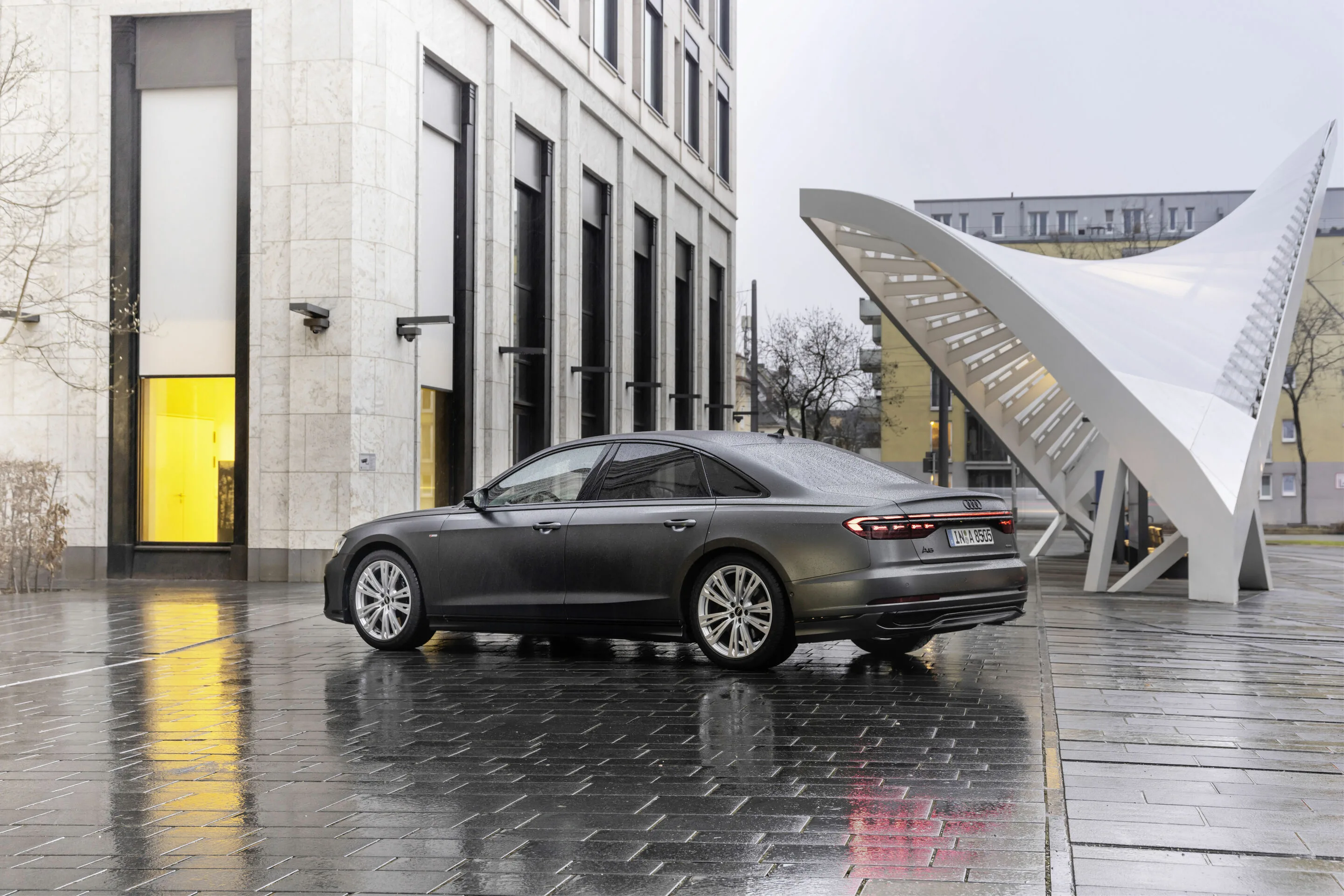
Audi A8 production ended at Neckarsulm in October 2026 after 32 years and four generations, according to reports in German, British and American automotive media. Audi has not issued a separate announcement identifying the final car, and it has not revealed a direct replacement. That distinction matters: the current A8 is no longer being built, but the manufacturer has not said that the nameplate has been retired permanently.
For buyers, the immediate consequence is that a new A8 can no longer be configured to order in markets where the order book has closed. German orders ended in February 2026, while availability in other countries has followed different schedules. Cars already built may still be held by importers or dealers, be in transit, or be offered as pre-registered stock. A listing should therefore be checked with the seller rather than treated as proof that factory orders remain open.
The final car reportedly left the line in mid-October
Recent accounts place the end of assembly in the middle of October at Audi’s Neckarsulm plant. The location has been central to the A8 story since production began in 1994. Audi’s official 2026 site profile confirms that date and records 15,509 employees and 181,454 vehicles produced at Neckarsulm during 2025. At the end of that year, the factory’s official model list comprised the A5, A6, A8 and e-tron GT.
Audi has not published the final vehicle’s chassis number, specification or destination. Those details should not be filled in with assumptions. What can be established is that the D5 generation, introduced in 2017 and updated in 2021, has reached the end of its industrial life. Media reports say capacity at Neckarsulm is being used for other products, including the A5 family, but the company has not provided an A8-specific production statement with a complete transition plan.
An end-of-production date is not the same as an immediate disappearance from every showroom. Remaining stock can be sold after a line closes, and registration dates may be substantially later than build dates. Customers considering one of the last cars should request the VIN, production date, precise market specification, warranty terms and a realistic handover date.
Four generations built around a technical flagship
The original A8 entered production in 1994 as the successor to the Audi V8. Its defining feature was the Audi Space Frame, an all-aluminium body structure. Audi describes the first A8 as the world’s first series-production vehicle with a complete aluminium body, a major engineering statement in a class led by the Mercedes-Benz S-Class and BMW 7 Series.
Three further generations followed, with the A8 repeatedly used to introduce technology before it reached less expensive Audi models. The fourth-generation car is 5.19 metres long, 3.00 metres between the axles, 1.95 metres wide and 1.47 metres high. Audi’s technical material says its body contains approximately 58% aluminium, alongside a hot-formed steel passenger cell, a carbon-fibre-reinforced polymer rear panel and magnesium strut braces.
The 2021 update brought Digital Matrix LED headlights with approximately 1.3 million micromirrors in each lamp, digital OLED rear lights and around 40 driver-assistance systems. The range included petrol and diesel engines, a plug-in hybrid and the performance-focused S8. A late official data sheet for the A8 60 TFSI e lists 340 kW, or 462 PS, 700 Nm and a 17.9 kWh gross battery, of which 14.4 kWh is usable. Those figures describe one derivative, not a universal final line-up for every country.
No confirmed replacement programme
The absence of an announced successor is the most significant part of the story. Earlier reports linked a future flagship with Porsche’s Leipzig plant, the Panamera’s industrial base or a fully electric architecture. Audi has not confirmed the factory, platform, powertrains or launch date of another A8. Claims that the next car must be electric, or that it will share its core engineering with a Porsche, remain unverified.
This leaves Audi without a conventional direct rival to the current S-Class and 7 Series. The company still offers large and expensive vehicles including the A6, Q7, Q8 and e-tron GT, but they serve different purposes. A large SUV does not automatically reproduce the low seating position and rear-passenger priorities of a limousine, while an electric grand tourer is not a complete substitute for a long-wheelbase executive saloon.
The hiatus could increase interest in well-kept used A8s, although rarity alone does not guarantee higher values. Ownership costs still reflect the complexity of a flagship: air suspension, advanced lighting, driver-assistance hardware, comfort electronics and, on plug-in hybrids, a high-voltage battery. A complete service record, diagnostic inspection and check for outstanding service campaigns matter more than a claim that a car is “one of the last”.
What is established in November 2026
The current A8 is out of production, orders closed earlier in its core markets, and the model completed four generations between 1994 and 2026. It remained one of Audi’s principal technology carriers throughout that period. There is no presented successor, official timetable or confirmed future format for the A8 name. Any future programme should therefore be kept separate from the verifiable news that the current production run has ended.