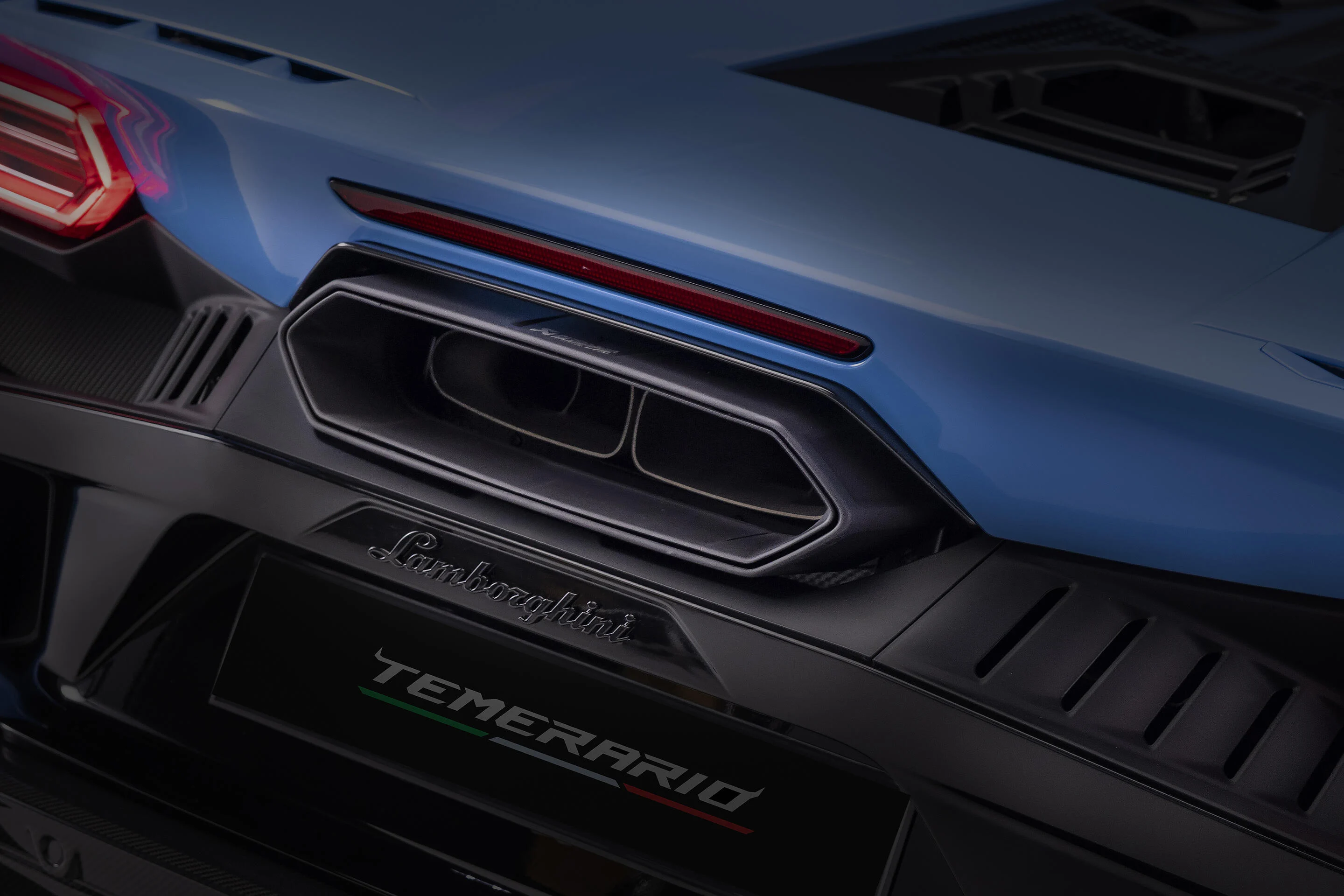
Lamborghini has added an official Akrapovič titanium exhaust to the Temerario Coupé accessories catalogue. The system weighs 11.40 kg, 12% less than the standard exhaust, and will be available both for new configurations and as a retrofit for cars already delivered. Lamborghini does not claim an increase in engine or system output.
The upgrade is principally about acoustic character and construction. Akrapovič has revised the exhaust geometry and layout, fitting larger-diameter pipes, bespoke manifolds and a different silencer architecture. Lamborghini has not announced its price, installation charge or precise ordering timetable.
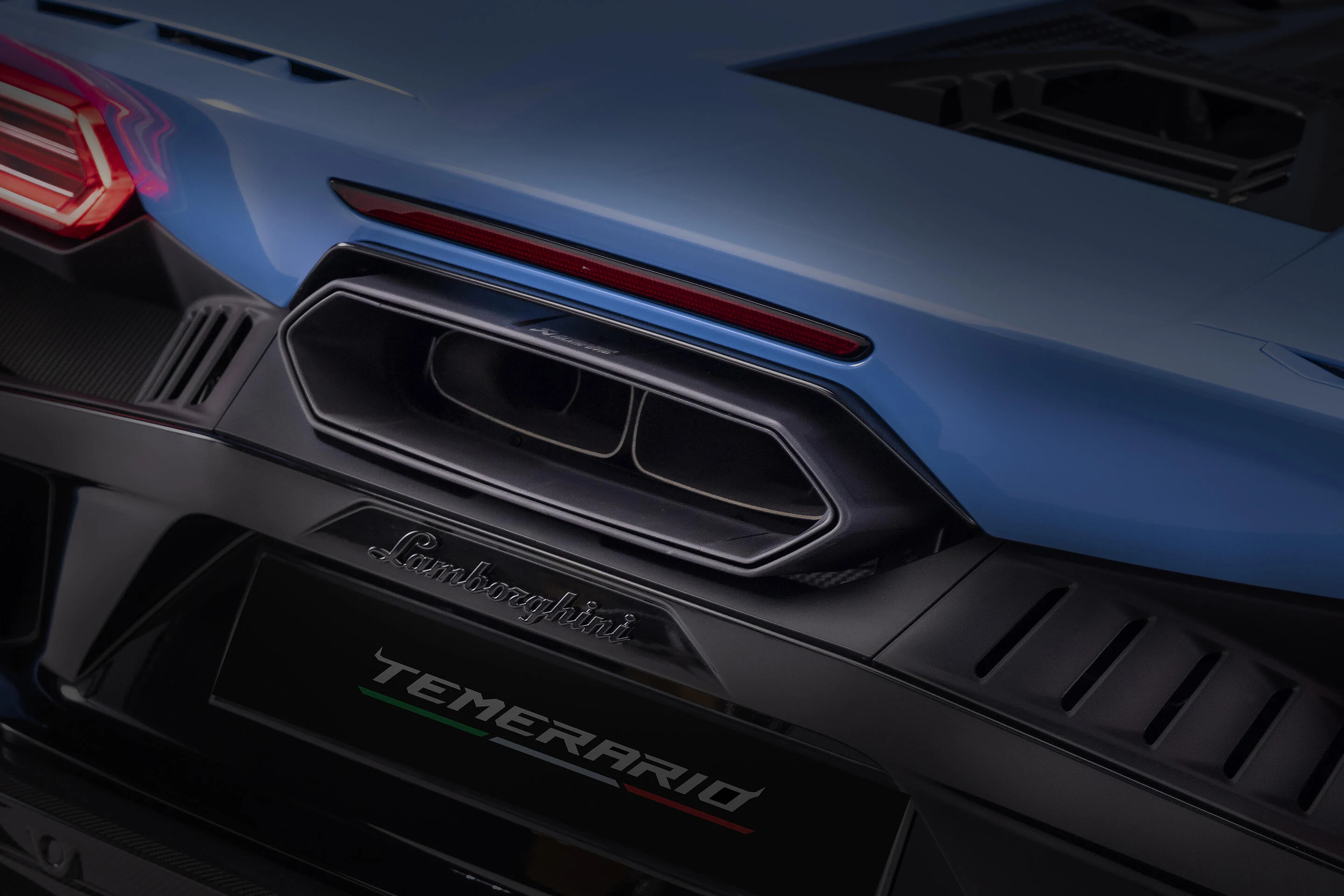
The black-finished outlet is integrated into the rear bumper. Photo: Automobili Lamborghini S.p.A., official press image.
What changes beneath the rear bumper
The redesigned route is intended to improve exhaust-gas flow. High-temperature areas receive comprehensive insulation to limit heat transfer into surrounding components. Akrapovič produces the precision-cast valve housings in its own foundry, while the system is assembled by hand from purpose-designed components.
The visible identifier is a dedicated black outlet integrated into the central rear opening. The 12% reduction applies to the exhaust assembly, not the entire vehicle. Using Lamborghini’s two published figures implies that the standard system weighs about 13.0 kg and that the saving is roughly 1.6 kg; those are calculated values rather than separately stated factory numbers.
No power or torque curve accompanies the announcement. Lamborghini describes lower weight and a retuned sound, but it does not state that the accessory improves the Temerario’s acceleration or top speed. The car’s 920 CV figure belongs to its standard combined hybrid powertrain and should not be attributed to the exhaust.
Tuning frequencies rather than simply adding volume
Noise, vibration and harshness engineers calibrated the system to emphasise selected frequencies. Lamborghini says its character progresses from deep notes at low engine speeds to a more incisive signature near 10,000 rpm. The company also presents the sound as useful feedback when choosing a shift point.
That is a manufacturer description, not an independent acoustic test. Lamborghini provides no comparative decibel readings, cabin measurements or identical-condition recordings with the standard and titanium systems. The release therefore does not establish how much louder the car becomes, how valves behave in each driving mode or whether any particular frequency changes inside the cabin.
Akrapovič’s general technical material explains that its engineers correlate sound with engine speed, exhaust temperature, vehicle speed and vibration. Development can include road and dynamometer work, transmission-loss testing, flow analysis and simulation. The Temerario announcement confirms targeted NVH calibration but does not publish the project’s test protocol or raw results.
The V8 hybrid powertrain is unchanged
Temerario uses a 4.0-litre twin-turbo V8 developed in Sant’Agata Bolognese. The combustion engine produces 800 CV between 9,000 and 9,750 rpm and 730 Nm from 4,000 to 7,000 rpm. Three electric motors take total system output to 920 CV.
Official specifications quote 0–100 km/h in 2.7 seconds and a 343 km/h maximum speed. The transmission is an eight-speed dual-clutch unit. Lamborghini has not issued revised performance figures with the Akrapovič accessory, so the standard data remain the only supported numbers.
The unusual feature is the V8’s 10,000 rpm limit, exceptionally high for a series-production twin-turbo engine. It explains why the exhaust project concentrates on high-frequency character and heat management. Specialised titanium alloys are selected for the different mechanical and thermal demands across the assembly, according to Lamborghini and Akrapovič.
Titanium is useful here because it combines reduced mass with resistance at elevated temperatures, but the material alone does not guarantee a particular sound or a performance gain. Pipe diameter, wall thickness, valve operation, manifold shape and silencer volume all influence the final result. The official release confirms several of those changes without quantifying their individual effects.
Factory accessory and retrofit route
The Lamborghini Titanium Exhaust joins the Accessori Originali programme. Crucially, Lamborghini explicitly says it will also be offered as a retrofit for customer cars that have already been delivered. Owners are not limited to vehicles specified with the part at the factory.
The announcement does not state fitting time, regional availability or whether all early cars require the same supporting parts. It also does not spell out local approval paperwork or the exact warranty treatment of the installation. Buyers will need a quotation and documentation from an authorised Lamborghini retailer before assuming that pricing or conditions are identical across countries.
The exhaust will also be offered on the first derivative of the Temerario family, whose world premiere is scheduled for the week following the 11 November announcement. Lamborghini does not name that derivative or identify its body style in this release. Calling it a confirmed roadster or Spyder before its presentation would go beyond the published information.
Extending an established partnership
Lamborghini says its technical relationship with Slovenia-based Akrapovič began with Urus. It later expanded to the Huracán family, including Huracán STO, and to Urus SE and Urus SE Performante. Temerario creates a different engineering brief because it couples a very high-revving turbocharged V8 with electrification, replacing the naturally aspirated V10 format associated with Huracán.
For an owner, the verified proposition is narrower than the marketing language might suggest. This is an official, lighter exhaust with a different internal layout and a manufacturer-designed soundtrack, and it can be installed after delivery. It is not presented as a power package. Price, measured sound levels and market-specific installation details remain necessary before its value can be judged.