The 2026 Golden Steering Wheel awards produced 17 automotive trophies across 15 categories, spanning small cars, electric SUVs, luxury models, sports cars and used vehicles. The 50th ceremony took place in Berlin on 10 November, half a century after BILD am SONNTAG first presented the award in 1976.
The main winners include the Opel Corsa GSE in the small-car class, Škoda Epiq among small SUVs, Kia K4 Sportswagon in the compact class, Kia EV5 in compact SUVs, BMW i3 in the mid-size category and Mercedes-Benz S-Class in the luxury class. BMW M2 CS won the sports-car award, while Škoda Peaq took the family-car trophy.
These are German-market awards. They do not establish that every winner is on sale in every European country, nor do the price-limited categories set a single price across the continent. Local equipment, taxes, launch timing and warranties still need to be checked country by country.
The complete 2026 winner list
AUTO BILD, BILD am SONNTAG and their parent company Axel Springer published the following results:
- Small car: Opel Corsa GSE
- Small SUV: Škoda Epiq
- Compact class: Kia K4 Sportswagon
- Compact SUV: Kia EV5
- Mid-size class: BMW i3
- Upper mid-size class: Genesis GV60 Magma
- Luxury class: Mercedes-Benz S-Class
- Sports car: BMW M2 CS
- Family car: Škoda Peaq
- Editorial award under €25,000: Volkswagen ID. Polo
- Editorial award under €30,000: Kia EV2
- Editorial award under €35,000: Mazda CX-5
- Best used car: Audi A4 Avant B9
- Innovation: Ferrari Luce
- Motorsport Award: Toto Wolff, Team Principal and CEO of Mercedes-AMG Petronas F1
Three historic winners were also selected by readers for the anniversary: the Mercedes-Benz SL R129, Porsche Carrera GT and Audi 100 C3. Those multiple historic recipients account for the difference between 15 categories and 17 automotive trophies.
The English version of the organiser's release labels both Epiq and EV5 as “Small SUV”. Kia's official release and the German-language organiser list identify EV5 correctly as the compact-SUV winner. That is the classification used here.
How the cars were selected
Seventy-nine new models entered the nine principal vehicle classes. AUTO BILD and BILD am SONNTAG readers voted three finalists through in each class, creating a field of 27 cars for testing at the DEKRA Lausitzring. The readers therefore set the final field but did not decide all class winners directly.
The test panel combined racing drivers, motoring journalists, automotive specialists and prominent car enthusiasts. The names highlighted by the organiser included nine-time World Rally Champion Sébastien Ogier, racing driver Klaus Ludwig, Boris Becker and presenter Andrea Kaiser. Five families with children formed a separate panel for the family-car category.
Assessment areas included everyday usability, quality, sustainability, powertrain, driving behaviour, efficiency and value for money. The precise emphasis varied by class. A sports car and a family vehicle were not judged as if they served the same purpose. The three price-band awards were editorial choices based on German base price, equipment and driving experience.
This mixed method is important when interpreting the result. It combines a public shortlist with a track and road assessment rather than being purely a readers' popularity poll. It is still an award run by German publications, not an independent European regulatory test.
Kia took three current-model awards
Kia was the only individual brand with three current vehicles on the winner list: EV2, EV5 and K4 Sportswagon. Kia says it is the first non-European manufacturer to win three Golden Steering Wheels in one year. EV2 won the sub-€30,000 editorial category, EV5 topped compact SUVs and K4 Sportswagon won the compact class.
The models address different buyers and did not compete directly. EV2 is a 4.06-metre electric B-segment SUV developed for Europe and built in Žilina, Slovakia. Kia quotes up to 453 km of range and as much as 403 litres of luggage capacity depending on specification and rear-seat position. The €30,000 threshold refers to the German entry price, not to a guaranteed price in every market.
EV5 is a larger electric compact SUV, while K4 Sportswagon is an estate positioned in the European compact segment. Kia's three results therefore cover two battery-electric cars and one model line offering combustion or electrified powertrains depending on market. The awards should not be read as an internal ranking among the three.
Six trophies for Volkswagen Group
Volkswagen Group counted six prizes once the historic Porsche Carrera GT and Audi 100 C3 trophies were included. Among current products, Škoda Epiq won the small-SUV class, Škoda Peaq the family-car award, Volkswagen ID. Polo the sub-€25,000 editorial prize, and Audi A4 Avant B9 the used-car category.
Volkswagen quotes up to 454 km of range for ID. Polo and official combined energy consumption of 13.3–14.8 kWh/100 km, depending on version. The award's €25,000 ceiling is tied to Germany. It is not confirmation that the same starting price, standard equipment or incentive conditions will apply across Europe.
Škoda describes Epiq as its electric entry model and Peaq as its new electric flagship. Their shared success does not imply similar size or pricing. It indicates that each was evaluated against different finalists and category priorities.
BMW won with an EV and a petrol sports car
BMW i3 won the mid-size category and M2 CS the sports-car class. The new electric i3 is part of BMW's Neue Klasse generation. For the i3 50 xDrive, BMW publishes official WLTP consumption of 13.4–18.0 kWh/100 km, with the final value depending on configuration and test conditions.
M2 CS uses a 3.0-litre turbocharged straight-six petrol engine producing 390 kW, or 530 PS, and 650 Nm. An eight-speed automatic transmission sends power to the rear wheels. BMW claims 0–100 km/h in 3.8 seconds and a 302 km/h maximum speed. These are manufacturer figures, not Carboratory measurements.
The two BMW awards also illustrate the technological spread of the results. Electric vehicles feature heavily, but the jury did not apply an EV-only rule. The final list includes petrol performance, several electrified formats, a luxury saloon with multiple powertrain choices and a used estate.
What the award can — and cannot — tell buyers
The Golden Steering Wheel can help reduce a long shopping list because the main winners survived a reader shortlist and a comparative jury test. It does not replace a local test drive, a safety rating or a long-term reliability assessment. The used-car award for the Audi A4 Avant B9 cannot establish the condition of an individual car; service history, mileage, specification and accident repairs remain decisive.
Several 2026 winners are new or not yet equally available across Europe. Buyers should verify delivery dates, local homologation, standard equipment and final prices. The €25,000, €30,000 and €35,000 categories are explicitly German-market bands.
The most useful conclusion is therefore narrower than “Europe's best cars”. The results identify models that performed strongly in a German reader-and-jury process across defined categories. That is meaningful comparative evidence, provided its geography and method remain attached to the headline.
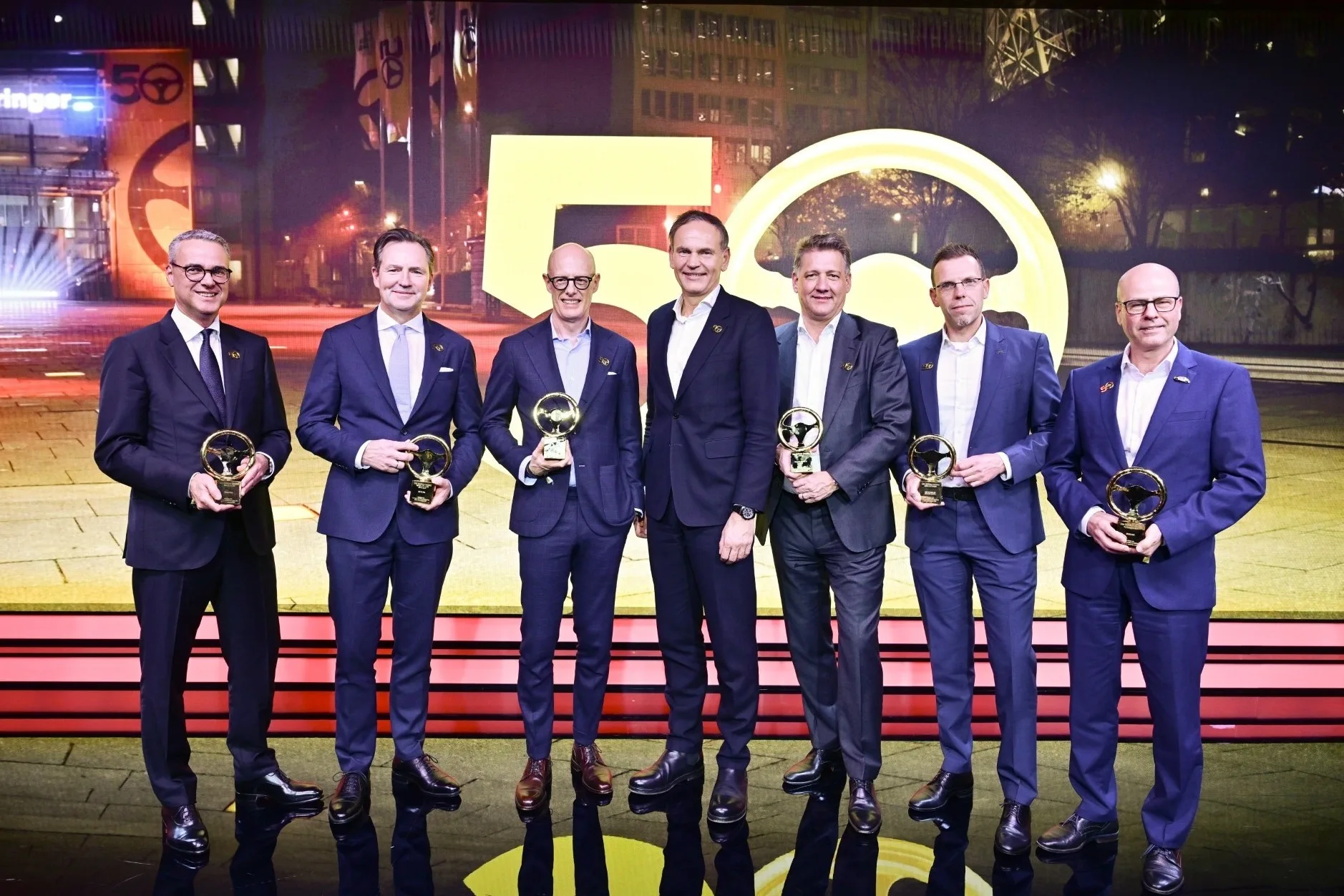
Image: BILD / Volkswagen AG. The official press photograph shows Volkswagen Group representatives at the Berlin ceremony. Volkswagen AG marks it as free of charge for editorial use.