Jaguar Land Rover Limited has applied to protect TYPE 02 as a word mark in the European Union. EUIPO application 019447495 was filed on 9 November 2026 and is listed as being under examination at the time of writing. Its Class 12 goods cover vehicles, electric vehicles and a range of vehicle parts. That makes the filing relevant to Jaguar's future naming strategy, but it does not confirm that a production car called Type 02 has been approved or scheduled.
Trademark applications are often filed before a product announcement. They can reserve options, secure a naming sequence or prevent another company from using a valuable term. They can also be opposed, refused, withdrawn or simply never used on a product. Jaguar has issued no Type 02 press release and has supplied no launch date, market list, body style, platform or technical specification for a car carrying this name.
What the EU filing actually covers
The register identifies Jaguar Land Rover Limited of Coventry, United Kingdom, as the applicant. TYPE 02 is a word mark filed in Nice Class 12. The goods description includes vehicles and electric vehicles, exterior and interior vehicle trim, seats, steering wheels, treadplates, alloy wheels, wheel covers, plus parts and fittings for those items.
That wording is broad enough to protect the name for a car and associated components. It does not distinguish between an SUV, crossover, saloon, coupé or grand tourer. There is no battery size, motor count, output, range, price or production location in the filing. Attaching any of those details to a Type 02 today would go beyond the evidence.
The status is equally important. An application under examination is not the same as a completed registration, and registration itself would still not oblige Jaguar to use the mark. The defensible conclusion is narrow: JLR is seeking EU protection for Type 02 in the automotive field. Everything beyond that remains unconfirmed unless Jaguar publishes it.
Why Type 02 follows naturally from Type 01
Jaguar provided the naming logic when it announced Type 01 in May 2026. The company said “Type” links the new car with names including C-type, E-type and F-TYPE. The zero represents electric propulsion and zero tailpipe emissions, while the one identifies the first Jaguar of the new generation. The production Type 01 made its full debut in New York in October.
Following that pattern, Type 02 looks like an intuitive label for a second vehicle in the new line. It is still an inference. Neither the trademark record nor an official Jaguar statement says that the number two means the second production model, and Jaguar has not publicly committed to a sequentially numbered range. For now, Type 02 is best described as a protected option rather than an announced car.
This distinction matters because a plausible name can quickly acquire invented specifications when it circulates online. The filing does not identify Type 02 as smaller or larger than Type 01, and it provides no evidence for a particular price bracket. A number in a model name is not a reliable guide to size, performance or market position without the manufacturer's explanation.
Type 01 is the only firm technical reference
The new-generation Jaguar that can be described in detail is Type 01. It is a four-door electric GT built on the dedicated Jaguar Electric Architecture. Jaguar specifies three motors, a usable 118 kWh battery, up to 1,030 PS and 1,365 Nm. The manufacturer quotes 0–100 km/h in 3.1 seconds and a 50:50 weight distribution. These are official figures, not independent Carboratory test results.
Type 01 is 5,235 mm long and 1,403 mm high. Standard wheels measure 23 inches, while 21-inch wheels are available. Jaguar quotes a drag coefficient of 0.23. The electrical system operates at 850 volts and supports up to 350 kW DC charging. Under the conditions stated by Jaguar, up to roughly 321 km of estimated range can be added in 13 minutes.
The company advertises up to about 644 km of estimated range for a fully charged car on 21-inch wheels in its North American material. That is a manufacturer estimate tied to that market and should not be presented as a European WLTP certification. Real range will depend on speed, weather, wheel choice, temperature and charging conditions.
US pricing starts at $130,500, with orders expected to open in early 2027 and first deliveries anticipated in the second half of that year. The dollar price is not an EU price: tax, equipment and regional strategy differ, and Jaguar has not provided a Type 02 price anywhere because no such product has been announced.
What the filing changes — and what it does not
For buyers, the Type 02 application changes nothing in the showroom. It is not an order opening, homologation notice or guarantee that a second model will reach a particular country. Its value is as evidence of legal preparation. Jaguar has chosen a name consistent with Type 01 and is seeking room to use it for automotive products in the EU.
The next meaningful evidence would be an official Jaguar announcement, an identified prototype programme, homologation documentation or specifications released by the company. Until one of those appears, reports should not give Type 02 a body shape, battery, power output or launch year. Even a successful trademark registration would protect a name, not validate a product plan.
The timing does make the application worth watching. It arrived just over a month after the complete Type 01 reveal, when Jaguar's new electric architecture and naming scheme were no longer abstract concepts. Yet timing alone cannot establish what the company will build next. The filing is a concrete legal record; the identity of the vehicle behind it, if any, remains an open question.
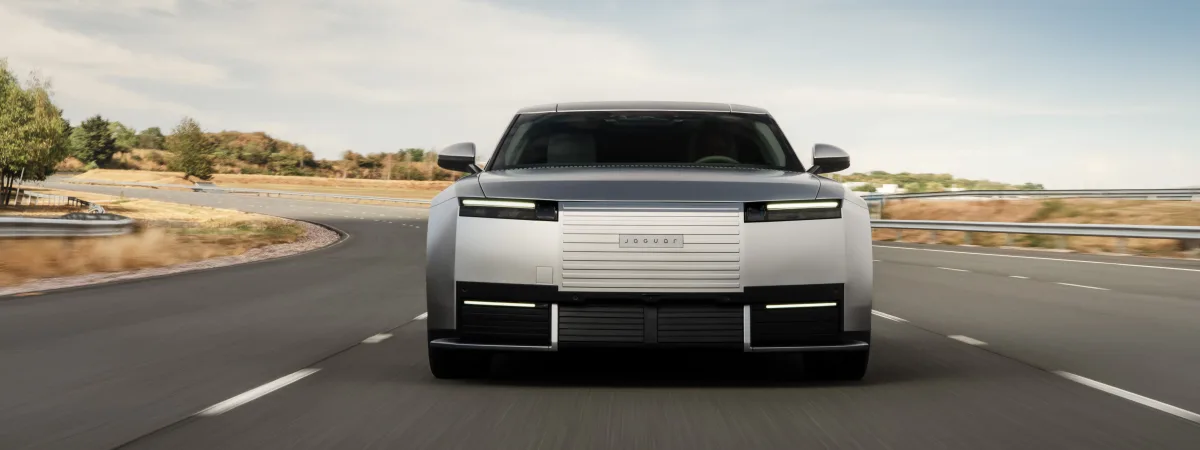
Image: official JLR Media photograph of Jaguar Type 01, used editorially to illustrate the naming family. Jaguar has not released an image of Type 02.