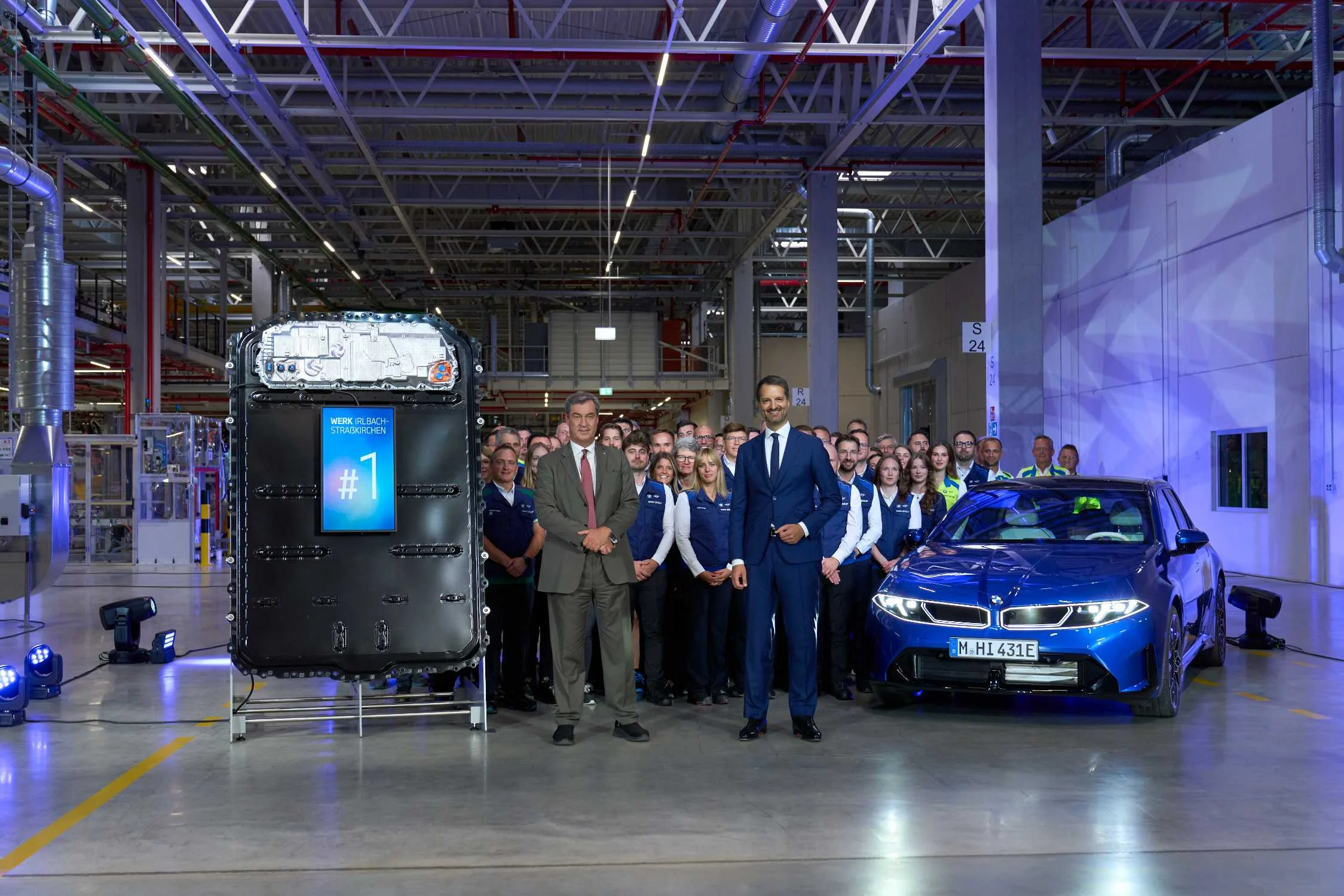
BMW has opened its Irlbach-Straßkirchen plant in Bavaria and begun series production of sixth-generation high-voltage batteries. Its first customer is BMW's Munich vehicle plant, where the packs are installed in the new i3. The battery facility entered production on two shifts immediately, a schedule BMW attributes to a faster-than-planned ramp-up of Neue Klasse models.
The company puts the investment at about €1 billion. The site covers 60 hectares, while the production area itself spans 50,000 square metres. Construction started in April 2024 and the first pre-series battery was completed in March 2026. BMW says roughly 1,600 people will work at the plant when it is fully operational, producing several hundred packs per day on two lines.
What Irlbach-Straßkirchen actually makes
This is a battery assembly plant, not a cell factory. Specialist suppliers deliver cylindrical cells, which undergo incoming checks including voltage measurements. The plant then turns those cells into complete high-voltage packs ready for vehicle installation. BMW's Gen6 design uses a cell-to-pack layout, placing the cells directly in the battery housing rather than first building conventional modules.
Cells are clustered and connected to cooling elements. The clusters and contact system are laser-cleaned and welded, followed by a foaming process intended to protect the components as one mechanical unit. The housing is then closed, sealed and riveted. Finally, BMW installs the Energy Master central control unit and puts every completed battery through an end-of-line inspection.
More than 3,500 data points are recorded and monitored for each pack, according to BMW. Around 500 robots work across the production floor, supported by internally developed AI assistants that analyse process data. Digital twins and virtual-reality tools were also used before commissioning for planning and staff training. These systems supplement rather than remove the final test: BMW states that 100% of completed batteries are inspected.
The first pack goes into the new BMW i3
Initial output is for the new BMW i3 built in Munich. This Neue Klasse saloon is separate from the compact i3 manufactured from 2013 to 2022. BMW quotes a usable battery capacity of 108.7 kWh for the i3 50 xDrive First Edition and a range of up to 906 km under the WLTP procedure. That is an official figure for the stated configuration, not a Carboratory road-test result.
The Gen6 electrical architecture operates at 800 volts and supports a peak DC charging rate of 400 kW in this version. BMW says the car can add up to 423 km of WLTP range in ten minutes under its specified test conditions. Real charging performance will depend on battery temperature, initial state of charge, the charger's output and the vehicle's charging curve. The model also supports bidirectional charging.
BMW calls the structural integration method “pack-to-open-body”: the battery housing forms part of the vehicle structure. It can make more efficient use of the available space, but it also means the body, pack and repair procedures need to be considered together. The factory announcement does not give replacement prices, repair times or insurance classifications.
One of five local assembly hubs
Irlbach-Straßkirchen is one of five new Gen6 pack plants located near BMW vehicle factories. The other sites are Debrecen in Hungary, Shenyang in China, Woodruff in the United States and San Luis Potosí in Mexico. BMW describes this as a “local for local” system: assembling large, heavy packs near the plants that consume them reduces transport distances and creates a common regional supply structure.
The Bavarian factory is the central platform for German vehicle plants. It begins with Munich and is intended to serve other German operations as Neue Klasse production expands. BMW reports that every directly contracted construction company was German, with two-thirds based in Bavaria. More than three-quarters of the production-equipment contractors were German and about one-third Bavarian.
The project also went through a local vote. In September 2023, more than 75% of participants in Straßkirchen's referendum approved construction, on turnout of about 77%. Those numbers establish the formal mandate for the development, though they do not imply unanimous local support.
Energy use and recycled inputs
BMW says routine plant operations require no fossil fuels. On-site photovoltaic panels supply part of the electricity, while additional power is sourced entirely from renewables. The pack assembly process is designed to use no water. These claims cover the factory's operation; they are not a cradle-to-grave assessment of mining, cell manufacture, transport, vehicle use and recycling.
Gen6 cells use secondary material for part of their cobalt, lithium and nickel content. BMW also says renewable energy is used to produce anode and cathode materials and manufacture the cells. On that basis, the company reports approximately 33% lower CO2-equivalent emissions per watt-hour than for the previous Gen5 cell. This is a cell-level comparison, not a claim that the complete car's lifecycle footprint falls by the same percentage.
The Bavarian battery network extends beyond assembly. The Battery Cell Competence Center in Munich researches cell technology, the Cell Manufacturing Competence Center in Parsdorf tests near-series processes, and pilot-pack facilities prepare manufacturing methods. In Salching, 16 km from Irlbach-Straßkirchen, the Cell Recycling Competence Center has operated since December 2025.
That recycling centre uses a BMW-developed direct process to mechanically dismantle production residues and complete cells. The recovered material can return to pilot cell production without the conventional energy-intensive chemical or thermal processing step for those streams. Encory, a BMW Group and Interzero Group joint venture, built and operates the centre; BMW owns the process intellectual property.
The factory opening does not by itself set retail prices or delivery times for buyers. It does confirm that BMW has moved its Gen6 pack concept from pilot development into high-volume series production. The i3 figures illustrate what the technology can deliver in one specified model, while equipment, price and availability still need to be checked market by market.
Photo: BMW Group official press image from the Irlbach-Straßkirchen plant opening, used editorially with source attribution.