The 600,000 figure is a target, not current output
BYD is seeking permits to double the planned annual capacity of its Camaçari complex in Bahia, Brazil, to 600,000 vehicles, according to Reuters reporting published on 23 October 2026. The company is approaching completion of stamping, welding and paint facilities, but the permit request should not be read as proof that the plant is already producing 600,000 cars a year. It is an expansion target for later phases of the project.
The distinction matters because public documents describe several capacity milestones. BYD has presented a first phase of 150,000 vehicles a year and a subsequent phase of 300,000. Brazilian state authorities have used the same sequence in their descriptions of the project. More recent company and government material refers to a possible 600,000-vehicle end state. Those figures describe different stages, not three simultaneous production totals.
Camaçari is becoming a regional manufacturing base for BYD rather than only a final assembly point. The company started with locally assembled vehicles using imported kits. It is now adding processes that can move more of the body and paint work into Brazil, while it recruits staff and looks for local suppliers. The business case depends on whether BYD can combine those industrial steps with enough demand in Brazil and neighbouring markets.
What is changing at Camaçari
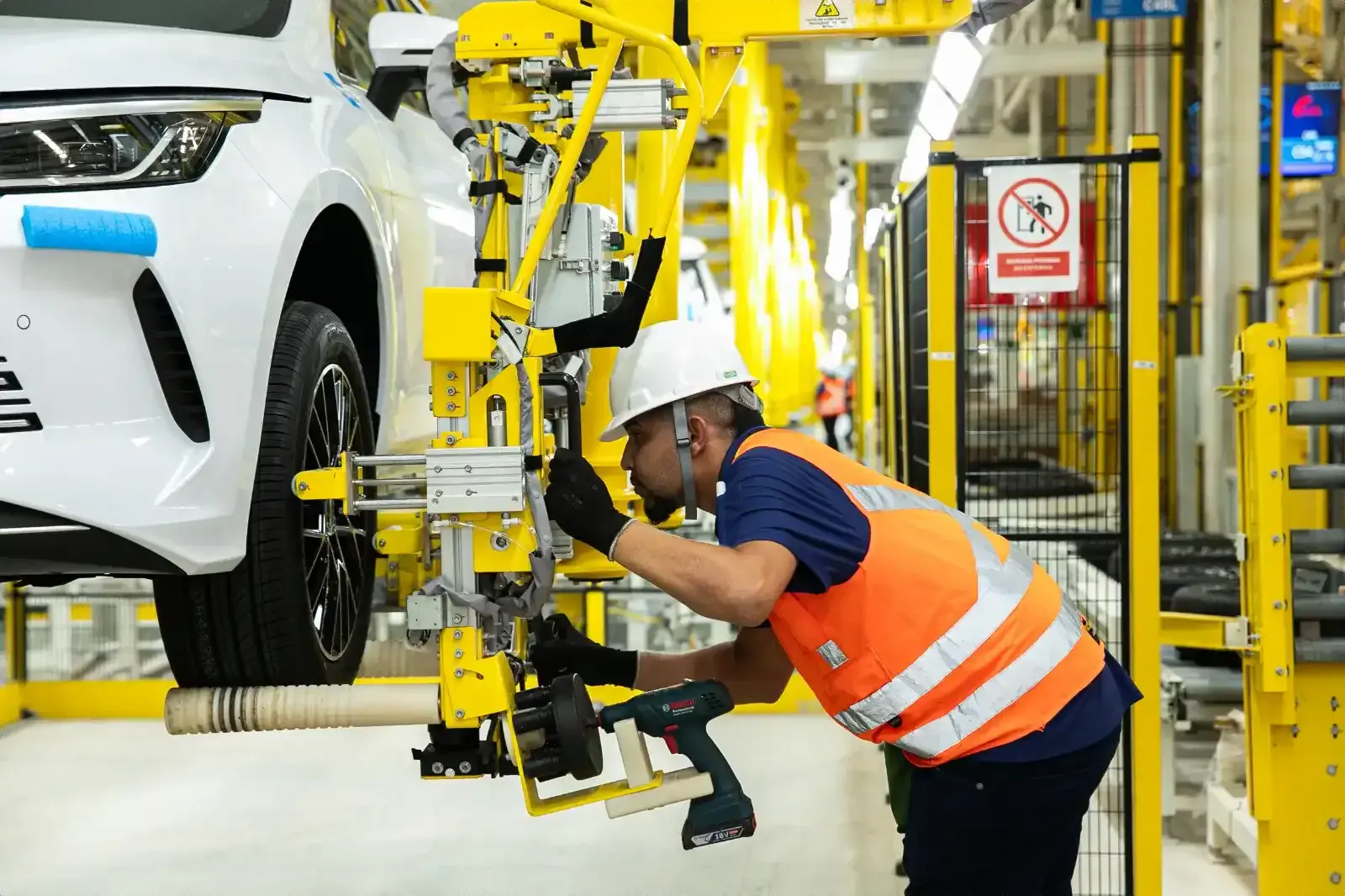
BYD opened the final assembly operation in October 2025 on the former Ford site. Its early Brazilian production has included the Dolphin Mini, King and Song Pro. In a January 2026 company update, BYD said the factory had produced close to 20,000 vehicles since its opening. That number shows that the plant is operating, but it is not evidence that the first-phase annual capacity has been reached.
The company said in September 2026 that its Camaçari operation had passed 8,000 direct employees and was preparing a third production shift. Government statements and trade reporting have used other figures at different points, partly because they count factory workers, construction staff and contractors differently. The changing headcount is best understood as evidence of an expanding project, not as a single audited employment series.
A third shift can raise output before a plant reaches its engineered capacity. It still needs parts, logistics, maintenance coverage, quality control and trained supervisors. At a higher volume, a supplier disruption can affect more vehicles, so the industrial network has to grow with the assembly line. That is one reason the move from imported kits to more local processes is important.
Why stamping, welding and paint matter
A kit-based assembly operation can build vehicles locally while receiving major structures and components from elsewhere. Stamping turns sheet metal into body panels. Welding joins the body structure. Paint facilities prepare and coat the body before final assembly. These steps require presses, tooling, robots or specialised stations, energy, water treatment, quality systems and workers trained to repeat the process at scale.
BYD has said that the stamping, welding and painting buildings are part of the move toward more national production. Quatro Rodas reported on 23 October that the civil works for welding and paint were complete and that testing was under way, with the first fully Brazilian-built vehicles expected in early 2027. That is a reported timetable, not a delivery promise confirmed in the company’s public material.
The company also announced a campaign to recruit Brazilian suppliers and said it was targeting more than 50% nationalisation of parts by 2027. This percentage is a goal. It should not be presented as a current result until BYD or a competent authority publishes a verified measurement. Local content can cover different categories of parts, so the definition and calculation method matter.
For suppliers, localisation means more than selling a component once. A local company may need tooling, certification, traceability, inventory planning and the ability to maintain quality over several shifts. For BYD, local sourcing can reduce exposure to import logistics and help the vehicles qualify for the status of locally produced cars under Brazilian rules. It can also create new dependencies if a supplier base is not mature enough.
Brazil as a base for regional exports
Alexandre Baldy, BYD’s senior vice president in Brazil, told Reuters that the company wants to be above the 50% local-content threshold as 2027 begins. He linked that milestone to formal recognition as a local producer and to the possibility of starting regional exports. Bahia officials and BYD representatives have mentioned Argentina and Mexico in discussions about future export opportunities.
Exports are not automatic once a vehicle is assembled in Brazil. Each destination has its own approval, origin, tax, safety and equipment requirements. A model may be suitable for one market and require changes for another. The factory would also need to balance domestic orders with export contracts, which can involve different left-hand-drive specifications, charging equipment, software and after-sales support.
The Camaçari site could shorten the physical distance between BYD’s production and Latin American dealers. It does not guarantee a particular model’s availability in Europe or in every South American country. BYD has not published a complete export programme with confirmed models, markets and annual volumes for the plant.
What 600,000 vehicles would require
A 600,000-vehicle annual capacity would make Camaçari one of the largest automotive production bases in the region. Capacity, however, is not the same as sales. A plant can be designed for a high theoretical volume and operate below it while demand, supplier readiness, distribution and working capital catch up.
BYD has said it wants to become Brazil’s biggest carmaker by sales by 2030. That is a company ambition, not an achieved ranking. Measuring progress will require registrations, imported and locally built vehicles, production reports, dealer coverage and the mix of electric, hybrid and flex-fuel models.
The employment effect also needs careful reading. BYD and public authorities have discussed thousands of direct jobs and a larger number of direct and indirect positions. The lasting economic impact will depend on how many jobs remain in regular production, what training they require, and whether local suppliers invest around the plant. A large headline capacity can support an industrial ecosystem, but it does not guarantee that every planned job or supplier contract will materialise.
What is still unknown
BYD has not published a detailed public schedule for reaching 600,000 vehicles a year. The final investment required for the expansion, the number of shifts, the complete export model list and the measured local-content percentage are not all confirmed. The timing of fully national production is also best treated as a reported expectation until the company documents the start of that phase.
The confirmed direction is clearer: Camaçari is expanding, key body and paint processes are being prepared, the workforce is growing and BYD is trying to deepen local sourcing. The next useful checkpoints will be the start of stamping, welding and paint operations, verified annual output, a published local-content calculation and a concrete export announcement.