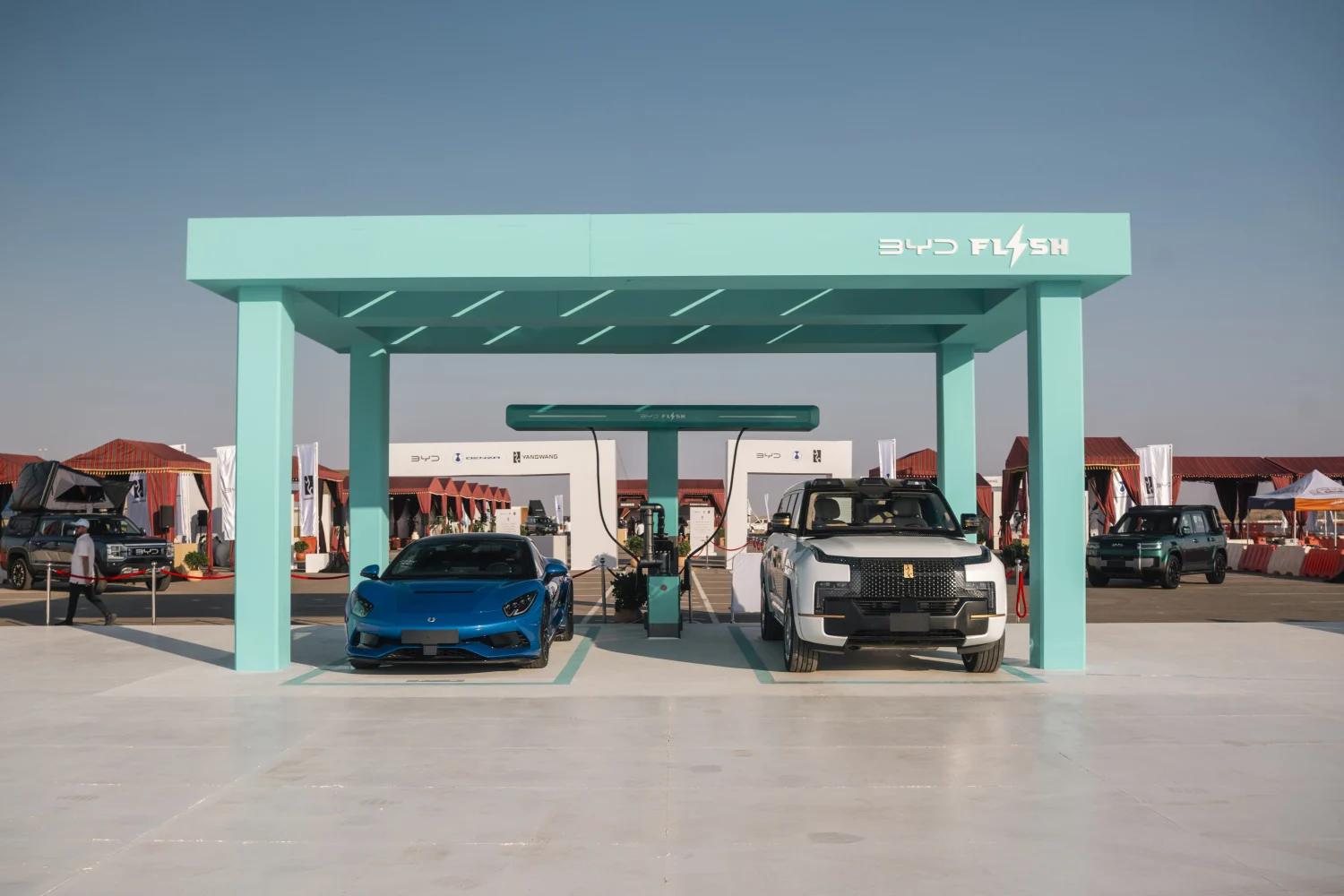
BYD has unveiled an installation in the Abu Dhabi desert that combines photovoltaic generation, stationary battery storage, FLASH Charging and a robotic arm that connects the charging cable. The manufacturer calls it the world's first system to integrate all four elements, but its 8 November 2026 announcement does not disclose the solar array's output, the storage capacity, the number of charging bays or the project's cost.
That missing information matters. The installation is best understood as a technology demonstrator, not evidence of a public charging station already operating at a known commercial duty cycle. BYD has not said whether drivers can use the site, how much a session would cost, or when an identical configuration might be deployed elsewhere.
Solar energy passes through a battery buffer
The site is built around BYD's Solar-Storage-Charging, or SSC, system. Solar modules generate electricity, a stationary battery holds it, and the FLASH charger supplies the vehicle when required. Storage allows energy collected earlier in the day to be used later and can provide the short, intense burst of power required for very fast charging without demanding the same instantaneous output from the local grid.
BYD says the SSC arrangement can support operation independently of the electricity grid. That is a capability claim, not a complete energy balance for the Abu Dhabi installation. The company has not published the solar area, peak generation, storage capacity, conversion losses or expected daily throughput. Without those figures, it is impossible to determine how many charging sessions the array can support or what proportion of each session comes directly from solar energy.
The desert location provides strong sunlight while also exposing equipment to heat, dust and scarce rainfall. BYD presents the site as a demonstration of operation in those conditions, yet the release gives no measured temperature data, derating figures, panel-cleaning schedule or reliability results. Those details would be necessary before comparing the concept with a conventional grid-connected public hub.
FLASH Charging figures remain manufacturer claims
The FLASH technology BYD detailed in March 2026 can deliver up to 1,500 kW through one connector in its Chinese-market specification. With the company's second-generation Blade Battery, BYD claims a charge from 10% to 70% in five minutes and from 10% to 97% in nine minutes. These are not universal EV charging times. A vehicle needs a compatible battery, charging port, voltage architecture and thermal-management system to accept that level of power.
BYD reported 4,239 FLASH Charging stations installed in China as of 5 March 2026 and set a target of 20,000 in the country by year-end. Its earlier technical explanation said each station could be paired with an ultra-fast-discharge energy-storage system. The buffer battery charges more slowly, then acts as both an energy reservoir and a power amplifier when a car requests the peak output.
The Abu Dhabi demonstrator adds solar generation and automated plug-in to that established battery-buffer idea. BYD now says it plans to establish 6,000 FLASH Charging stations worldwide by the end of 2027. It has not provided a country-by-country breakdown or said how many of those stations will use photovoltaic canopies and robotic arms. The network target therefore should not be read as a commitment to build 6,000 copies of the desert site.
A robot locates and opens the charge port
The robotic arm uses visual guidance and force feedback, according to BYD. It locates the vehicle's charge port, opens the flap and inserts the connector while monitoring alignment and contact. The company links this function to Automated Valet Parking: the occupants leave and lock the car, which then travels by itself to a designated bay before the robot completes the physical connection.
The sequence could remove the need to handle a heavy high-power cable and keep occupants out of extreme outdoor heat. It may also support future automated fleets, where no driver is available to plug in. The release does not, however, identify compatible production models, connector standards, error-recovery procedures or whether vehicles from other manufacturers could use the arm.
Those are not small implementation details. A public system would have to recognise different port positions, body shapes and flap mechanisms, remain accurate when cameras and surfaces are dusty, and stop safely if a person or object enters the operating area. BYD's demonstration shows the intended sequence; it does not establish universal compatibility.
BYD brings three existing business areas together
BYD says its solar division has more than 16 years of experience and serves customers in over 100 countries and regions. The company attributes more than 300 research and development specialists and over 200 technology patents to BYD Solar, whose portfolio covers cells, modules and complete systems. Its official solar brochure already describes EV charging solutions that combine power supply, storage and charging equipment for locations such as airports, railway stations, industrial parking areas and residential sites.
The Abu Dhabi project's distinctive feature is the combination of that energy architecture with FLASH Charging and robotic connection in one installation. Stella Li, BYD Executive Vice President, described the event as the first time the company's integrated Solar-Storage-FLASH Charging technology had been brought to a global stage. Her statement explains BYD's strategic framing, while the undisclosed capacity and operating data limit independent assessment.
The project also links back to the “Three Green Dreams” vision set out by BYD chairman and president Wang Chuanfu in 2006: generate electricity from solar power, store it in batteries and use it in electric vehicles. The new site packages those parts into a visible demonstration, but the commercial case still depends on local sunshine, land, grid constraints, storage cost, vehicle throughput and maintenance.
For drivers outside the United Arab Emirates, there is no immediate change. BYD has not announced a local price, public opening date or a confirmed deployment list for this exact configuration. The practical idea is nonetheless clear: generate some energy on site, store it to reduce the grid's peak burden, deliver it at very high power to compatible cars and automate the final cable connection. The size of the solar contribution and the timetable for commercial rollout remain unanswered.