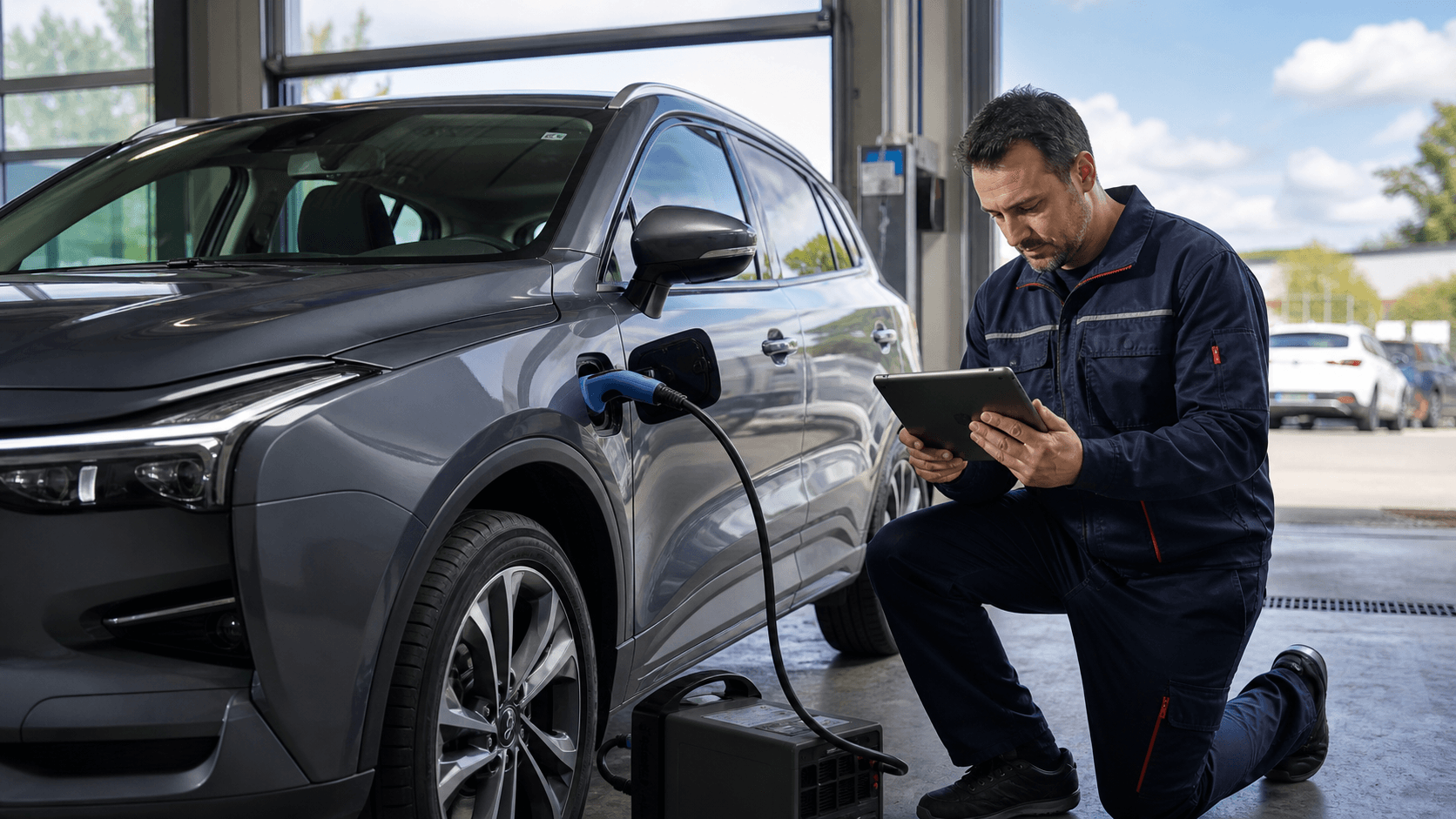
Battery condition should be measured before buying a used electric car. Illustrative image
How long an electric-car battery lasts: degradation, warranty and costs
The battery of a modern electric car can remain usable for 15–20 years, but there is no identical lifespan for every model. Field data show that capacity loss is gradual, and a complete pack replacement remains rare on cars built in recent years.
A Geotab analysis published in 2026, based on data from 22,700 electric vehicles, measured average degradation of 2.3% per year. At that rate, the battery would on average keep about 81.6% of its initial capacity after eight years.
This is a statistical average, not an expiry date. Some batteries lose less, others more, depending on the model, cell chemistry, temperature control, climate and charging habits.
What battery degradation means
A new battery has a usable capacity, expressed in kWh. As it ages, it can store less energy. The ratio of currently available capacity to the original figure is called State of Health (SOH).
If a 60 kWh pack reaches 85% SOH, its usable capacity is, in simplified terms, about 51 kWh. The car continues to work, but the range between charges falls.
Degradation is not always linear. A slightly more visible loss can appear at the start of use, followed by a more stable period. The battery-management system can also keep a reserve inaccessible to the driver, so the figure shown by the car may not reproduce the physical ageing of the cells exactly.
What the 2026 data show
The Geotab study updated a 2024 analysis, when measured average degradation had been 1.8% per year. The 2.3% figure in the new set does not automatically mean recent batteries are weaker. The sample is larger, includes other models and reflects more frequent use of high-power rapid chargers.
In the same dataset, eight of the 11 models also tracked in the previous analysis settled at average degradation of about 1.4% per year. The gap shows why the result for a given car cannot be deduced from the market-wide average alone.
Recurrent data, obtained from more than 30,000 electric cars, provide another reference. Outside large recall campaigns, fewer than 4% of the cars analysed had the battery replaced. On models built from 2022 onwards, the recorded rate was about 0.3%. The cars are still young, so the figure cannot on its own anticipate their behaviour at 15 years.
Rapid charging has the largest influence among controllable wear
In the Geotab analysis, cars charged frequently at DC stations above 100 kW recorded average degradation of up to 3% per year. Vehicles charged mainly on alternating current or at lower DC power sat around 1.5% per year.
The conclusion is not that rapid charging must be avoided entirely. Occasional stops at a rapid charger, needed on a long trip, are not the same as using it for almost every charge. For daily use, AC charging at home or work is gentler and, as a rule, cheaper.
Temperature matters because high-power charging and discharging produce heat. Cars with liquid thermal management can bring the battery into the right range and can limit power when the cells are too cold or too hot.
Heat, cold and long-term parking
Geotab observed in high-temperature regions degradation about 0.4 percentage points per year higher than in temperate climates. For Romania, the main risk is not a cold winter day, but repeated exposure to extreme temperatures and keeping the battery for a long time at a very high state of charge.
Cold temporarily reduces range and charging speed, but that loss must not be confused with permanent degradation. A substantial part of the range returns when the battery warms up. Preconditioning the cabin and the pack while the car is plugged in reduces the energy used after departure.
If the car sits unused for several weeks, the manufacturer's instructions must be followed. In general, long storage with the battery fully charged or nearly empty is not recommended.
Should it only be charged between 20% and 80%?
The 20–80% window is a practical rule, not a universal limit. Keeping daily use away from the extremes can reduce stress on the cells, but the exact recommendation depends on the model and battery chemistry.
Some cars with LFP batteries periodically recommend charging to 100% to calibrate the estimation system. Other models allow a daily limit of 70%, 80% or 90%. The car handbook and the instructions shown in the manufacturer's app take priority over a general rule found online.
Charging to 100% before a long trip is normal use. The problem is repeatedly keeping the battery at maximum for long periods, especially at high temperatures.
The warranty does not promise a battery without degradation
Many manufacturers offer for the traction battery a warranty of about eight years or 160,000 km, sometimes with a threshold of 70% of initial capacity. The terms differ, however, between brands, models and markets.
An eight-year warranty does not mean the battery must be replaced after eight years. It means the manufacturer covers certain defects and, if stated explicitly, a drop below a given SOH threshold within the period or mileage limit set.
The buyer should check in the warranty certificate:
- the date from which cover began;
- the mileage limit;
- the minimum guaranteed capacity threshold;
- mandatory service operations;
- whether the warranty transfers to the next owner;
- exclusions applying to damage, modifications or improper use.
The European battery regulation aims to make state of health and estimated lifetime accessible from battery-management data. The requirements are being applied in stages, so not all used cars today give the owner the same transparency.
What to check on a used electric car
The range shown after charging is not enough. It is influenced by outside temperature, recent driving style, tyres and climate-control use.
Before purchase, the following are useful:
- An SOH report from diagnostics, preferably at a workshop that knows the model.
- Errors and imbalance between modules or cells, not only the overall percentage.
- The history of recall campaigns and of work carried out on the battery.
- Remaining warranty, checked against the chassis number and first-delivery date.
- Inspection of the battery casing, especially after impacts to the underside of the car.
- An AC and DC charging test, to identify abnormal limits or interruptions.
- A consumption test on a known route, carried out at a reasonable temperature.
Two SOH reports can produce slightly different results, because manufacturers and independent tools use different estimation methods. The figure should be read together with errors, history and the car's behaviour.
Is the battery repaired or fully replaced?
A fault does not always require changing the whole pack. Depending on battery construction and manufacturer procedures, a workshop can replace a module, electronic components, contactors or the cooling system.
Cost cannot be expressed as a single general figure: it differs massively between a local repair, a remanufactured pack and a new battery. Before buying a model out of warranty, diagnosis fees and repair scenarios should be requested from an authorised or specialist workshop.
Normal degradation is not a fault. A car that still has 80–85% of capacity can remain useful for a long time if the resulting range covers the owner's journeys.
How to extend battery life
- use AC charging for the daily routine when possible;
- keep rapid charging for trips where it saves time;
- set the daily limit recommended by the manufacturer;
- avoid leaving the car for a long time near 0% or 100%;
- activate preconditioning before rapid charging if the model allows it;
- install software updates that manage the battery and charging;
- do not confuse reduced winter range with permanent capacity loss.
Frequently asked questions
How many years does an electric-car battery last?
Under normal conditions, a modern battery can remain usable for 15–20 years. Lifespan depends on the model, climate, charging and the range threshold the owner finds acceptable.
How much capacity remains after eight years?
The 2026 Geotab analysis estimates an average of about 81.6%, but the result for a specific car can be better or worse.
Does rapid charging destroy the battery?
Not after a few uses. Very frequent use of high-power DC stations is associated with faster degradation than predominantly AC charging.
Must the battery be changed when it reaches 70%?
Not automatically. The 70% threshold is used by some warranties, but the battery can continue to work. Available range and any errors determine real usefulness.
How do I check the battery of a used EV?
Ask for an SOH report, module diagnostics, a check of the warranty and recall campaigns, plus charging and consumption tests.