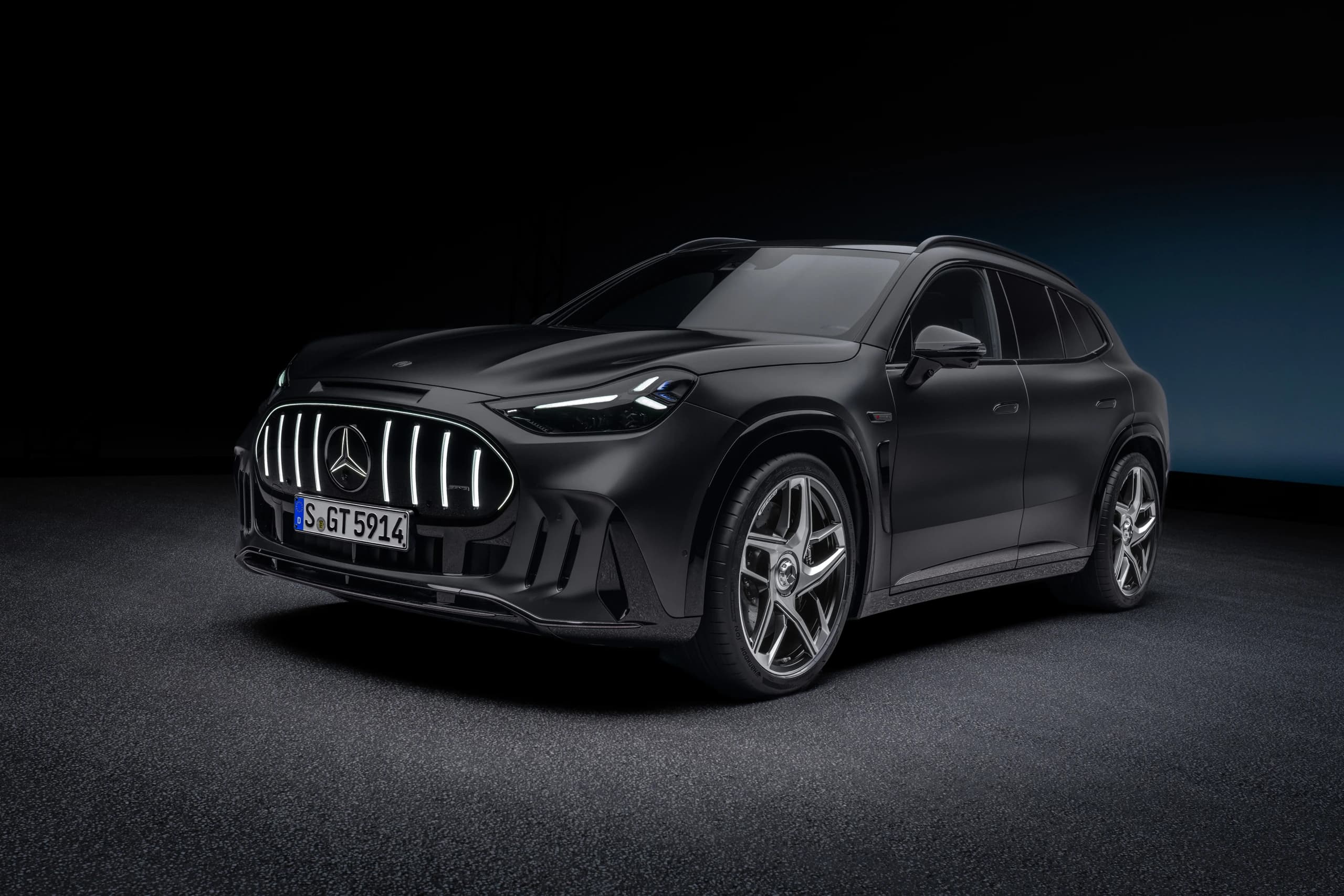
Mercedes-Benz is displaying the new Mercedes-AMG GT 53 SUV at €115,800 on its Romanian website. The electric model combines a quoted peak output of 400 kW, or 544 metric horsepower, with all-wheel drive and a 106 kWh usable battery. The local specification gives a 668 km WLTP range and a 4.2-second 0–100 km/h time.
This is Romanian pricing for the GT 53 configuration shown, rather than a Europe-wide price or an offer for the 1,169-horsepower GT 63. Buyers elsewhere should not transfer the figure to their own market. The Romanian page allows an offer request, while a binding delivery date and the final option list still need to be established with the supplying retailer.
The entry model has its own drivetrain
AMG revealed the SUV family on 17 October 2026, identifying GT 53, GT 55 and GT 63 derivatives. Its launch announcement scheduled orders for the entry version from 20 October, with the other two following in spring 2027. That international timetable does not confirm when an individual Romanian customer will receive a car.
The GT 53 uses two synchronous motors, one on each axle. The front motor supplies extra drive or traction when needed and can be disconnected under light loads to reduce losses. A two-speed transmission at the rear combines a shorter first ratio for pulling away with a second ratio intended for higher-speed operation, according to the manufacturer’s technical explanation.
AMG separates the GT 53’s 400 kW peak figure from a 270 kW continuous output, equivalent to 367 metric horsepower. Maximum torque is quoted at 800 Nm. These figures should not be treated as interchangeable measures of sustained performance. The Romanian page lists a 230 km/h maximum speed for the configuration it displays.
The flagship’s three axial-flux motors are a different arrangement. Its headline 860 kW, or 1,169 metric horsepower, therefore cannot be attached to the €115,800 Romanian GT 53. Sharing the AMG GT SUV name does not give every derivative the same motors, brakes or charging specification.
Why the Romanian charging table needs checking
The local technical table gives a DC charging limit of 350 kW and 16 minutes for a 10–80% charge. It also lists 287–321 km of WLTP range added in ten minutes. Those are manufacturer-published figures, not measurements from a Carboratory charging session.
There is a discrepancy within the available documentation. AMG’s international launch table lists up to 600 kW DC and 11 minutes from 10–80% for the GT 53. The Romanian page separately promotes AMG Performance Charging at up to 600 kW and notes that availability depends on configuration. The launch release also marks certain figures as preliminary, with possible deviations from final official values.
The higher number should consequently not be promised for every Romanian base configuration. The ordered car’s charging equipment needs to be confirmed in the offer. Peak power is also different from the average sustained throughout a charging stop: battery conditions and a compatible charger matter to the result. For AC charging, the Romanian table lists an 11 kW maximum and around 11 hours from empty to full. A cable’s power rating does not increase the onboard charger’s limit.
Range, dimensions and the everyday specification
The GT 53 has an 800-volt architecture and 106 kWh of usable battery energy. AMG describes cylindrical cells cooled directly by electrically non-conductive oil. This is the company’s engineering description of its thermal-management system, rather than independent evidence of long-term battery durability.
The international GT 53 range interval is 597–668 km WLTP, depending on configuration. Romania’s displayed 668 km is its upper end, accompanied by a published consumption figure of 18.8 kWh/100 km. Mercedes identifies driving style, ambient conditions, tyres, payload, options and auxiliary consumers among the factors affecting actual range. The maximum WLTP figure is not a guaranteed motorway distance in winter.
The local dimensions are 5,084 mm long, 2,001 mm wide excluding mirrors and 1,653 mm tall. Width rises to 2,197 mm with the mirrors open, an important distinction when checking garage access. The specification provides five seats and 607 litres of boot capacity. It also lists a 2,600 kg EU kerb weight, 570 kg payload and 3,170 kg permissible gross weight; these should not be mixed with the DIN masses or different battery versions in the international tables.
Read equipment and acceleration claims by version
The ordinary 0–100 km/h figure for GT 53 is 4.2 seconds. AMG also publishes 3.8 seconds using rollout, which omits the first 30.48 cm of travel from the measurement. Comparing that number directly with another car’s standing-start time would introduce a methodological difference. The faster figure is not a separate Romanian engine variant.
The family announcement describes a 14-inch central screen and 10.2-inch instrument display, with a separate 14-inch passenger screen available. It also identifies optional AMG Performance seats. Such presentation material does not establish that every feature is included in Romania’s displayed price. AMG explicitly specifies steel brakes for the GT 53, whereas the GT 63 has carbon-ceramic brakes as standard.
Production takes place in Hall 32 at Sindelfingen, adapted for AMG.EA architecture. The international release quotes €113,050 as a non-binding German recommended price including German 19% VAT. That is a separate market reference from Romania’s €115,800 displayed configuration. An actual purchase comparison requires the retailer’s complete specification, confirmed DC charging capability and agreed delivery conditions, rather than a combination of each derivative’s best headline figures.
Official Mercedes-Benz Media illustration of the AMG GT SUV family. The photographed derivative and equipment may differ from the Romanian GT 53 configuration. Credit: Mercedes-Benz AG; editorial use only.