Cupra still intends every new model it launches to be fully electric by 2030. Its latest commercial and financial disclosures make clear why that target is more complicated than a product countdown. Battery-electric orders are rising rapidly and the Raval has delivered the brand’s strongest launch, yet SEAT & CUPRA says electric vehicles must reach margin parity with combustion cars while the combined company operates with very little financial headroom.
The wording matters. Cupra’s official sustainability page says all new Cupra models will be fully electric by 2030. It does not provide a retirement date for every combustion or plug-in hybrid derivative already on sale, nor a complete replacement schedule for Leon, Formentor or Terramar. Volkswagen Group separately describes the aim as a fully electrified Cupra line-up by 2030. Both establish direction; neither is a model-by-model launch plan.
Raval gives the strategy commercial evidence
Raval is the first fully electric vehicle built at Cupra’s Martorell home and the most concrete test of its electric push. SEAT & CUPRA reported more than 51,000 orders between April and September 2026, calling it the most successful launch in Cupra history and the brand’s best-selling model since its April introduction. An earlier Paris Motor Show release said almost 15,000 cars had already been delivered.
Across the brand, deliveries exceeded 250,000 vehicles in the first nine months, 2 percent higher year on year. Cupra said battery-electric orders rose 79 percent to more than 108,000 over the same period. In the third quarter, BEV orders were up 175 percent and almost one in two Cupra orders was for a fully electric car. These are company-reported orders and deliveries, not an independently audited measure of the entire European market.
The product case is deliberately broad. Cupra’s launch communication placed the entry Raval at about €26,000 before national taxes, incentives and equipment differences. The later Plus derivative combines a 99 kW motor with an LFP battery and up to 300 km of stated range, while larger-battery versions are quoted at around 450 km WLTP. Real-world range will vary with speed, weather, load and heating or cooling use.
For buyers, those distinctions are more useful than the 2030 headline. A future strategy does not tell a customer the on-road price, charging time or delivery date of a specific car. It does indicate where the manufacturer’s engineering and capital spending are heading.
Strong demand does not settle the margin question
SEAT & CUPRA posted an operating result of just €6 million for January through September 2026. That number covers the company behind both brands and should not be presented as a standalone Cupra profit. Management attributed the pressure to a growing BEV share, fiercer competition, geopolitical volatility, regulatory uncertainty, launch and market-entry costs, and the reduced benefit of internal CO₂-credit sales within Volkswagen Group.
Chief executive Markus Haupt said the faster-than-expected electric shift in several European markets validates the strategy while increasing the urgency of improving BEV margins. Finance chief Patrik Andreas Mayer was blunter: low profitability and cash generation threaten the company’s ability to fund its future, requiring tighter cost discipline and a critical reprioritisation of planned investment.
This is not evidence that Cupra has abandoned electrification. It identifies the condition that must be met for the programme to sustain itself. A manufacturer can gain electric market share while earning less per vehicle than it did from mature combustion products. Battery cost, factory utilisation, software development, discounting, warranty provisions and trim mix all affect the result. Cupra has not disclosed a model-level margin for Raval, Born or Tavascan in the cited releases, so strong orders cannot be converted into a reliable profit estimate.
Martorell is the industrial centre of the plan
SEAT & CUPRA says more than €3 billion has been invested in transforming Martorell. The plant now builds Raval and Volkswagen ID. Polo as part of Volkswagen Group’s Electric Urban Car Family: four compact EVs across Cupra, Volkswagen and Škoda, made in Spain and based on shared architecture.
The company leads that cross-brand project within Brand Group Core and will also spearhead continued development of the MEB21 platform. Volkswagen says the shared platform and governance model deliver €600 million in cost savings while allowing four differentiated cars. The number is a group estimate, but it shows the scale of saving required to make smaller European EVs viable.
Martorell remains capable of producing electric, hybrid and combustion vehicles. That flexibility is not inconsistent with the 2030 Cupra target; it is protection against uneven demand and changing regulation across markets. It also means Cupra’s product future and the factory’s powertrain mix should not be treated as the same question.
The current range is already mixed
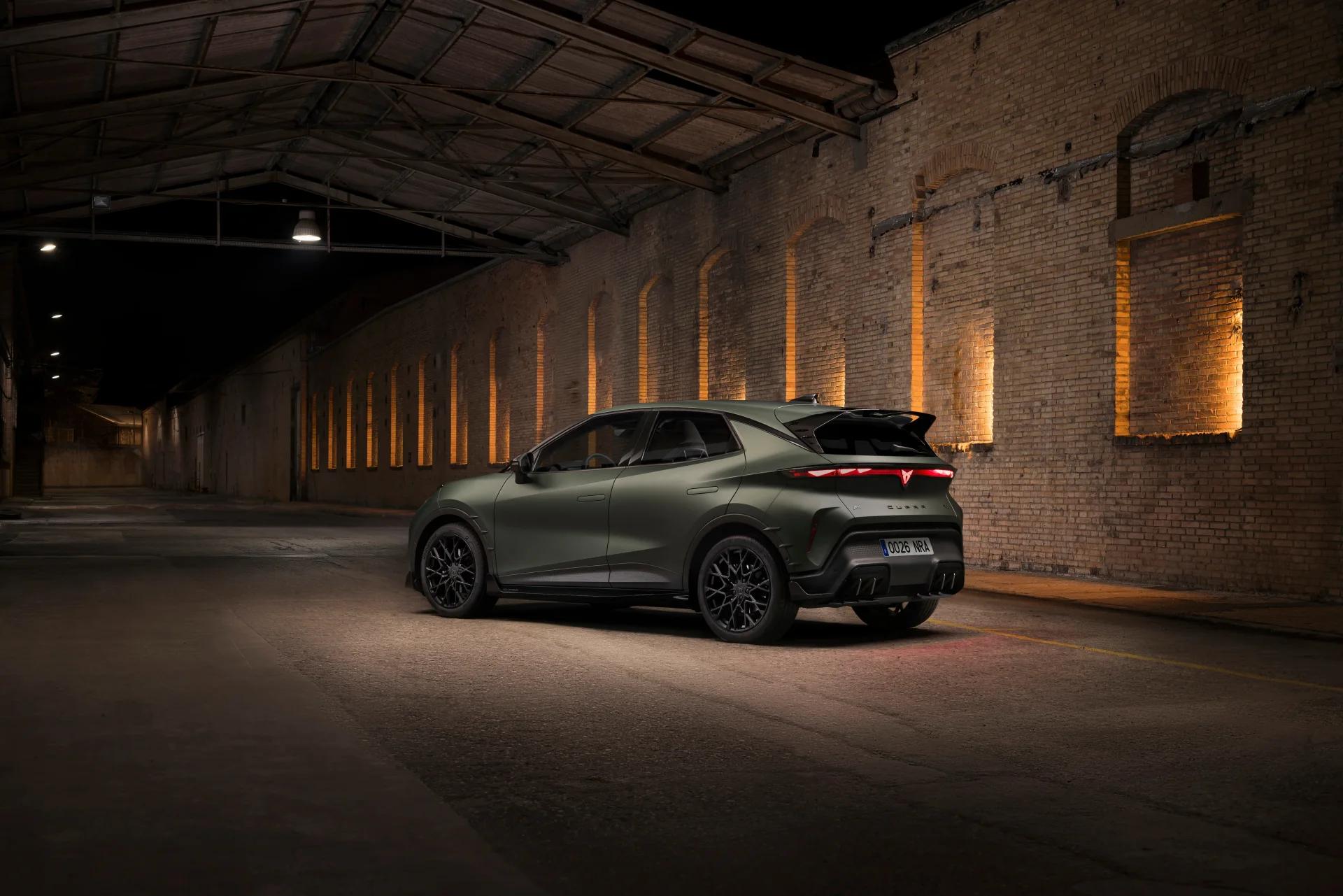
Cupra sells three battery-electric nameplates in 2026: Raval, Born and Tavascan. Formentor, Leon and Terramar provide plug-in hybrid choices, while combustion engines remain in parts of the range. This transition portfolio gives customers several paths today but leaves unanswered which nameplates will carry over, which will be replaced, and where their successors will be built.
The Tindaya show car signals Cupra’s intended design language and management has said its ideas will become reality. A concept, however, is not confirmation of battery capacity, production timing, price or even final body dimensions. Until Cupra publishes a series-production programme, those details remain unknown.
The distinction is especially important around the phrase “by 2030”. It refers to the brand’s stated destination for new products, not an assurance that every market will have the same EV share on 1 January 2030. Availability can differ with homologation, local incentives, charging infrastructure and dealer rollout.
What to watch before 2030
Cupra is working towards a 3 percent European market share and further international expansion, including a planned Middle East entry. For its electric strategy, the more revealing milestones will be Raval’s order rate after the launch surge, Martorell’s production ramp, BEV margins, and the confirmation of additional series models.
Raval has already answered one question: a four-metre electric Cupra at a lower entry price can generate substantial interest. The €6 million nine-month operating result exposes the next question. Cupra must convert that interest into profitable volume while keeping its cars distinct from related Volkswagen Group products.
That makes the 2030 ambition credible as a direction, but not automatic as an outcome. The hardware, factory and initial demand are visible. The missing proof is a business model that funds the next generation without depending indefinitely on better-margin combustion vehicles.