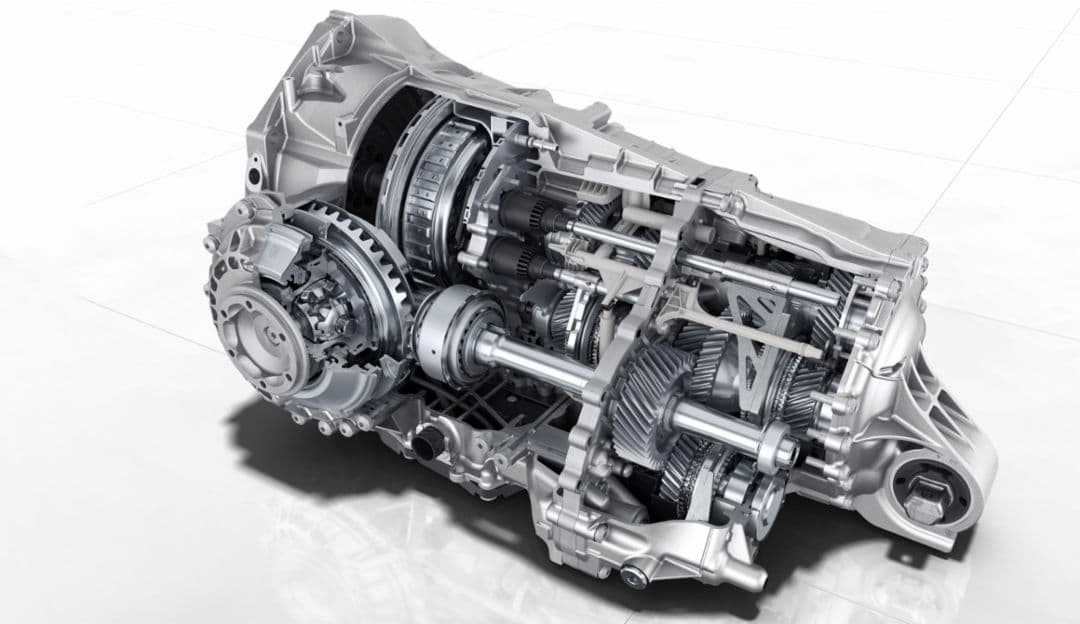
A PDK transmission opened up, with the two drive circuits housed in the same casing. Photo source: Porsche
Why cars use dual-clutch gearboxes and how they actually work
A dual-clutch gearbox tries to combine the mechanical efficiency of a manual transmission with the ease of an automatic. The driver does not press a clutch pedal or move a lever for every gear, but inside there are gears and clutches close in principle to those of a manual gearbox.
The same technology appears under several commercial names. Volkswagen uses DSG, Porsche calls it PDK, Renault uses EDC, and other manufacturers choose the generic abbreviation DCT. The names differ, but the basic idea remains the same: two partial transmissions work in turn.
How the two clutches work
One clutch usually serves the odd gears — 1, 3, 5 and 7 — and the other serves the even gears — 2, 4 and 6. Reverse is assigned to one of the two circuits, depending on how the transmission is built.
When the car is running in first gear, the gearbox can already select second on the other clutch’s shaft. At the shift, the first clutch opens while the second closes. Engine torque thus moves from one circuit to the other with a very short interruption.
The mechatronic unit decides which gear should be prepared. It combines the electronic control module, sensors and hydraulic or electromechanical actuators. It analyses throttle position, vehicle speed, engine speed, driving mode and driver demand.
The process can be summarised as follows:
- The car is running in a gear on the first clutch.
- The next gear is selected in the other circuit, but its clutch stays open.
- At the moment of the shift, the first clutch opens and the second closes almost simultaneously.
- The gearbox then prepares the gear it estimates the driver will request next.
Why the shift is so fast
With a manual gearbox, the driver interrupts the link with the engine, takes the transmission out of one gear, selects another and re-engages the clutch. A dual-clutch transmission prepares part of this process before the shift is commanded.
The advantage is felt most under acceleration. The engine stays closer to the speed range where it delivers power, and the car loses less time between gears. Porsche shows that PDK was originally developed for motorsport precisely for shifts made without a pronounced interruption of drive. The system reached production 911 models in 2008.
Speed is not the only reason manufacturers choose this solution. The direct mechanical connection can reduce energy losses compared with some conventional torque-converter automatics. The result can be lower fuel consumption, but the real difference depends on the car, engine, calibration and how it is used.
Dry or wet clutches
There are two main families. In transmissions with dry clutches, the friction surfaces do not run in an oil bath. The assembly can be lighter and has lower mechanical losses, and it is often found on engines with lower torque.
In a gearbox with wet clutches, the discs are cooled and lubricated with oil. The solution handles high temperatures and loads better, but it is more complex and needs a dedicated oil circuit.
The clutch type cannot be established from the number of gears or the lettering on the selector alone. Two models that use the same commercial name can have different transmissions. The gearbox code and the car’s technical documentation are the correct references.
| Characteristic | Dry dual clutch | Wet dual clutch |
|---|---|---|
| Clutch cooling | by air and housing | by oil circuit |
| Mass and mechanical losses | generally lower | generally higher |
| Engine torque handled | suited mainly to moderate loads | suited to higher loads and torque |
| Maintenance | depends on the model and gearbox circuit | may include periodic oil and filter changes |
Why it can hesitate when pulling away
A conventional automatic can transmit torque through a hydrodynamic converter, which allows a very smooth take-off. A dual-clutch gearbox has to control the slip of a friction clutch, similar to how a driver lifts the pedal in a manual car.
That can produce small hesitations, vibrations or a more abrupt engagement at very low speeds. The behaviour is more noticeable in parking manoeuvres, when climbing a slope slowly and in traffic that moves a few metres and stops again.
Shifts can also become less smooth if the driver suddenly asks for strong acceleration while the electronics had prepared a higher gear. The gearbox has to abandon the anticipated selection and choose one or more lower gears.
How it compares with a torque-converter automatic
A conventional automatic transmission usually uses a torque converter and planetary gearsets. Modern designs have a lock-up clutch, many gears and fast controls, so the old gap in consumption and speed versus a DCT has narrowed.
The dual-clutch gearbox remains valued for quick responses and the direct link between engine and wheels. The torque-converter automatic is often chosen where the priority is smoothness off the line, towing or handling very high torque. There is no universal winner; a transmission’s calibration matters as much as its architecture.
A CVT works on a different principle: it varies the ratio continuously and does not need fixed gears in the classic sense. It is efficient in some applications, but the feel under acceleration differs a great deal from that of a DSG or PDK.
How to drive a dual-clutch car properly
In normal use, the transmission does not require special techniques. A few habits do, however, reduce heat and clutch wear:
- hold the car still with the brake, not the accelerator, when waiting on a slope;
- avoid creeping for a long time centimetre by centimetre with the clutch slipping;
- do not switch between D and R before the car has stopped;
- respect the maximum towing load and the manufacturer’s instructions;
- follow the service interval for the exact transmission code.
Not all dual-clutch gearboxes have the same maintenance plan. Some require oil and filter changes at a fixed interval, while others have circuits or clutches for which the manufacturer specifies different operations. The car’s handbook and service history are more relevant than a general rule found online.
What to check on a used car
On a road test, the transmission should be observed both when cold and after it has warmed up. Pulling away forwards and in reverse should be predictable, without hard knocks, excessive slip or dashboard warnings. A few low-speed manoeuvres are useful, plus moderate acceleration in which the gearbox climbs and drops through several gears.
A slight difference in behaviour compared with a torque-converter automatic is normal. Strong jerks, long delays engaging D or R and metallic noises should, however, be investigated before purchase. Electronic diagnosis and a check of maintenance invoices can reveal faults, work on the mechatronics or missed oil changes.
The dual-clutch transmission exists because it offers fast shifts, good efficiency and automatic control in a compact package. The same clutches that give it a direct response also explain why very slow traffic and prolonged manoeuvres can be less smooth than with a conventional automatic.