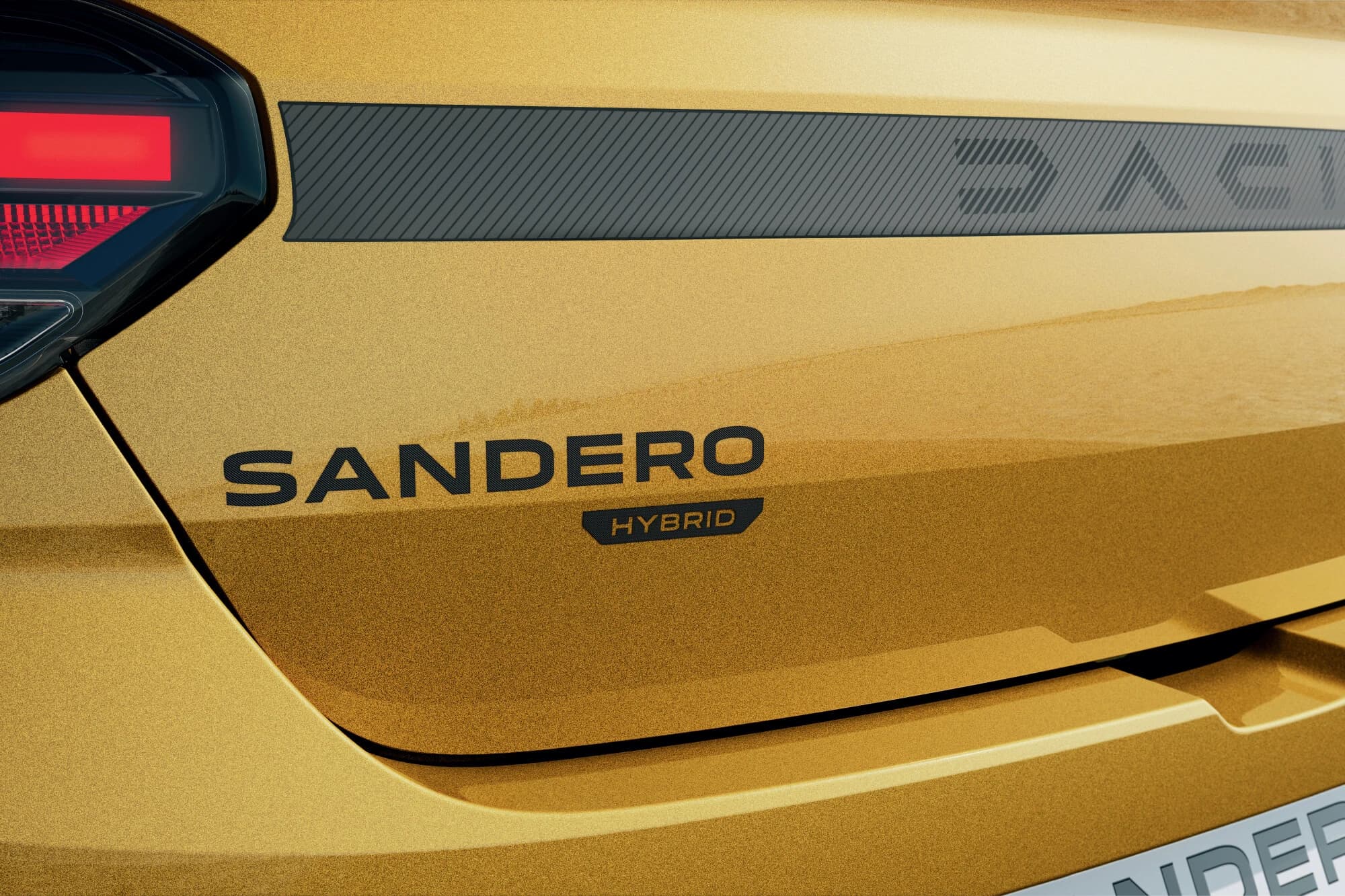
Photo: Dacia / Renault Group. Official Sandero image.
Dacia Sandero leads Europe’s car sales after the first eight months
Dacia Sandero was Europe’s best-selling car between January and August 2026, according to Dataforce figures reported on 22 September. The model reached 145,424 sales, but its volume was 11.2 per cent lower than in the same period of 2025. Sandero therefore retained the lead while selling fewer cars than a year earlier.
The Volkswagen Golf ranked second with 133,249 units, followed by the Volkswagen T-Roc with 132,845. Sandero’s advantage over the Golf was 12,175 cars, while its lead over the T-Roc was 12,579. The ranking covers European markets monitored by Dataforce; the source material does not publish a complete market-by-market breakdown or every detail of its counting method.
The European top 10
The Renault Clio was fourth with 128,941 units, ahead of the Tesla Model Y at 126,395 and the Peugeot 208 at 122,923. The Toyota Yaris Cross reached 122,292, while the Volkswagen Tiguan recorded 121,401. The final two positions went to the Peugeot 2008, with 110,707, and the Opel Corsa, with 108,336.
The list mixes small hatchbacks, compact cars and SUVs. It is a volume ranking rather than a like-for-like product comparison. Sandero, Golf and T-Roc have different body styles, prices, powertrains and customer profiles, so the result says which nameplates accumulated the most registrations or sales in the measured markets, not which car is objectively better.
Dataforce is the named source for the figures. Because the published summary does not set out every market and does not clarify here whether each number represents registrations, deliveries or sales under an identical national definition, the results should be attributed to Dataforce and kept within the January–August period.
A lead achieved during a decline
The 11.2 per cent fall changes the interpretation of the headline. Sandero was still number one, but it was not growing against 2025. The lead reflects its position relative to other models during the period, not an increase in demand. A percentage decline of that size corresponds to roughly 18,000 fewer cars than a flat year-on-year result would have produced, using the reported 2026 volume as the basis for an approximate calculation.
That estimate is not a separately published 2025 total. It only illustrates the scale of the change. The accurate statement is that Dataforce reported 145,424 Sandero sales and an 11.2 per cent year-on-year decline.
Why Sandero’s ranking matters to Dacia
Dacia says Sandero has been Europe’s best-selling model among private customers every year since 2017. The brand also states that it was Europe’s best-selling vehicle across all customer channels in 2024 and 2025. Those statements use different customer categories and time periods from the Dataforce ranking for the first eight months of 2026.
That distinction matters. A private-customer ranking excludes or separates fleets, while an all-channel ranking may include company buyers and rental registrations. The current result should therefore be described as the Dataforce European ranking for the period, rather than automatically extended to every sales channel or the whole year.
Sandero is one of Dacia’s volume pillars alongside the Duster, Jogger, Spring and Bigster. It sits within Renault Group’s wider European strategy, but its market position comes from Dacia’s own combination of a small-car footprint, several powertrain choices and controlled equipment levels.
What changed for the 2026 range
Dacia announced design, equipment and powertrain updates for the 2026 Sandero, Sandero Stepway and Jogger. The manufacturer lists a 1.0-litre TCe 100 petrol engine and an Eco-G 120 LPG option, with an automatic gearbox available on certain versions and markets.
The full-hybrid 155 powertrain has also been extended to Sandero and Sandero Stepway. Dacia describes it as a 1.8-litre, 109-horsepower petrol engine combined with two electric motors, a 1.4-kWh battery and an electrified automatic transmission. These are manufacturer specifications, not Carboratory test measurements.
Dacia’s French media information lists the Sandero hybrid 155 from €19,900 and the Sandero Stepway hybrid 155 from €21,400 in specified trims. Those prices apply to France and cannot be treated as Romanian prices. Equipment, taxes, homologation status and importer pricing vary between markets.
Why the powertrain mix matters
Sandero is not a battery-electric model. Depending on the country, customers can choose petrol, LPG or full-hybrid versions. That mix gives Dacia access to buyers with different annual mileages, fuel preferences, charging access and budgets. It also means the model’s sales performance should not be read as a pure electric-car result.
The broader market is becoming more complicated. Compact cars and small SUVs are receiving hybrid and battery-electric alternatives, while Chinese brands are adding vehicles in the same price-sensitive areas. Sandero’s lower volume in 2026 suggests that keeping the lead does not remove pressure from new products and changing customer preferences.
What it means for Romania
Sandero has particular relevance in Romania because Dacia is headquartered in the country and has its main manufacturing link to Mioveni. However, the European total does not show how many of the 145,424 cars were sold in Romania. A national market share cannot be calculated from the published European figure alone.
For Romanian buyers, the ranking is a useful indicator of demand and residual visibility, not a recommendation for one specific engine. Petrol, LPG and hybrid versions involve different purchase prices, service needs and real-world operating patterns. Local availability, warranty terms and the exact equipment list should be checked separately.
The measured conclusion
Dataforce placed Dacia Sandero first in Europe after eight months of 2026 with 145,424 units, ahead of the Volkswagen Golf and T-Roc. The model remained in front, but its volume fell 11.2 per cent year on year. That combination is more informative than a simple “best-selling” headline.
Sandero remains a strong European nameplate, but the ranking does not make it the right car for every buyer, and it does not compare identical vehicle categories. The result should be read alongside the powertrain, price and customer-channel definitions used in each market.