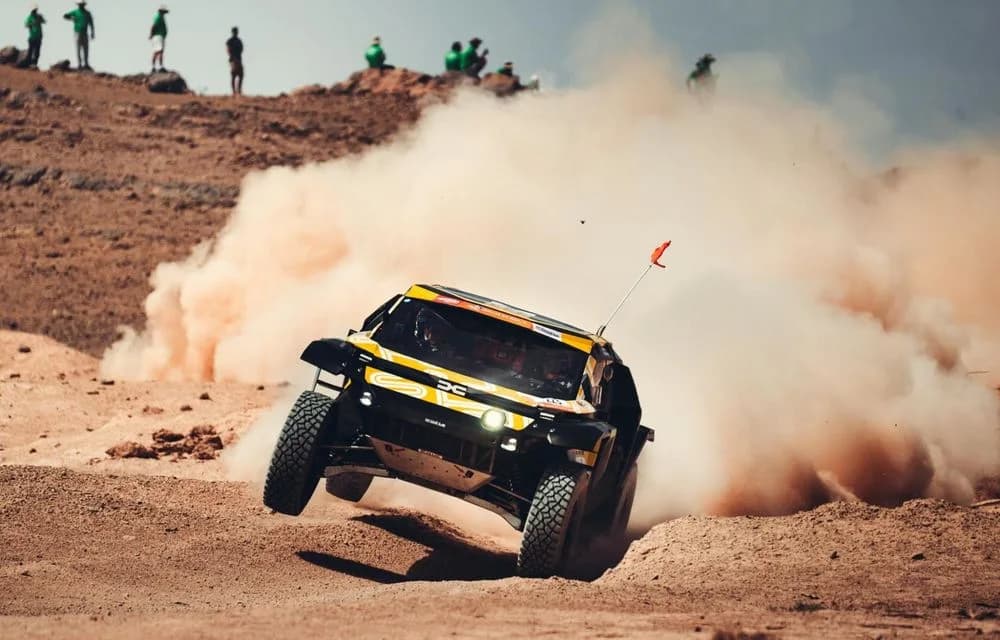
Dacia Sandriders will field three cars at the Abu Dhabi Desert Challenge from 22 to 27 November as it completes its participation in the FIA World Rally-Raid Championship. Nasser Al-Attiyah and Fabian Lurquin, Sébastien Loeb and Édouard Boulanger, and Lucas Moraes and Pablo Moreno enter the 2026 finale with the manufacturers’, drivers’ and navigators’ titles still undecided.
The championship programme ends in Abu Dhabi
Dacia describes this as the Sandriders’ 11th and final W2RC appearance following a winning debut at Rallye du Maroc in October 2024. Across the ten starts completed before Abu Dhabi, the team records five victories, four additional podium finishes and 23 stage wins.
The wording matters. The manufacturer calls Abu Dhabi the conclusion of its two-campaign W2RC adventure, not a routine test before another confirmed championship season. It has not announced a Sandriders W2RC entry for 2027 in this release. The statement does not rule on every possible future motorsport activity, but it does establish that the current world-championship programme ends here.
Car number 299 is assigned to Al-Attiyah and Lurquin, number 219 to Loeb and Boulanger, and number 223 to Moraes and Moreno. All three entries run on Aramco-supplied sustainable fuel and BFGoodrich tyres, as they have throughout the championship.
Dacia leads Toyota in the manufacturers’ table
Dacia reaches the fifth and final round with 372 manufacturers’ points. Toyota Gazoo Racing W2RC has 325 and Ford Racing 232. Despite the 47-point advantage, both Dacia and the championship promoter say the title remains to be settled in Abu Dhabi, so the team cannot treat its lead as mathematically secure without the final scoring outcome.
Seth Quintero heads the drivers’ standings on 135 points. Loeb is second on 121, 14 points behind, while Al-Attiyah is third with 115. Henk Lategan is the fourth driver still described by W2RC as mathematically eligible. The navigators’ classification has Andrew Short on 135, Boulanger on 121 and Lurquin on 115.
An event victory is worth 30 points before the full competitive picture is resolved. That gives Loeb and Al-Attiyah a route to the title, but not a prediction of the outcome. Rally-raid results can change through navigation errors, punctures, mechanical delays and penalties, while stage and overall scoring must be applied after the event.
A 1,931 km route from Al Ain
The 35th Abu Dhabi Desert Challenge starts and finishes in Al Ain. It covers 1,931 km, including 1,326 km against the clock. A seven-kilometre prologue on 22 November is followed by five stages from 23 to 27 November.
Stage 1 runs from Al Ain to Madinat Zayed. The second stage moves west to Al Sila, where crews enter a seaside marathon camp. Stage 3 returns to Madinat Zayed, Stage 4 forms a loop through the Liwa Desert, and the deciding run heads back to Al Ain with dunes around Al Quaa forming part of the challenge.
The organisers list dirt and sandy tracks, dried lakes, tarmac and rocky sections. Dunes account for 23% of the timed distance. The figure does not make the remaining route easy: changing surfaces affect tyre choice, visibility and suspension loads, while the marathon format limits normal service support during a strategically important part of the rally.
Al-Attiyah brings five Abu Dhabi victories
Al-Attiyah has won the Abu Dhabi Desert Challenge five times, in 2008, 2016, 2021, 2024 and 2025. His record gives Dacia a driver with direct knowledge of the terrain and the event’s pacing. Lurquin has framed victory and even a 1-2-3 finish as ambitions for the team’s farewell, not as guaranteed results.
Loeb arrives second in the championship after winning Rally-Raid Portugal with Boulanger. Their 14-point deficit keeps them in contention. Moraes, the reigning world champion when he joined Dacia for 2026, is not listed among the four remaining title candidates, but his result can still influence the manufacturers’ contest and the points available to rivals.
The crews therefore have overlapping but different priorities. Loeb and Al-Attiyah must balance event victory with their individual title positions. Moraes can attack the rally result and support the teams’ classification. Road order will also matter: opening a line across dunes can cost navigation time, while starting behind rivals introduces dust and tactical calculations.
What the Sandrider is
The Sandrider is a purpose-built FIA Ultimate T1+ prototype, not a production Duster with rally equipment. Its tubular chassis carries carbon-fibre bodywork, and a 3.0-litre twin-turbo V6 sends power through a six-speed sequential gearbox and four-wheel-drive system.
Dacia’s homologated figures are 265 kW, or 360 bhp, and 539 Nm. The suspension uses double wishbones with 350 mm of travel. Seventeen-inch aluminium wheels carry 37-inch BFGoodrich tyres. The car is 4,140 mm long, 2,290 mm wide and 1,810 mm high, with a 3,000 mm wheelbase.
Aramco’s synthetic fuel combines renewable hydrogen with captured carbon dioxide, according to Dacia. The manufacturer presents it as a lower-carbon option compatible with an internal-combustion competition engine. The finale release does not provide an independent full-lifecycle emissions comparison, so the environmental claim should remain attributed to the companies involved.
A final result still has to be earned
Abu Dhabi brings together three separate endings: the 2026 season, the world-title fights and Dacia Sandriders’ current W2RC programme. A Dakar win, a Portugal victory and the lead in the manufacturers’ standings give the team a strong record, but none determines the result of the final 1,326 timed kilometres.
The confirmed facts are the three crews, the route, the provisional points and Dacia’s decision to finish its championship adventure after this round. A victory, a clean sweep or any of the three titles remains an objective until the cars reach Al Ain on 27 November and the organisers publish the final classifications.