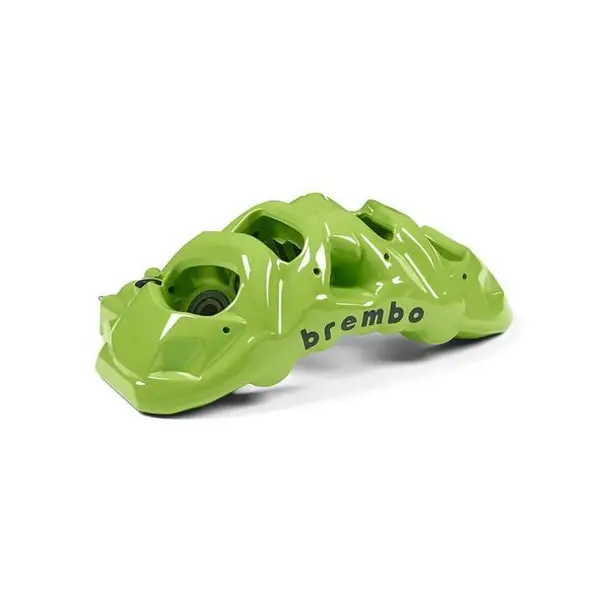
Colour turns a technical part visible through the wheel into a design element. Photo source: Brembo
Why cars have brake calipers in different colours and what each colour means
Red, yellow or blue calipers are often associated with performance cars, but there is no universal colour code. A yellow caliper can identify carbon-ceramic brakes on a particular Porsche, while on another car it can be only an aesthetic choice. Colour, taken on its own, does not say how quickly or how consistently the car can stop.
The finish has three main roles: it makes the braking system easier to recognise, it differentiates versions and equipment packs, and it protects the caliper surface. Performance is determined by the construction of the whole system, not by the pigment.
Why coloured calipers became popular
With the arrival of alloy wheels with more open spokes and large-diameter discs, the caliper became a highly visible part. Car manufacturers and brake suppliers used that surface to highlight the technical equipment and brand identity.
Brembo says it began producing coloured car calipers in the 1980s. Red gradually became associated with performance brakes, even though it does not define a particular construction. Today the company offers numerous finishes for original equipment and aftermarket systems.
For the manufacturer, a contrasting caliper is also a simple visual marker of a more expensive version. The customer can recognise a sport pack immediately, even without seeing disc diameter or the number of pistons.
What red, yellow, blue or black can mean
The meaning has to be checked separately for each brand and model. It is not correct to apply the following table to every car, but it shows associations often encountered:
| Colour | What it can indicate | Why it is not a universal rule |
|---|---|---|
| Red | sport pack or an enlarged braking system | it can also be ordered as an aesthetic finish |
| Yellow | carbon-ceramic brakes at some brands, including Porsche | other manufacturers use yellow without the same technology |
| Blue | certain sport packs, such as BMW M Sport | the technical specification differs between models and generations |
| Green | sometimes a hybrid or electrified version | not all hybrid models use green |
| Black, grey or silver | standard system, a discreet look or an option without contrast | they can also hide a very high-performance system |
Porsche offers a clear example of an internal code. On some 911 models, red calipers accompany the standard system of the performance versions, and yellow ones identify the optional Porsche Ceramic Composite Brake. Even here there are exceptions: the company allows black calipers with carbon-ceramic brakes on certain configurations. Yellow is therefore not sufficient proof without the car’s specification sheet.
What actually matters in a braking system
Colour does not change braking force. To compare two systems you have to analyse the components and how they behave under repeated load:
- disc diameter, thickness and material;
- fixed or floating caliper and the number of pistons;
- pad surface and composition;
- cooling of the discs and calipers;
- resistance to fade through overheating;
- tyres, the car’s mass and ABS calibration.
A larger disc can manage heat better, and a rigid caliper with more pistons can spread pressure more evenly on the pad. Stopping distance still depends on tyre grip, the road surface and the electronic systems.
Paint also has a protective role
A correctly applied finish must withstand high temperatures, water, salt, brake dust, brake fluid, oil and stone chips. Brembo describes for its calipers a process with surface preparation, epoxy primer, a polyurethane coat, application of the logo and a clear coat, followed by temperature, humidity and corrosion tests.
This protection helps preserve appearance, but it does not turn an ordinary caliper into a performance one. Two technically identical parts, painted in different colours by the manufacturer, will have the same braking capability.
Is it safe to paint calipers at home?
The job can affect safety if it is done without correctly removing and protecting the parts. Paint must not reach discs, pads, pistons, seals, bleed nipples or contact surfaces. Ordinary products can change colour, peel or fail to withstand temperature.
Brembo warns in particular about improper refurbishment and oven drying: if the caliper is not dismantled correctly, heat can damage the piston seals. A safe intervention needs dedicated products and a workshop that knows how to work with hydraulic braking systems.
A driver should not buy a used caliper only for colour or a logo. Compatibility depends on the car, the master cylinder, the discs, the ABS system and brake-force distribution. A larger part is not automatically suitable for every car.
How to check what brakes a used car has
Do not rely on colour. Check the chassis number in the manufacturer’s catalogue, the part codes and the options invoice. On inspection, look at whether the finish is even, whether the logo looks original and whether there is paint on seals or pipes.
On a purchase test, the condition of the discs, pad thickness, any leaks and pedal feel matter more than the look of the caliper. If the car is presented as having ceramic brakes or an expensive sport pack, confirmation should be made at a brand service.
Sources
- Brembo – the painting process, tests and the risks of repainting calipers
- Brembo – the role of colour in caliper identity
- Porsche Newsroom – colour codes and braking-system specifications
- Porsche Newsroom – red calipers, yellow PCCB brakes and the black option
- BMW M – blue or red calipers for the M Sport system