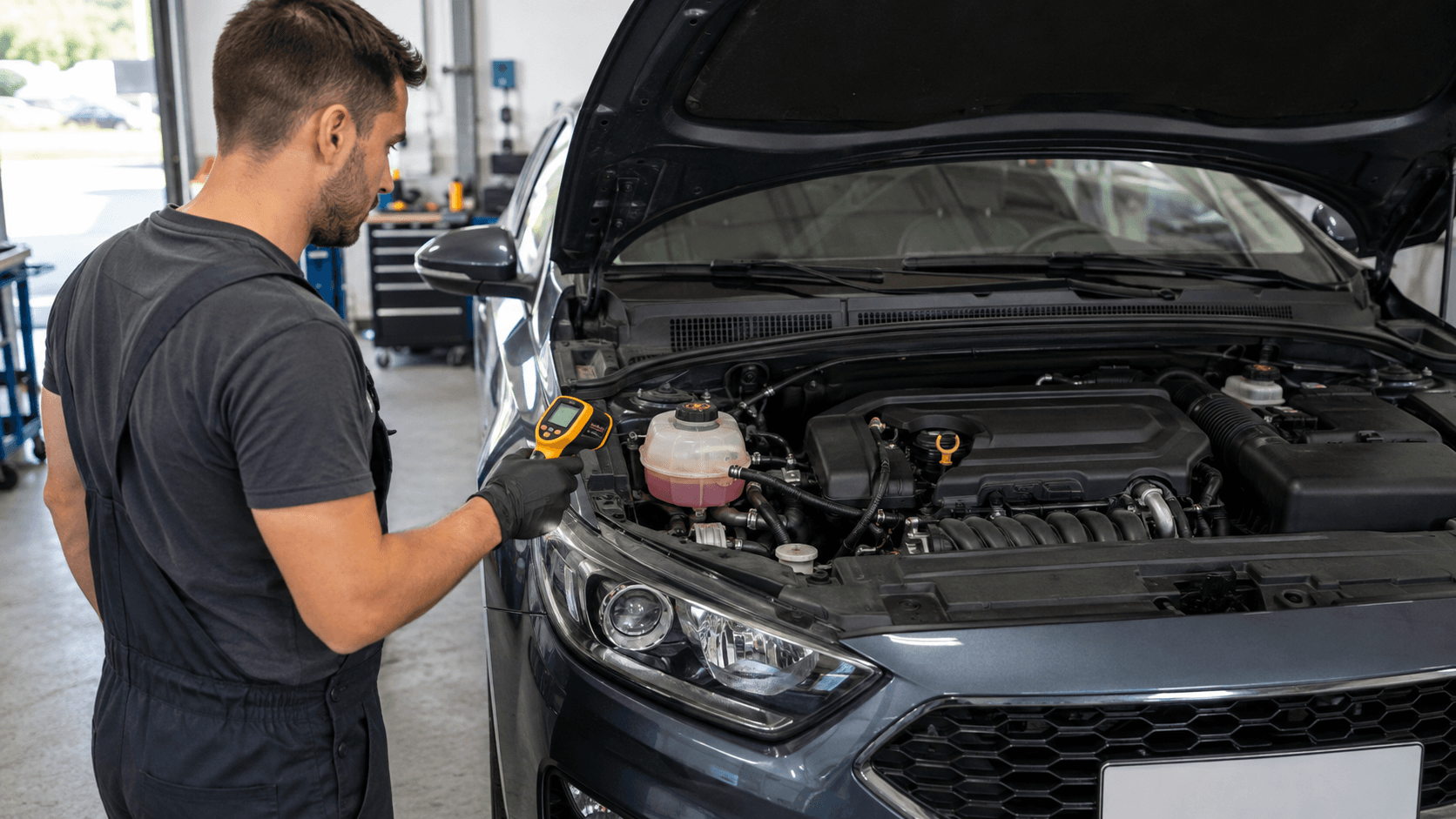
The short answer
A little movement of the fluid in the expansion tank can be normal on some cars, because coolant circulates and increases in volume as it heats. It is not normal for the fluid to boil, to be pushed out, to produce steam, or for continuous bubbles to appear together with a rise in temperature.
The cause can be relatively simple, such as a cap that no longer controls pressure or air left after a repair. It can also be a circulation problem — thermostat, fan, radiator or pump — or a leak through which combustion gases enter the circuit. The appearance of the tank alone does not establish the diagnosis.
If the temperature needle enters the red zone, a temperature warning appears, or steam or fluid comes out from under the bonnet, pull over to the right in a safe place and stop the engine according to the car’s handbook. Do not open the cap while the engine and circuit are hot. The Hyundai handbook warns that fluid and steam can come out under pressure and cause serious burns.
Pressure in the tank is normal up to a point
The cooling circuit of a modern engine is closed and pressurised. Coolant takes heat from the engine, the pump puts it into circulation, the thermostat directs it towards the radiator, and the fan helps especially at low speed or when the car is stationary. The tank takes up the volume variation between cold and hot fluid.
HELLA explains how the circuit works and indicates, as a general technical example, pressures of about 1.0–1.5 bar. The correct value does not, however, apply universally: the cap, temperature and test procedure are chosen according to the model, engine and manufacturer documentation.
For that reason, a firmer hose after warm-up or a higher level in the tank does not automatically mean a head gasket. The warning signal is the combination of pressure or bubbles and other symptoms: overheating, fluid loss, unstable cabin heating, strained hoses, traces around the cap or irregular engine running.
How to interpret what you see in the tank
| What you observe | What it can mean | What you do |
|---|---|---|
| Level rises when hot and returns when cold | Normal expansion, if it stays between the provided marks | Compare the level only when cold, on level ground |
| Level drops once after a coolant change | Possible air expelled from the circuit | Note the level; if it drops again, ask for a check |
| Bubbles after work on the pump, thermostat or radiator | Incomplete bleeding is one of the hypotheses | Repeat filling and bleeding according to the manufacturer procedure |
| Continuous bubbles already from a cold start | There may be gases or a circulation problem; it is not a verdict | Do not undo the tank; ask for workshop tests |
| Fluid pushed past the cap | Overfilling, defective cap/tank, boiling or overpressure | Stop if temperature rises; test the circuit and the cap |
| Temperature rises especially in traffic | The fan and its control enter the checklist | Read real temperatures and test the fan |
| Temperature rises under load or at speed | Insufficient flow or heat transfer, a leak or gases in the circuit | Check the radiator, pump, thermostat and sealing |
The table offers diagnostic directions, not confirmations. The same symptom can have several causes, and some cars use electric pumps, electronically controlled thermostats and separate thermal circuits.
1. The level is too low or the tank was filled above MAX
With too little fluid, the pump can draw in air, circulation becomes irregular and very hot local zones can appear. With too much fluid, the extra volume no longer has room to expand, and the excess can be expelled through the cap or overflow. In both situations, traces around the tank can mislead.
Check the level only with the engine completely cold, on a flat surface, and use the marks and procedure in the handbook. Colour does not prove fluid compatibility. The manufacturer specification and the correct concentration matter more than two products having the same shade.
If you have to top up repeatedly, there is a leak or the fluid is being expelled. The guide on coolant that drops with no puddle under the car covers hoses, the cabin heater matrix, the EGR cooler and internal losses that do not show on the tarmac.
2. The cap or tank no longer controls pressure
The tank cap is not an ordinary stopper. Its valves must manage overpressure on heating and underpressure on cooling. A cut seal, a stuck valve, a damaged thread or a fine crack in the tank can change the pressure at which the circuit works.
Useful signs are dry deposits on the tank neck, moisture under the cap, fluid traces on the container and plastic deformation. Do not test the cap by opening it when hot. At a workshop it can be checked separately with an adapter and pump, at the value specified for the car.
HELLA’s cooling-system diagnosis includes both checking the cap seal and testing the overpressure and underpressure valves. A new cap can fix a cap fault; it does not, however, rule out a stuck thermostat, a weak pump or combustion gases in the circuit.
3. Air was left after a fluid change or a repair
Air can remain in the high points of the circuit after replacing the radiator, pump, thermostat, a hose or the coolant. Bubbles reduce local circulation and can produce temperature swings, intermittent cabin heat and a drop in level when the air pocket is expelled.
There is no universal bleeding procedure. Some cars have dedicated screws; others require a sequence for the electric pump, diagnostics or vacuum filling. HELLA recommends filling and bleeding according to the manufacturer’s instructions, then checking sealing.
The explanation “it still had air” is credible only if it matches recent history and if the level stabilises after the correct procedure. Persistent bubbles and a repeated drop in level require the diagnosis to continue.
4. The fan does not cool enough in traffic
At low speeds, airflow through the radiator depends largely on the electric fan. If temperature rises at traffic lights, in a queue or with the air conditioning on, but falls after the car picks up speed, the fan, fuses, relays, control module and temperature sensor must be checked.
This pattern alone does not prove that the fan is defective. A dirty or blocked radiator, a condenser mounted in front of it full of debris, or incorrect temperature control can produce similar behaviour. Do not put your hand into the engine bay: the electric fan can start without warning, including after the engine is stopped on some models.
5. The thermostat, radiator or pump limits circulation
A thermostat that does not open correctly prevents fluid from being sent to the radiator. A blocked radiator no longer transfers enough heat, and a pump with a weakened impeller, defective sealing or problematic electric control no longer provides the necessary flow.
HELLA recommends measuring temperature before and after the thermostat and radiator, checking flow, the fan and the pump. Order matters: changing the thermostat “to see if it goes away” can leave a defective fan, a sensor that reports incorrectly or a damaged pump unresolved.
Do not feel hot hoses and do not try to see flow by removing the cap. Temperatures can be followed through diagnostics and with non-contact instruments, and components are tested according to the engine procedure.
6. Combustion gases enter the circuit
A leak at the head gasket, cylinder head or block can allow gases from the cylinder to reach the coolant. Pressure can appear quickly after a completely cold start, bubbles can continue, fluid can be pushed out, and the engine can lose coolant or overheat.
Even so, bubbles do not automatically mean a head gasket. Remaining air, local boiling and return circulation can look similar. Neither white smoke on a cold start nor emulsion under the oil filler cap is enough on its own for a verdict.
HELLA technical documentation on coolant pumps explicitly mentions the situation in which engine gases enter the circuit through a defective head gasket. Confirmation may require a test for combustion gases in the fluid, a pressure test, a cylinder check and inspection of the oil, depending on the symptoms.
7. Boiling and expulsion of fluid are the effect of overheating
Sometimes the tank, cap and hoses did not start the problem. The engine heats up for another reason, pressure rises, and the fluid is expelled. After cooling a low level remains, which looks like the cause although it was the consequence.
Note the exact moment: temperature rises at idle or at speed, on a climb, with a trailer, immediately after a repair or only with the climate control on? These details help the workshop more than the phrasing “it makes pressure”. For general causes and the effects of driving with high temperature, see the guide on engine overheating.
What to do immediately if the fluid boils or comes out of the tank
- Reduce load and look for a safe place where you can stop without sudden manoeuvres.
- If a temperature warning, steam or fluid loss appears, follow the car’s handbook and stop the engine. The exact procedure may differ between models.
- Do not open the bonnet while steam or fluid is coming out strongly from under it.
- Do not undo the tank cap and do not remove the radiator cap when hot.
- Let the system cool. There is no universal number of minutes that guarantees the pressure has gone.
- After cooling, check the level visually through the tank, without touching hot parts or fans.
- If the tank is empty, there is a large leak, temperature has gone into the red or the problem repeats, call roadside assistance.
- If the handbook allows topping up, use only compatible fluid and the indicated procedure. Do not set off just because the level has been restored.
The Hyundai handbook for an overheating situation says the bonnet should not be opened until steam or leakage stops and the engine should be stopped if fluid is flowing. Ford warns that fluid and steam can come out with force from the pressurised circuit and that “stop leak” additives can affect cooling or heating.
Which tests to ask for at a workshop, in order
- Reading of real temperature and of faults, to separate overheating from an incorrect sensor indication.
- Inspection when cold and after controlled warm-up, for the tank, cap, hoses, radiator, pump, thermostat housing and hidden traces behind the undertray.
- Testing of the cap, with the correct adapter and pressure.
- Circuit pressure test, without exceeding the manufacturer limit.
- Checking the fan and its control, including activation temperatures.
- Measuring temperatures before and after the thermostat and radiator, for circulation and heat transfer.
- Checking pump flow, by the method specified for that engine.
- Test for combustion gases in the fluid, if rapid pressurisation, persistent bubbles or a suspected internal leak appear.
- Filling and bleeding according to the manufacturer, followed by a road test and a new check when cold.
A good report shows temperatures, test pressure, the moment bubbles appear and the confirmed part. Phrases such as “probably the head” or “we’ll change the cap and see” do not replace measurements.
What not to do
- Do not open a hot tank, not even through a rag, just to “release the pressure”.
- Do not pour cold water suddenly into an overheated engine.
- Do not mix coolants by colour and do not fill above MAX.
- Do not put your hand near the fan, belts or pulleys with the engine running or hot.
- Do not use sealing solution to avoid diagnosis; it can block narrow passages and heat exchangers.
- Do not remove the thermostat as a permanent repair.
- Do not continue the journey if temperature rises again after topping up.
- Do not accept a head-gasket diagnosis based only on a clip of bubbles in the tank.
Checklist: what to note before booking a workshop appointment
- The engine was completely cold at the first observation.
- The cold level was photographed against MIN and MAX.
- You noted the date, mileage and quantity topped up.
- You know whether work was done recently on the pump, thermostat, radiator or coolant.
- Bubbles appear immediately after start or only after warm-up.
- The fluid only moves, or it boils and is pushed out.
- There are dry deposits on the cap, tank, fittings or undertray.
- Temperature rises in traffic, at speed, on a climb or in any regime.
- Cabin heating stays constant or becomes cold.
- The fan is heard starting, without being touched or blocked.
- Steam, a coolant smell or persistent smoke appears after warm-up.
- The engine starts and runs regularly when cold.
- Oil and fluid were checked for contamination.
- Fault codes were saved before being cleared.
- The cap and circuit will be tested separately.
- The workshop will check real temperature, not only the needle on the dashboard.
- Bleeding will follow the manufacturer’s exact procedure.
- After repair, the level will be checked again when cold.
If the problem appears on a car you want to buy, include the tests in the complete engine check. Do not accept a test drive with the engine already warm and the tank topped up before the visit. For the red temperature warning light and the other warnings that require stopping, also consult the guide on dashboard warning lights.
Frequently asked questions
Is pressure in the expansion tank normal?
Yes, the circuit works pressurised when it is hot. Pressure alone does not indicate a fault. It becomes suspect when it appears very quickly from cold, remains together with continuous bubbles, pushes fluid out or is accompanied by overheating and coolant loss.
Is it normal to see bubbles in the tank?
Return movement or a few bubbles after an intervention can have normal explanations, depending on construction. Persistent bubbles, boiling, expulsion of fluid and temperature swings require diagnosis. Do not open the tank when hot in order to observe better.
Do hard hoses mean a head gasket?
No. Hoses become firmer as the hot circuit pressurises. Unusually rapid pressurisation from cold can guide the diagnosis, but testing of gases, the cap and the circuit is needed before a conclusion.
Can I drive to a workshop if coolant has been pushed out?
There is no universally safe distance. If temperature has gone into the red, steam has come out, the tank is empty or fluid continues to be lost, ask for a flatbed. Even if the engine has cooled, the cause that raised temperature or pressure can reappear immediately.
Why does it bubble after I changed the thermostat or pump?
Remaining air is a plausible hypothesis after the circuit was opened, but the fitting, sealing, the new part and pump operation must also be checked. Ask for bleeding according to the manufacturer procedure and confirmation of sealing.
Can a new cap solve the problem?
Yes, if the old cap no longer controlled pressure. Replacing it does not, however, prove that the rest of the circuit is in order. If bubbles, loss or overheating continue, the workshop must test circulation and the possible entry of combustion gases.
Can the water in the tank be topped up with tap water?
Follow the car’s handbook. For normal use, fluid with the approved specification and concentration is required, not a choice by colour. Unsuitable water and the wrong mix can reduce protection against freezing, boiling and corrosion.
Technical sources
- HELLA TechWorld — construction and operation of the cooling circuit
- HELLA TechWorld — checking the fan, thermostat, radiator, pump and cap
- HELLA TechWorld — bleeding, vacuum filling and the pressure test
- HELLA TechWorld — engine gases in the circuit and pump failure
- Hyundai Owner's Manual — what to do if the engine overheats
- Ford Owner's Manual — pressurised circuit and topping-up precautions