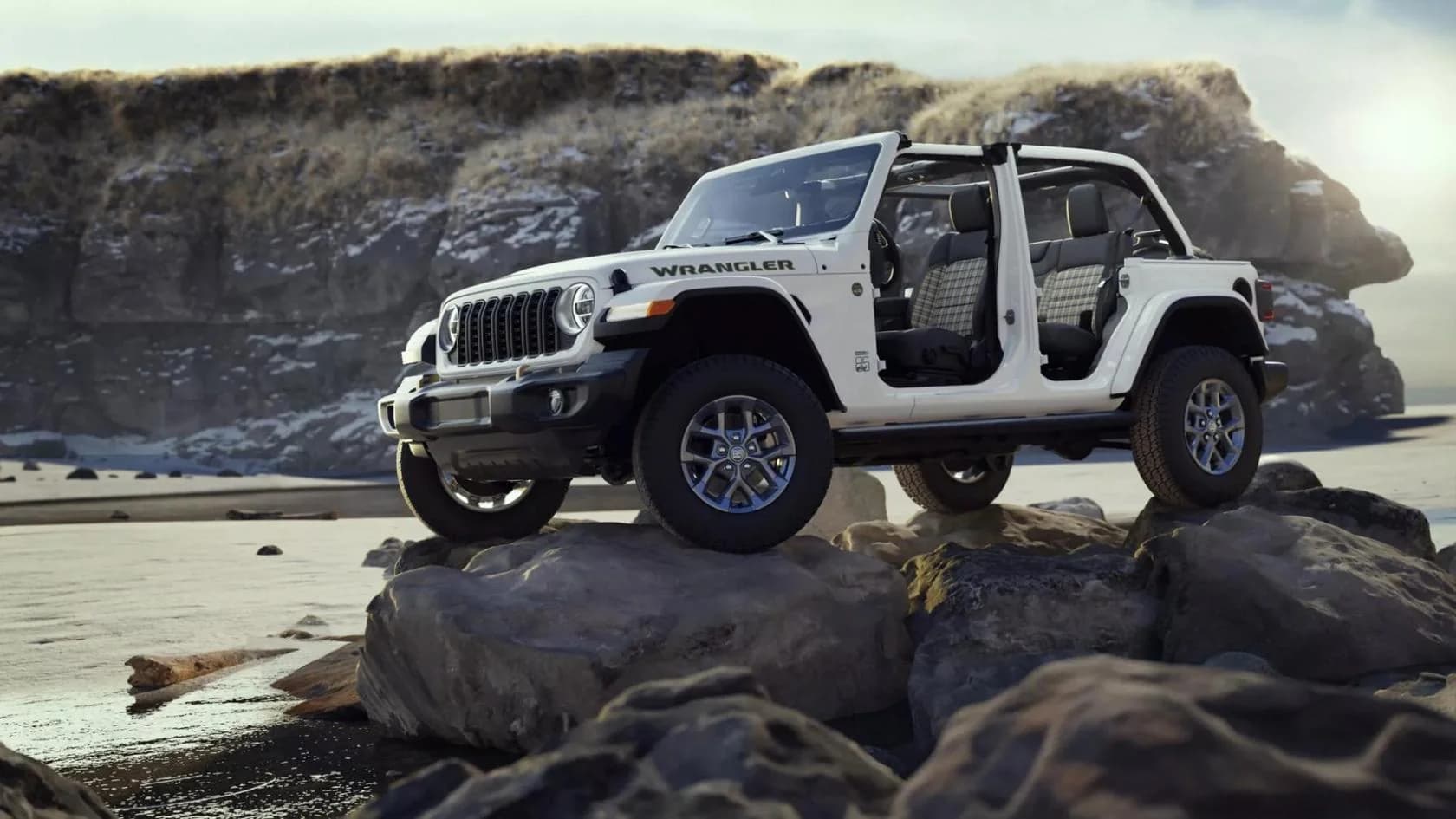
The seven vertical slots, round headlights and trapezoidal wheel arches define the face of a modern Jeep. Photo source: Carboratory archive / Jeep
Why the Jeep grille has seven slots: continents myth vs CJ-2A headlights
A Jeep is recognisable from a distance: seven vertical slots in the grille, round headlights, a near-vertical windscreen, sometimes trapezoidal arches over the wheels. The number 7 looks symbolic — “seven continents”, freedom, global adventure. The documented history is more prosaic: the slots appeared as a bodywork compromise when the military jeep became the civilian CJ-2A, in 1945.
It did not start with seven slots
In the Second World War, Willys-Overland, Ford and American Bantam answered the US Army’s request for a light 4x4. The first Willys prototypes (MA) had a grille of vertical bars (welded).
Ford put a stamped-steel grille with nine slots on its prototypes — lighter and easier to make than the welded version. The Army preferred that solution; the design was standardised on the Willys MB and the Ford GP (the off-road models used in bulk during the conflict).
So the “classic” military jeep in wartime photographs usually has nine slots, not seven. The seven-opening grille comes after the war.
CJ-2A (1945): from nine slots to seven
The first series civilian Jeep, the CJ-2A (Civilian Jeep), entered production in 1945. Willys-Overland changed the grille: seven slots instead of nine.
The brand’s official explanation, restated by Stellantis in Form and functionality: the pillars of Jeep design (2016):
One of the licensing conditions for the civilian Jeep was that the vehicle should have larger headlights than the military version. To make room for the larger headlights, the outer slots were removed — seven slots remained.
In short: the number 7 was not “chosen” as a symbol; two slots were taken off at the ends so larger headlights would fit, in line with civilian type-approval requirements. The remaining 7 stayed as a visual signature.
What Stellantis says about the legends
In the same release the company lists several popular stories: the seven wonders of nature, seven continents, seven seas, seven summits, the seven colours of the rainbow, seven directions (up, down, left, right, forward, back, centre) and so on.
It then states explicitly that it does not matter what inspired the figure 7 — what matters is that the design elements (grille, arches, windscreen) have stayed recognisable for decades.
The “seven continents = seven slots” myth remains fan folklore, not a historical document from Willys. Nor is the theory that Willys avoided a nine-slot design “owned” by Ford supported by clear patents found in the archives — it is sometimes repeated, but without solid proof.
Not every Jeep always had seven slots
The grille’s history is more nuanced than today’s slogan:
| Period / model | Slots in the grille |
|---|---|
| Early military prototypes | vertical bars |
| MB / GP (WWII) | 9 (standardised Ford design) |
| CJ-2A and the CJ series | 7 |
| Willys Wagon, pick-up, Wagoneer, early Cherokee | 8–13 (varied) |
| FC, Jeepster (1966–1973) | 7 |
| From 1998 | 7 on all Jeep models |
From 1998, the brand unified the face: Wrangler, Grand Cherokee, Compass, Avenger and the rest wear the same seven-slot grille, even if proportions and materials have been updated (for example, a black texture on a recent Wrangler).
Why it still matters
The 1945 decision was functional; the effect became brand identity. The grille ties a European urban SUV to a 1940s combat vehicle — without those slots, a Jeep would look like any other crossover.
Alongside the grille, Stellantis cites as visual “DNA”:
- round headlights;
- trapezoidal arches (originally, space for a wheel in off-road use);
- vertical windscreen;
- Wrangler details (fabric door “ears”, visible bonnet hinges) — function plus aesthetics, not ornament.
For Romania
Jeep sells models here such as the Compass, Avenger or Renegade (depending on period and network). The seven-slot grille is the same recognition mark as on a US Wrangler. It does not change consumption, warranty or 4x4 hardware — but it explains why the brand insists on this front end, including on SUVs with no direct military roots.
Frequently asked questions
Did the Second World War Jeep have seven slots?
No. The standardised military variant (MB / GP) had nine slots, after the stamped grille introduced by Ford.
Why exactly seven?
Documented: larger headlights on the CJ-2A → removal of two outer slots → 7 remain. The symbolism (continents, wonders and so on) is legend, not the official explanation.
Have all Jeeps had seven slots?
Not always. Many classic models (Wagon, Wagoneer, early Cherokee) had 8–13 slots. From 1998, the rule is 7 across the range.
Can I change the grille without “breaking the identity”?
Legally and aesthetically, that is the owner’s choice. For many enthusiasts, changing the number of slots is equivalent to changing the brand’s “face” — which is why the grille remains a sensitive subject in off-road communities.