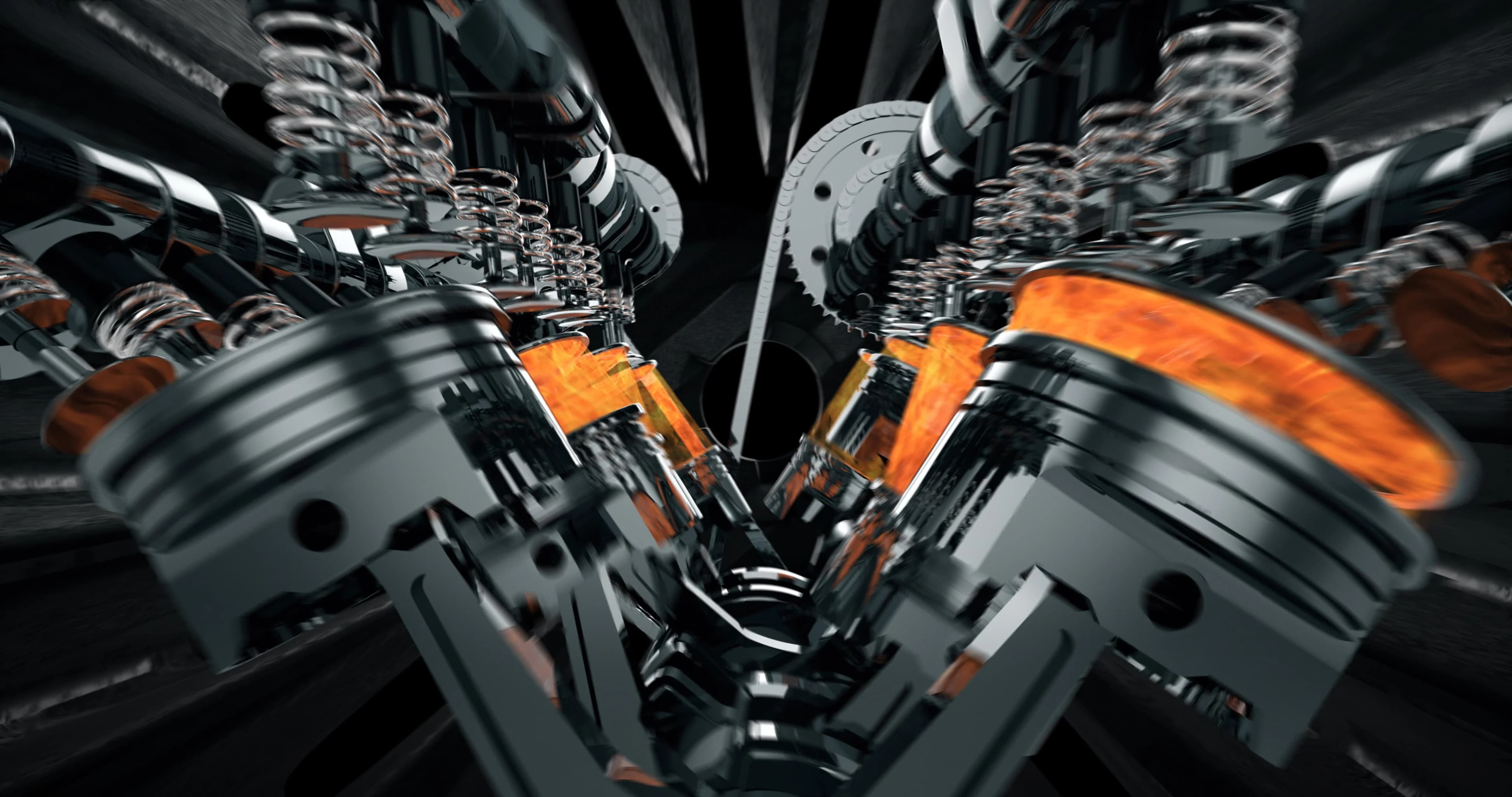
Displacement is not determined only by the number of cylinders. Their diameter and the distance the pistons travel are just as important. Illustrative image.
Why engines have cylinders of different sizes and why 500 cc is a frequent benchmark
A 2.0-litre four-cylinder engine and a 3.0-litre six-cylinder can use almost identical cylinders. In both cases, unit displacement is about 500 cc. At the same time, a 2.0-litre engine can have six smaller cylinders, and a 4.0-litre V8 again reaches about 500 cc for each cylinder.
Manufacturers do not choose these sizes by a single rule. Combustion, maximum revs, friction losses, cooling, vibration, cost and the space available under the bonnet all have to be reconciled. That is why two engines with the same total displacement can have a very different character and construction.
An important clarification: in a conventional car engine, the cylinders are the same size as one another. The differences discussed here appear from one engine to another, not between the cylinders of the same unit.
How a cylinder’s size is calculated
The useful volume of a cylinder is determined by bore, that is the internal diameter, and by piston stroke, the distance between top dead centre and bottom dead centre. The formula is:
volume of one cylinder = π × (bore / 2)² × stroke
The result is multiplied by the number of cylinders to obtain total displacement. The chamber left above the piston at top dead centre does not enter displacement; it counts in the calculation of the compression ratio.
That is why the simple label “2.0-litre engine” says too little about geometry. The same displacement can be obtained with a larger bore and a shorter stroke, or with a narrower cylinder and a longer stroke.
Why about 500 cc per cylinder appears so often
In the modern car industry, a volume close to 500 cc for each cylinder is a frequently used compromise, not a physical limit. BMW built its modular engine family around this benchmark: three cylinders for 1.5 litres, four for 2.0 litres and six for 3.0 litres.
BMW technical data shows this relationship concretely. The 1,998 cc B48 engine has four cylinders, and the 2,998 cc B58 has six. Both use an 82 mm bore and a 94.6 mm stroke. Unit displacement is thus about 499.5 and 499.7 cc respectively.
Standardisation brings industrial advantages. The manufacturer can use similar processes, components and interfaces for engines of different power and size. Development and production become simpler, and one family can cover everything from a compact hatchback to an SUV or a performance saloon.
The 500 cc benchmark is not, however, universal. The 875 cc Fiat TwinAir engine has two cylinders of about 437.5 cc each, with an 80.5 mm bore and an 86 mm stroke. The choice made it possible to obtain a compact unit, but it required solutions for the vibration control specific to a two-cylinder engine.
Smaller cylinders: revs and fast combustion, but more parts
For the same total displacement, a larger number of cylinders means smaller pistons. Their mass can be reduced, and the distance the flame must travel in the combustion chamber is shorter. These characteristics can help an engine climb the rev range and run more smoothly, because combustion pulses occur more often.
There are also costs. More cylinders require more pistons, connecting rods, valves, injectors and spark plugs. Total surface area through which heat is lost, mechanical friction, weight and complexity all increase. A six- or eight-cylinder engine is, in general, more expensive to manufacture than a three- or four-cylinder of comparable total displacement.
Engines with few cylinders reduce the number of components and can be more compact. They are not automatically more efficient in every regime: vibration, the high load demanded of each cylinder and turbo calibration influence the final result.
What bore and piston stroke change
An engine is often called “oversquare” if the bore is larger than the stroke. The pistons travel a shorter distance on each revolution, and the cylinder head offers more room for large valves. The solution is frequently found on engines that need to reach high revs.
On a long-stroke engine, the bore is smaller than the distance the piston travels. The combustion chamber can have a smaller surface area relative to volume, which limits some of the heat losses. On the other hand, mean piston speed rises at the same revs, and mechanical loads limit the maximum regime.
It does not follow that a long-stroke engine automatically produces more torque, or that one with a large bore automatically produces more power. Supercharging, cylinder pressure, valve timing, intake, exhaust and electronic management can radically change performance. Geometry is only one of the variables.
Why cylinders are not enlarged without limit
A very large cylinder raises combustion and mechanical-strength problems. The flame has to cross a greater distance, the risk of uneven combustion rises, and the piston and connecting rod become heavier. The forces applied to the piston and the vibration can require a more robust block and crankshaft.
At the opposite extreme, splitting displacement into very many small cylinders increases the number of parts and friction losses. The manufacturer looks for the point at which the engine delivers the desired power and refinement without unnecessary cost, size or losses.
The turbocharger has changed this balance. An engine of smaller displacement can introduce more air into the cylinders and produce the power that, in the past, required a larger naturally aspirated unit. Even so, the extra pressure raises thermal and mechanical load, so materials, cooling and calibration become decisive.
What a buyer can learn from these figures
Displacement and the number of cylinders are not enough to anticipate consumption or reliability. Bore and stroke explain part of the engine’s character, but they do not replace data on torque, the rev range, the car’s mass, the transmission and measured consumption.
For the buyer, the difference is felt mainly through throttle response, vibration, sound and the way the engine delivers torque. Two 2.0-litre units can have the same unit displacement and still behave very differently if one is diesel, the other runs on petrol, and boost pressure and compression ratio are different.
Frequently asked questions
Can the cylinders of the same engine have different sizes?
In a conventional car engine, no. The cylinders have the same bore and the same stroke. There are experimental projects and other types of engines, but they do not represent the usual construction of passenger cars.
Does a larger cylinder always produce more power?
No. Larger volume allows a greater quantity of air and fuel to be introduced, but power also depends on revs, boost pressure, combustion efficiency and many other elements.
Why do many engines have about 500 cc per cylinder?
It is a useful compromise between combustion, heat losses, mass, friction and costs. For modular families, it allows 1.5-, 2.0- and 3.0-litre engines to be built from similar modules.
Is a large bore better than a long stroke?
There is no better variant in every situation. A large bore favours larger valves and high revs, and a long stroke can help thermal efficiency, but it increases piston speed at the same revs.