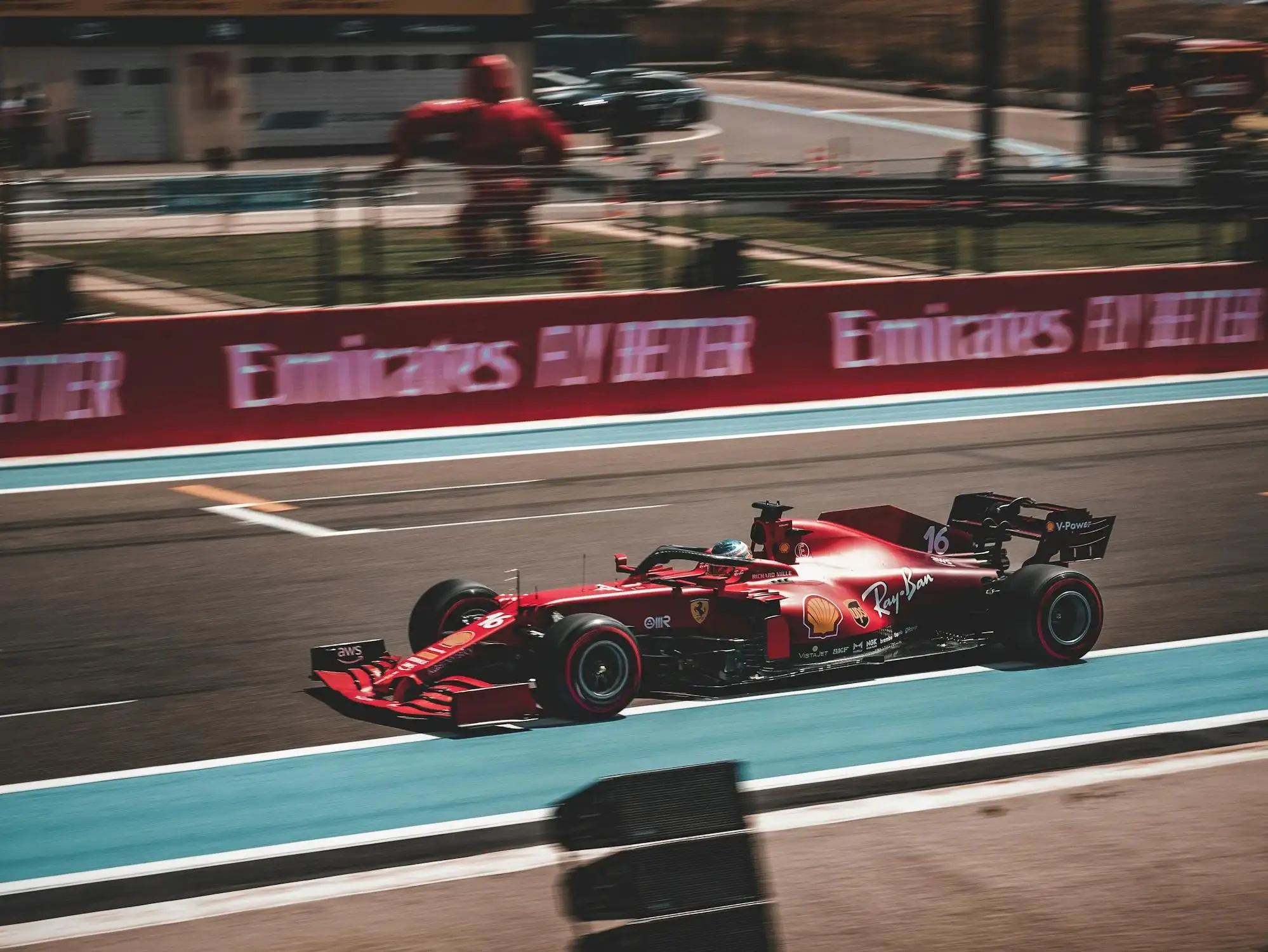
Today’s Formula 1 keeps the principle set after the Second World War: all teams build cars to the same set of rules. Illustrative image.
Why it is called Formula 1: the origin of the name and the first rules
The name Formula 1 describes the competition’s place in the motor-racing system. “Formula” is the set of rules that all participating cars must follow, and the figure “1” shows that this is the principal category of single-seaters organised under the authority of the Fédération Internationale de l'Automobile.
The name does not come from the number of drivers in the car, from the first race, or from a particular engine capacity. The regulations have changed many times, but the basic idea has stayed the same: manufacturers look for different solutions within the same technical and sporting formula.
What “formula” meant in motor racing
Grand Prix races existed for many decades before the Formula 1 World Championship. Organisers needed criteria to decide which cars could compete together. Those criteria could include mass, engine capacity, the type of supercharging, dimensions or fuel consumption.
The set of conditions was called a “formula”. The term did not describe an identical model built by every team, but the limits within which each manufacturer could design its car.
The same principle is visible today. FIA regulations set dimensions, minimum mass, powertrain architecture, aerodynamic requirements and safety standards. McLaren, Ferrari, Mercedes and the other teams must respect them, but they develop the chassis and many components separately.
The category took shape in 1946
After the Second World War, the Commission Sportive Internationale, the sporting division of the body that would become the FIA, began reorganising international racing. In 1946 the concept of a new Grand Prix category was approved.
According to the history published by Formula 1, the name used at first was Formula Internationale. Some accounts of the period also mention the name Formula A. The documentation does not establish with certainty that Formula A was the official title used everywhere.
In the end the name Formula 1 was chosen, easier to understand as the category at the top of the hierarchy. Formula 2 designated the lower level, and Formula 3 would later be recognised for smaller cars.
The first rules allowed two types of engine
The regulations applied from 1947 accepted two main configurations:
- naturally aspirated engines with a capacity of at most 4.5 litres;
- supercharged engines with a capacity of at most 1.5 litres.
The second category came from the old “voiturette” class, intended before the war for cars smaller than the main Grand Prix single-seaters. The equivalence tried to bring onto the same grid cars built to different technical philosophies.
The same capacity limits were used at the start of the World Championship, from 1950 to 1953. The formula did not stay fixed: the FIA repeatedly changed the permitted engines, mass, aerodynamics and sporting rules as technology and safety requirements evolved.
Formula 1 existed before the World Championship
Races organised to the new category’s regulations took place from 1947. The Drivers’ World Championship was confirmed in 1949, however, and began in the 1950 season.
The distinction explains why archives contain Formula 1 races held before 1950. They used the technical formula, but did not award points in a World Championship that had not yet been launched.
Conversely, not all races called Grand Prix were or are part of Formula 1. “Grand Prix” is an older name and can be used by competitions in different categories.
The first World Championship round was held at Silverstone
The first race of the new World Championship took place on 13 May 1950, at Silverstone, in Great Britain. The circuit had been laid out on an airfield used during the war and had already hosted the 1948 and 1949 editions of the British Grand Prix.
Giuseppe “Nino” Farina won the 1950 race for Alfa Romeo. At the end of the season, the Italian driver became the first Formula 1 world champion.
The inaugural calendar comprised seven rounds: Great Britain, Monaco, the Indianapolis 500, Switzerland, Belgium, France and Italy. Including the Indianapolis 500 gave the championship an international dimension, although joint participation by European and American drivers and teams was very limited.
In 1950 only the drivers’ world title was awarded. The Constructors’ Championship was introduced in 1958, eight years after the inaugural season.
Who had the idea of the World Championship
There is no single document that attributes the idea beyond doubt to one person. Formula 1 frequently points to the Italian marquis Antonio Brivio-Sforza, a former Grand Prix driver and Italy’s representative in FIA structures from 1946.
Brivio had raced before the war and finished on the podium at Monaco in 1935 and at the Nürburgring in 1936. He is generally credited with promoting a World Championship organised around the new formula, but the regulations and the competition were the result of decisions taken by international motor-sport bodies.
What existed before Formula 1
Between 1931 and 1939, the Association Internationale des Automobile Clubs Reconnus, the FIA’s predecessor, had organised a European Drivers’ Championship. Rudolf Caracciola, Tazio Nuvolari and Bernd Rosemeyer were among the champions of the period, and Mercedes-Benz, Auto Union and Alfa Romeo were the important manufacturers.
The European competition stopped with the outbreak of war. Formula 1 did not therefore appear in empty space; it took over the Grand Prix racing tradition and placed it in a reorganised rulebook and world championship.
Why the name stayed, even though the regulations changed
The 2026 technical formula no longer resembles that of 1947. Modern engines are hybrids, the cars use composite structures, and safety is regulated in details that did not exist at the start of the competition.
The name does not describe a particular generation of engine. It designates the principal category governed by the formula set for that season. When the regulations change, Formula 1 remains Formula 1 as long as it occupies the first level of the FIA hierarchy for single-seaters.
Frequently asked questions
What does the word “Formula” in Formula 1 mean?
It is the set of technical and sporting rules that participating cars and teams must follow.
Why is there a figure 1?
The figure indicates the category’s position at the top of the single-seater system. Formula 2 and Formula 3 are distinct levels, with different regulations and performance.
Did Formula 1 start in 1946 or in 1950?
The new category was discussed and approved in 1946, and the regulations were used from 1947. The World Championship began in 1950.
What was the first race of the Formula 1 World Championship?
The British Grand Prix, held at Silverstone on 13 May 1950. The race was won by Giuseppe Farina.
Was Formula 1 originally called Formula A?
Some accounts use the name Formula A, and Formula 1 mentions that it circulated in the early period. The name Formula Internationale is also documented. Formula 1 was chosen to identify the principal category clearly.