Electric cars can wear their tyres faster than combustion cars, but there is no defensible percentage that applies to every EV. Controlled research, fleet records and recent particle studies point in the same broad direction while producing very different numbers. Vehicle mass, tyre construction, route, alignment and driver inputs can matter as much as the powertrain label.
For an owner, that means tyre pressure, uneven wear and tread depth deserve close attention—particularly on a heavy, powerful car or one regularly driven with hard acceleration. It does not mean every electric car will consume a set at the same accelerated rate.
A 2022 experiment measured 27% more tread loss
A study published in Science of the Total Environment in 2022 compared particulate emissions from an electric car with petrol and diesel vehicles. The researchers measured tread wear on a controlled 550 km route at the Korea Automobile Testing and Research Institute's high-speed circuit.
Average tyre tread wear was 201.7 mg/km for the tested EV, against 158.9 mg/km for the petrol car and 167.4 mg/km for the diesel. Under those conditions, the electric vehicle's result was about 27% above the petrol car and 20% above the diesel.
Those figures belong to the vehicles and test conditions used. They do not establish that every EV owner will replace tyres 27% sooner. The paper also examined brake, road and resuspended-dust particles, and its purpose was to compare total particulate emissions rather than to set a commercial replacement interval for all cars.
The BMW iX1 test shows why weight matters
UTAC conducted a road programme for ACEA and OICA using an electric BMW iX1 and several combustion BMW X1s. The cars shared a model platform and covered 15,000 km together on 245/45 R19 summer tyres. Original-equipment and aftermarket products were assessed through mass loss and tread-depth loss.
In absolute terms, the heavier iX1 shed more material per kilometre. Once the result was normalised for vehicle load, the original-equipment tyre on the electric BMW recorded 87.110 mg/km/tonne, while the same specification on the reference combustion vehicle recorded 88.620 mg/km/tonne. The normalised difference was small and slightly favoured the EV.
One comparison cannot prove that mass explains every case. It does show why a simple EV-versus-ICE result can be misleading if weight, tyre size and exact tyre model are not controlled. Two cars with the same badge may have materially different mass, axle geometry and torque distribution.
Fleet records reveal cost, not a single cause
British fleet-management company Epyx reported in October 2025 that electric company cars in its service data received a first tyre change at an average 14,352 miles, or approximately 23,097 km. The combustion-car average was 18,333 miles, about 29,504 km. That put the EV change at roughly 22% less distance.
These are real workshop records, but they are not a controlled experiment with identical cars and routes. Epyx covers many models, drivers and duty cycles. It had previously cautioned that its EV sample leaned towards larger vehicles, which generally impose greater tyre loads. The figures matter to fleet budgets, yet they cannot attribute the entire gap to electric propulsion.
Recent papers do not all measure tyre life
A 2026 Environmental Research paper used electric and combustion versions of the same passenger-car platform. It measured a tyre-and-road wear particle emission factor of 7.6 ± 4.2 mg per vehicle-kilometre for the EV, compared with 5.8 ± 1.9 mg for the combustion version—an average difference of around 31%.
That does not mean the EV's tyres reached replacement depth 31% sooner. The team collected on-road particles, then studied their composition and behaviour after laboratory ageing. The ranges were wide, and particle emissions are not identical to the distance a tyre covers before its main grooves reach a legal or safety threshold.
Another paper, published by Mechanika in October 2026, tested four commercial tyres and estimated 35–62% less tread-life mileage on the electric platforms. However, the electric and combustion cars used different routes, with the EVs covering more urban driving. Frequent acceleration, braking and cornering can increase wear independently of propulsion. The result documents the tested use cases but does not cleanly separate car type from route.
Mass and delivered torque explain the risk
ADAC describes a broadly linear relationship between vehicle weight and tyre abrasion within the normal passenger-car range. A heavier load asks the contact patch to transmit more force during acceleration, braking and cornering. Batteries make many EVs heavier than similarly sized combustion cars, although the rule is not absolute: a small EV can still weigh less than a large petrol SUV.
Immediate torque can add wear when the driver repeatedly uses it. The peak figure in a specification sheet does not remove rubber by itself; the relevant factors are torque actually delivered at the wheel, traction-control calibration and the driver's accelerator input. Progressive mapping and smooth driving can produce a markedly different result from repeated hard launches in the same car.
Alignment, road surface, temperature, speed, towing, wheel diameter and tyre compound also change the outcome. Heavy wear limited to the inner shoulder of one tyre is more likely to indicate alignment or suspension trouble than an unavoidable characteristic of electric power.
An EV-branded tyre is not compulsory
ADAC says a dedicated EV marking is not required. The replacement must meet the vehicle maker's approved size, load index, speed category and other specifications. Many EVs require XL or HL tyres capable of supporting higher loads without moving to a larger nominal size.
Products developed for electric cars may combine reinforced construction, wear-resistant compounds, low rolling resistance and noise treatment. Those functions are separate. Acoustic foam can reduce the road noise heard in a quiet cabin, but it does not automatically extend tread life. Lower rolling resistance can support range, but it should not be pursued at the expense of wet grip and braking.
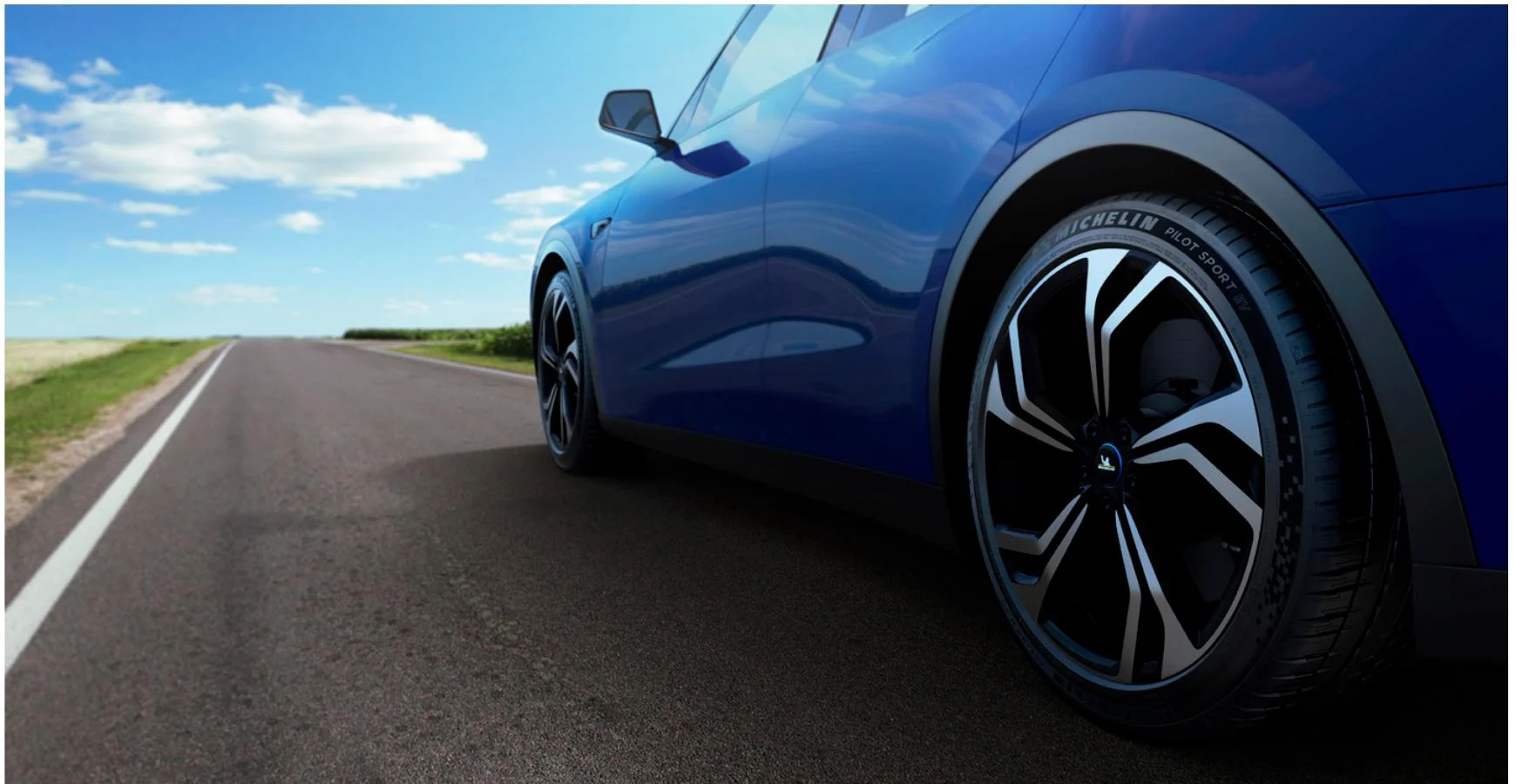
Michelin attributes additional stress to weight and torque delivery and recommends correct pressure, wheel rotation where the vehicle maker permits it, alignment checks and progressive acceleration. The company also says its conventional lines can be used on EVs when load restrictions are observed. A marketing symbol is not a substitute for technical compatibility.
What an owner should check
Pressure should be measured cold and set to the vehicle manufacturer's placard or handbook, not to the maximum moulded into the tyre sidewall. Incorrect pressure can increase wear, energy use and heat. A tyre-pressure monitoring system is a safety backstop rather than a maintenance gauge: its warning normally appears only after a meaningful loss.
Tread depth should be measured at several points, including the inner shoulder. European rules set a 1.6 mm minimum in the main grooves of passenger-car tyres, but wet performance can decline before the tread reaches that threshold. Axle-to-axle rotation should be done only in line with the handbook; staggered wheel sizes and directional tyres reduce the available options.
On a used EV, the four tyres can reveal both driving history and geometry problems. A replacement set can be expensive on a large-wheel SUV. Inspection should cover make and model, date code, load rating, repairs, cracking, tread-depth variation and whether all four tyres are compatible with the car.
The evidence supports a careful conclusion: some electric cars do wear tyres faster. It does not support a blanket statement that every EV loses 20%, 30% or 60% of tyre life. For the person paying the bill, the car's mass, the selected tyre, inflation, alignment and accelerator use are more useful than a single headline percentage.
Sources
- Science of the Total Environment — experimental comparison of total particulate emissions, 2022
- UNECE/UTAC — tyre-abrasion study for ACEA and OICA
- Environmental Research — EV and combustion versions of the same platform, 2026
- Mechanika — controlled-road comparison of tyre tread wear, 2026
- Epyx — first tyre-change service data, 2025
- ADAC — tyre abrasion factors and EV replacement guidance
- Michelin — guidance for reducing electric-car tyre wear
- EUR-Lex — 1.6 mm minimum tread depth