Ford Racing has brought the Mustang Cobra name back into its product plan, promising that “the story continues in 2027”. A 36-second teaser published on 10 November spells out Cobra over the sound of an engine accelerating through several gears and describes the car as having an “all-motor heart born from racing”.
That is the full extent of the confirmed technical information. Ford has not shown the car, named its engine, published a power figure or specified a transmission. There is no price, production volume or market list, and the wording does not establish whether 2027 refers to a reveal, an order opening or first deliveries.
What Ford's wording does and does not confirm
In American performance-car language, “all motor” normally means an engine making its power without a turbocharger or supercharger. It is a strong signal towards natural aspiration, but a slogan is not an engineering specification. Ford Racing does not state a cylinder count, displacement, crankshaft layout or rev limit.
The soundtrack is clearly intended to make the engine central to the announcement. It also includes audible gear changes, yet sound alone cannot prove that the production car will be manual. Reports pointing to a 5.2- or 5.4-litre V8, a flat-plane crank or more than 600 horsepower remain reports rather than Ford specifications.
At the end of the animation, the R in Cobra is isolated and coloured blue. That visual reference invites a link with the track-focused Cobra R lineage. It does not confirm that Ford will sell both Cobra and Cobra R variants, nor that the final badge will necessarily include the R.
The three Cobra R models explain the anticipation
Ford's own Mustang chronology dates the first SVT Mustang Cobra to 1993. The more focused Cobra R from the same year was limited to 107 cars and sold out before production began. It was conceived as a competition-ready derivative rather than a cosmetic package.
The second Cobra R followed in 1995. Ford records a run of 250 cars, powered by a 5.8-litre V8 rated at 300 horsepower. In 2000, the third Cobra R used a naturally aspirated 5.4-litre DOHC V8 producing 385 horsepower and introduced the first six-speed manual transmission offered in a Mustang.
Those figures are historical context, not a preview specification. The 2000 car's 5.4-litre displacement may explain some of the current speculation, but the new teaser never prints that number. The regular SVT Cobra continued into the 2004 model year, meaning a Ford-built road-going Mustang has gone more than two decades without the Cobra badge.
A crowded modern Mustang hierarchy
The present Mustang range gives Ford several reference points. The US-market Dark Horse has a naturally aspirated 5.0-litre Coyote V8 rated at 500 horsepower. The Dark Horse SC uses a supercharged 5.2-litre V8 with 795 horsepower, while the GTD sits at 815 SAE horsepower, 900 Nm and a claimed 325 km/h maximum speed in Ford's European information.
There is room in that hierarchy for a higher-revving, naturally aspirated model above the Dark Horse, but Ford has not stated where Cobra will sit. It has not called the car a Shelby GT350 successor, confirmed a Mustang GT3-derived 5.4-litre engine, or announced wider bodywork, larger brakes and revised cooling.
“Born from racing” can describe technology transfer, architecture or development experience. A road engine still has to meet durability, emissions, noise and service requirements that differ from those of a GT3 competition unit. Until Ford provides a parts-level explanation, the phrase should not be read as proof that the race engine is moving directly into a production car.
Europe is not yet part of the announcement
Ford Racing's post contains no regional availability statement. A US launch would not automatically mean official European sales, particularly for a low-volume model with an as-yet-undisclosed emissions and homologation position.
There is a precedent for a specialist Mustang crossing the Atlantic. Ford opened a European application window for the GTD in September 2026 and said no more than 500 cars were expected for the region. That limited process demonstrates that Ford can homologate a flagship Mustang for Europe, but it tells us nothing about Cobra allocations.
European buyers therefore have no official euro price, order date, emissions figure or delivery schedule. Importing a North American-market car independently would raise separate questions about type approval, warranty coverage, lighting, taxation and parts support; none can be assessed before the production specification exists.
The facts to watch in 2027
The next announcement needs to define what kind of Cobra Ford is building. Engine displacement and aspiration will be the headline figures, but transmission choice, kerb weight, tyre specification, cooling, brakes and aerodynamic changes will reveal whether the car is a road-focused special or a genuine circuit derivative.
Ford must also explain whether the blue R was simply a heritage cue or a distinct model. Production volume will matter because the three historic Cobra R editions were deliberately scarce, while the regular SVT Cobra served a broader enthusiast audience.
For now, the accurate description is narrow but significant: Ford Racing has officially revived the Mustang Cobra name and tied its next chapter to 2027. A naturally aspirated character is strongly suggested by the “all-motor” wording, while the much-repeated 5.4-litre engine, manual-only layout, output, Cobra R edition and price remain unconfirmed.
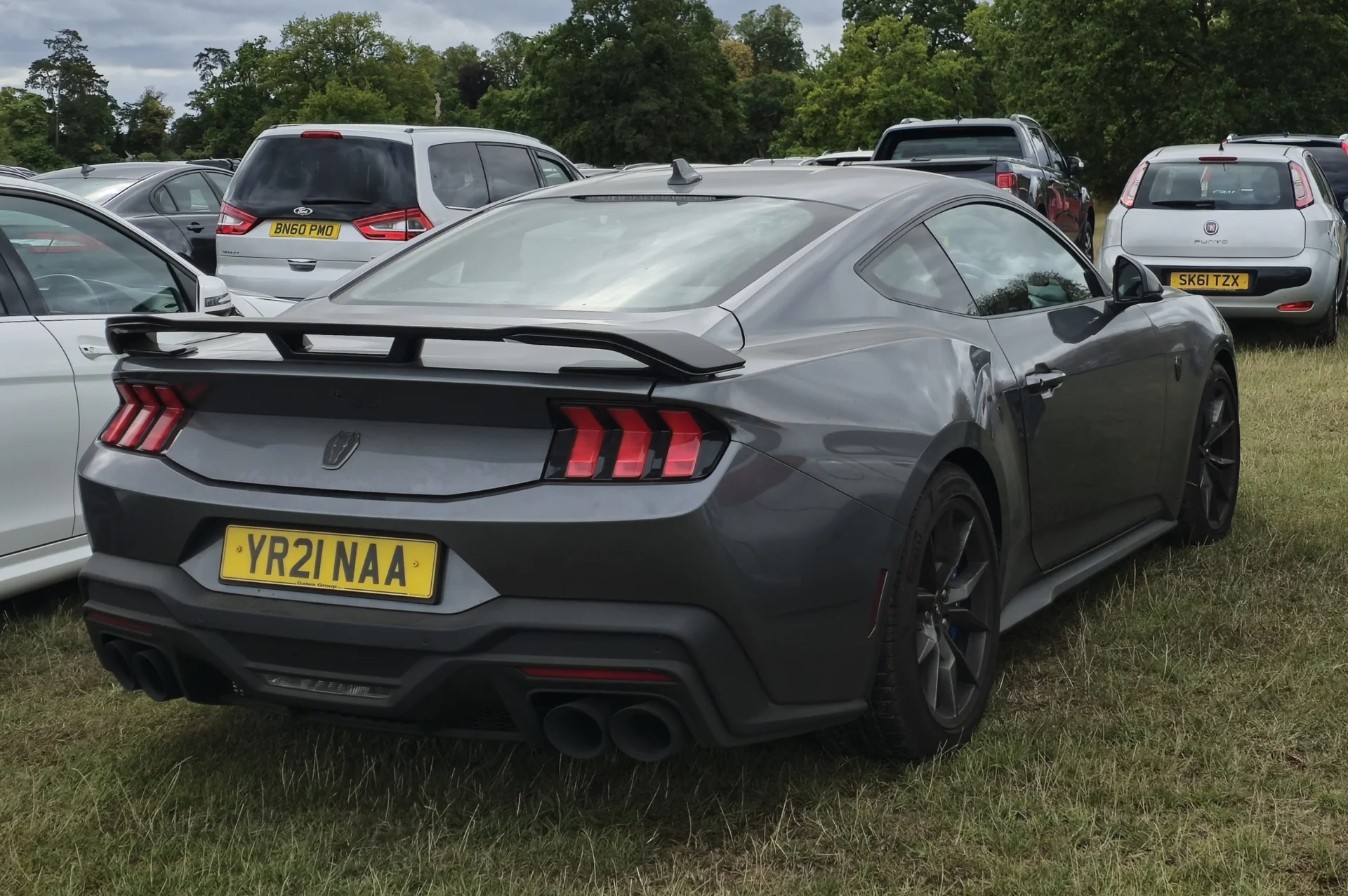
Representative image: a current S650-generation Ford Mustang Dark Horse, not the unrevealed Cobra. Photograph by Calreyn88 via Wikimedia Commons, CC BY-SA 4.0; resized and converted to WebP.