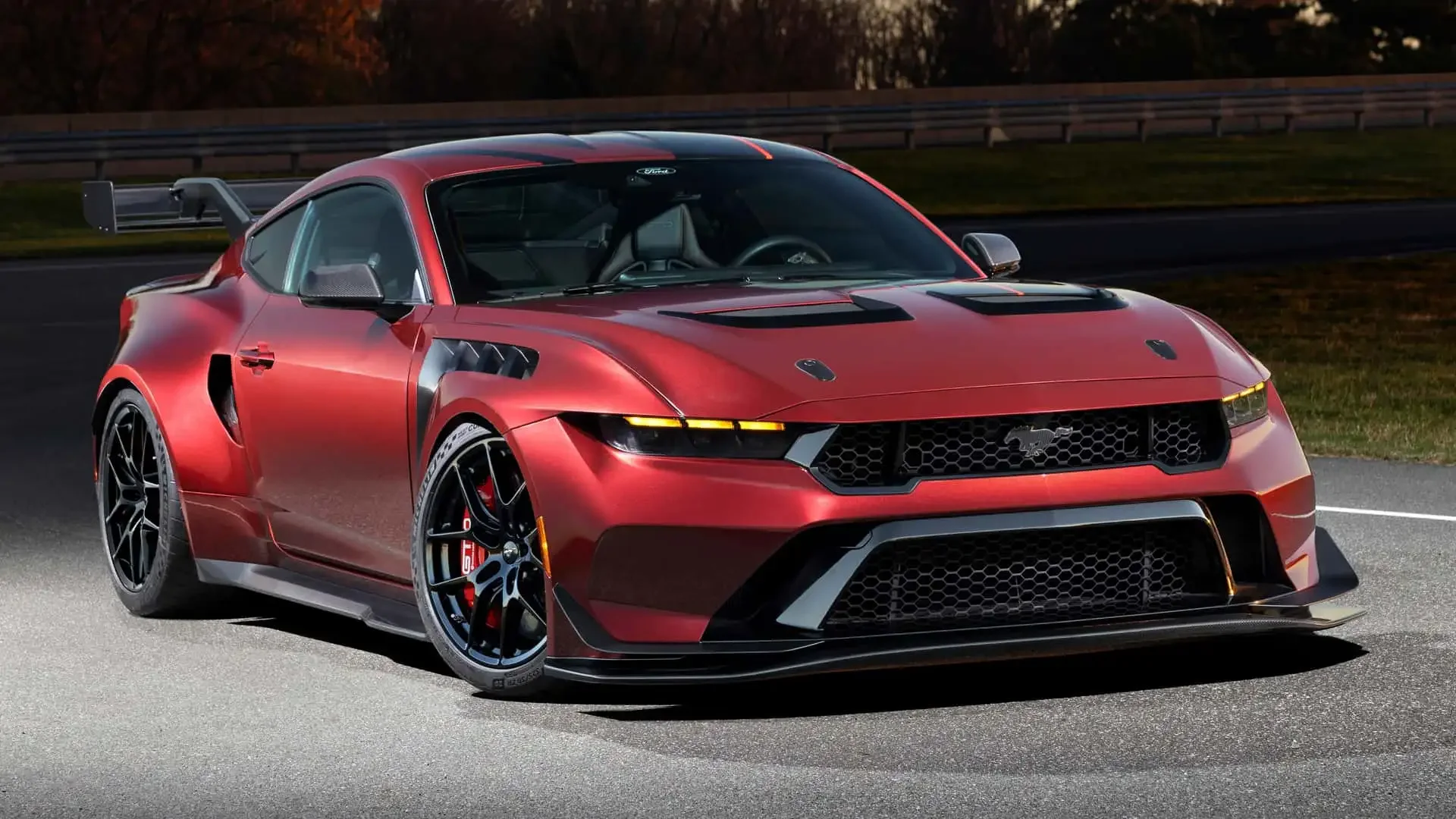
Ford has revealed the Mustang GTD 1901 for the 2028 model year, using a deep Royal Red finish and an offset black stripe to recall the two-cylinder “Sweepstakes” racer driven by Henry Ford in 1901. The historical treatment does not bring a separate engine tune. Official figures remain 815 hp SAE, 664 lb-ft — 900 Nm — and 202 mph, or 325 km/h, from the supercharged 5.2-litre V8.
The price, production total and market-by-market allocation have not been announced. Those omissions matter more than the colour chart for prospective buyers, because Mustang GTD availability is tightly controlled. Ford describes 1901 as its latest GTD livery and equipment package, not as the more powerful GTD Competition that set a later Nürburgring time.
Why 1901 is more than a model-year number
On 10 October 1901, Henry Ford entered a 10-mile race on a dirt horse track near Detroit. Ford Racing's account says he was an inexperienced driver facing Alexander Winton, the established favourite. Ford's 26-hp machine was almost 50 hp down on Winton's car, yet “Sweepstakes” won through speed and dependability.
The immediate rewards were a $1,000 prize and a glass punch bowl. The larger consequence was publicity: the result helped Henry Ford secure backing before Ford Motor Company was formed in 1903. That chronology gives the new livery a specific reference rather than a convenient heritage label. Both cars were conceived as engineering showcases, although no direct technical line can be drawn between a 1901 two-cylinder racer and a modern carbon-bodied GTD.
The original machine had a black body over a deep-red frame, suspension and wheel rims. On the 2028 GTD, Royal Red covers most of the body while a broad black racing stripe sits away from the centreline. A bright red line runs inside it and diagonal graphics break up the stripe. The splitter, rocker panels, diffuser and rear wing remain exposed carbon fibre.
Performance Package comes as standard
Ford includes the GTD Performance Package on the 1901. It bundles the more track-focused aerodynamic and weight-saving content, but Ford has not published a separate kerb weight or downforce figure for this edition. It would therefore be misleading to calculate a unique power-to-weight ratio from the announcement.
The underlying GTD architecture combines extensive carbon-fibre bodywork with an inboard rear suspension and semi-active dampers. Carbon-ceramic Brembo brakes are part of the hardware, while available active aerodynamics can change the rear-wing angle and operate flaps beneath the front of the car. These systems balance drag and downforce according to the operating condition; they are core GTD technology rather than 1901-only additions.
Magnesium wheels are available again for model year 2028 after earlier supply constraints. Ford says the set cuts 50.3 lb, or 22.8 kg, of unsprung weight compared with the standard Magnetite aluminium wheels. That is a manufacturer comparison, not a Carboratory measurement, and Ford has not attached a price to the option. A lower unsprung mass can help the suspension follow the road, but tyres, damper calibration and surface conditions still determine the result the driver feels.
Mahogany Red leather and reclaimed aerospace metal
The cabin gives the 1901 its clearest model-specific treatment. Seats are trimmed in Mahogany Red leather with bright Race Red stitching. Race Red also edges the seatbelts, echoing the stripe outside, while Mahogany Red suede appears on the inner portion of the steering wheel.
Across the complete 2028 GTD range, genuine full-grain leather becomes standard on the instrument panel, inner door areas and centre-console lid. Ford is therefore separating the 1901's colour combination from a broader model-year improvement in material coverage. It is useful to make that distinction: the red cabin is edition-specific, but the additional leather is not.
An optional titanium trim package brings longer, redesigned shift paddles and a new rotary selector. Both are 3D-printed from metal reclaimed from retired F-22 fighter aircraft components, according to Ford. The selector's outer pattern takes its cue from the shock-tower brace in the engine bay. A titanium plaque displaying part of the VIN sits on the passenger side of the dashboard. The unusual feedstock is verified by the manufacturer, although Ford does not disclose the share of reclaimed material in each finished component.
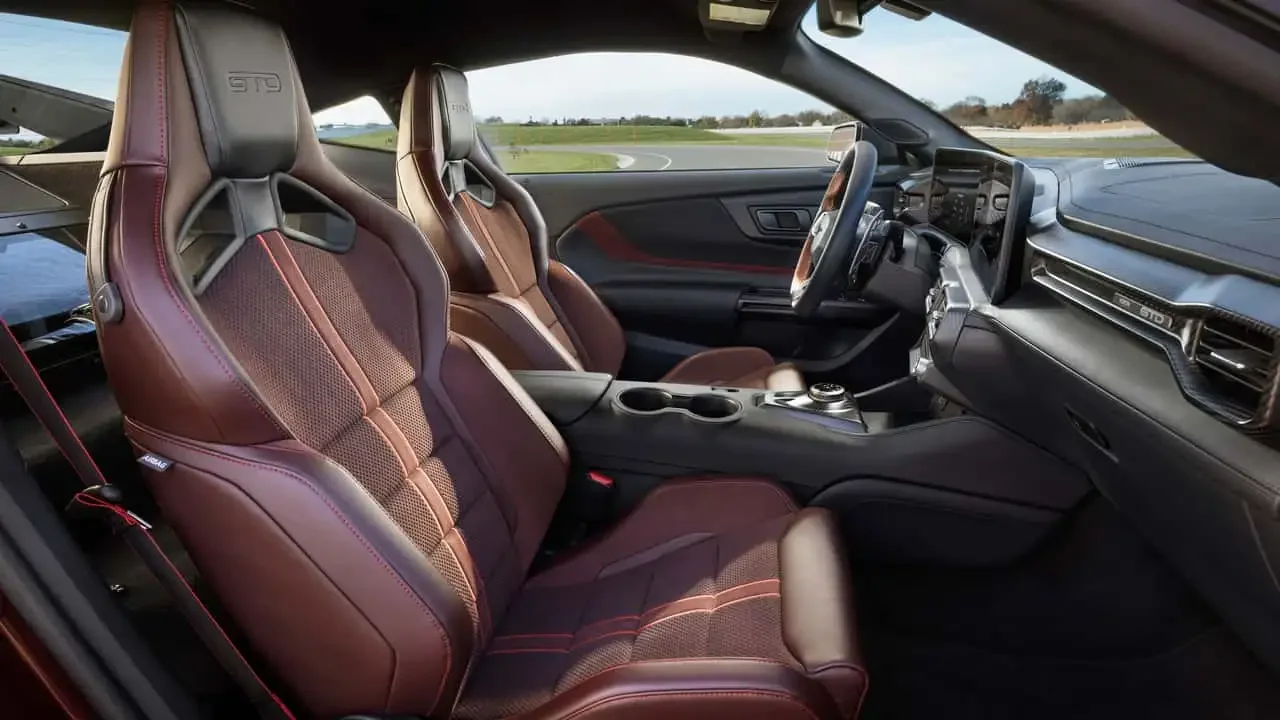
Image: Ford Motor Company via Motor1. The source asset was locally converted to WebP for editorial publication; rights remain with Ford.
The familiar 5.2-litre V8 remains
The dry-sump, supercharged 5.2-litre V8 is unchanged for the 1901. Ford quotes 815 hp under the SAE standard, equivalent to 826 PS, at 7,400 rpm, and 900 Nm at 4,800 rpm. An eight-speed dual-clutch transaxle sits at the rear, a layout chosen to assist weight distribution. The dry-sump system is intended to maintain lubrication during sustained high-load cornering, and the engine's redline reaches 7,650 rpm.
Official maximum speed remains 325 km/h. Ford also points to GTD's Nürburgring record, but the relevant version must be named carefully. A standard Mustang GTD first became the first production car from an American brand to lap the Nordschleife in under seven minutes. The later 6:40.835 time belongs to Mustang GTD Competition, with changes to power, aerodynamics, tyres and weight. It is not a lap time Ford has claimed for the GTD 1901.
Other 2028 changes include newly available painted racing stripes, a revised Liquid Carbon livery with teal accents, and Incognito Green and Teal Tonic paint choices replacing Sage Green and Blue Metallic. The 1901 is the strongest historical narrative in the update, but not the entire model-year programme.
Orders, deliveries and the missing price
Ford told US media that ordering is due to begin in December, with deliveries expected from the second quarter of 2027. It has not published a 1901 price or confirmed allocation for every region. In an earlier European application window, Ford expected only 500 GTDs for Europe, a useful indication of scarcity but not proof that 500 examples of this particular edition will be offered.
An application, a dealer allocation and a confirmed order are different stages. Taxes, homologation and final specification can also vary by country. Until Ford releases the commercial details, the defensible description is narrow: GTD 1901 is a historically themed 2028 configuration with standard Performance Package, a distinctive cabin and the established 815-hp drivetrain. It should not be presented as a new mechanical flagship simply because its colours tell Ford's oldest racing story.