
There is no universal number of countries involved in building a modern car. A vehicle may be assembled in one country, use an engine, transmission or battery made in another, and rely on supplier modules whose raw materials and subcomponents have crossed several more borders. The answer changes with the model, powertrain, factory, production year and destination market.
The question raised by Motor1 is useful because it separates two ideas that are often treated as identical: where the vehicle is finally assembled and where the vehicle’s complete industrial content comes from. A badge that says “made in Germany”, “made in Romania” or “made in China” normally identifies a manufacturing stage and the relevant rules of origin. It does not mean every part was made in the same country.
Final assembly is only one stage
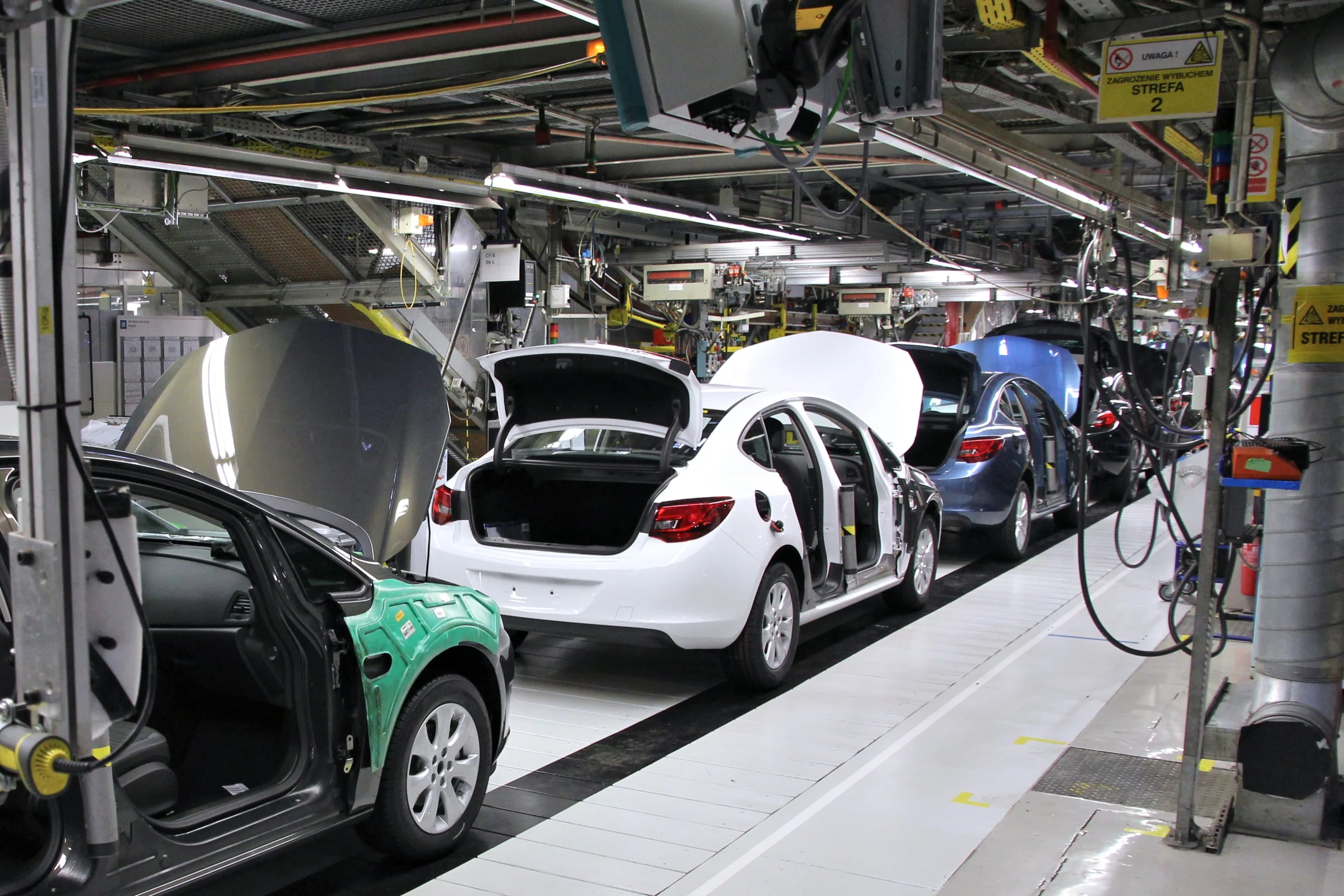
At an automotive plant, body panels may be stamped or welded, the body is painted, and the vehicle moves through stations where the powertrain, wiring, interior, glazing and safety systems are installed. The plant may make some parts itself, but it also receives complete modules from Tier 1 suppliers. Those suppliers buy materials and subcomponents from Tier 2 and Tier 3 companies.
As a result, the country listed on a vehicle document identifies the final assembly location or the place where a meaningful share of value was created. It is not a full map of the supply chain. The Federal Reserve Bank of Chicago notes that an automaker’s headquarters tells very little about where the parts in a vehicle came from. In the United States, the required vehicle label can list the assembly plant, the origin of the engine, transmission or battery and the share of content from the United States and Canada.
The same principle applies to European production, even though the paperwork and origin rules differ. A vehicle assembled in the European Union can include systems produced in several member states and imported materials or electronics. A model built in two plants can also have different supplier mixes depending on the market it serves.
A production network spread across continents
OICA recorded 96,383,650 motor vehicles produced worldwide in 2025, compared with 92,723,280 in 2024. Its regional totals for 2025 were 59,210,250 vehicles in Asia-Oceania, 17,201,525 in Europe, 18,742,843 in the Americas and 1,229,032 in Africa. These are production totals, not a count of the countries involved in each individual vehicle, but they show how widely distributed the industry is.
In the same OICA dataset, China produced 34,530,738 vehicles in 2025, Japan 8,410,232, India 6,490,810, South Korea 4,102,200, Germany 4,148,836, Spain 2,274,026 and Romania 545,510. The United States produced 10,243,844 vehicles and Mexico 4,092,448. OICA’s table covers cars and commercial vehicles according to its reporting method, so comparisons should remain within the same category.
A country can therefore be both a vehicle producer and a supplier to factories elsewhere. Germany may provide machinery or vehicle systems to a Central European plant, while that plant receives semiconductors from Asia, wiring from North Africa and battery materials processed in other markets. Without a supplier list for a specific model and production year, claiming an exact country count would be misleading.
Electric vehicles add another layer
An internal-combustion vehicle depends on mining, steel, aluminium, plastics, rubber, electronics, an engine, a transmission and exhaust systems. An electric vehicle removes some of those modules but adds a traction battery, cells, cathode and anode materials, power electronics and an electric motor.
The International Energy Agency describes battery supply chains as geographically concentrated, especially in processing and cell manufacturing. That does not mean a battery comes entirely from one country. Lithium, nickel, cobalt, graphite and other materials may be mined in different places, processed elsewhere and assembled into cells or packs before reaching a vehicle plant.
The European Commission has separately studied interdependencies in the automotive industry and exposure to suppliers outside the European Union. Its analysis points to the growing importance of electronics and battery-related supply chains as vehicles become more electrified. A car assembled in Europe can therefore contain strategically important components made in Asia or North America.
The battery also makes country-of-origin claims more difficult for consumers. A pack may be assembled near the vehicle plant while the cells come from another region. The cells may depend on processed materials from several countries, and the machinery used in the cell plant may have its own international supply chain. These stages are normally invisible in a simple “assembled in” statement.
Why automakers source globally
Global suppliers are used for cost, capacity, specialist expertise, access to materials and proximity to the assembly plant. Some companies operate dedicated factories that serve multiple carmakers and several vehicle programmes. A braking, seating, display or sensor supplier can have plants on different continents, with products adapted to each market’s safety or technical regulations.
A longer supply chain is not automatically good or bad. It can lower costs and provide access to specialist skills, but it also increases exposure to port closures, trade disputes, natural disasters, semiconductor shortages and export controls. The pandemic showed how a disruption at one supplier could stop a vehicle line even when the final plant and customer demand were unchanged.
Manufacturers respond with multiple suppliers, larger inventories, regional sourcing and common parts shared by several models. Localisation does not mean complete independence, however. A component made in Europe may still rely on imported raw materials, chips, production equipment or subassemblies.
What a buyer can actually verify
For a specific car, the strongest evidence comes from the manufacturer’s documentation, the compliance label, the certificate of origin, the VIN and the data for the exact powertrain and market. The engine, battery and transmission may have different origins from the body or final assembly. A model built in two plants may also have different supplier content depending on destination.
For European buyers, the country printed in registration or conformity documents should not be treated as a complete list of the countries in the industrial chain. It helps identify the production location and supports customs or compliance processes, but it does not answer every question about minerals, semiconductors or individual subcomponents.
The most accurate conclusion is therefore not that a car is built in a fixed number of countries. Some models have a relatively regional supply chain; others depend on suppliers spread across several continents. The exact count can only be calculated for a named model, configuration, plant and production year. In general terms, a modern car is a global product finished at one plant but created through a much wider industrial network.


