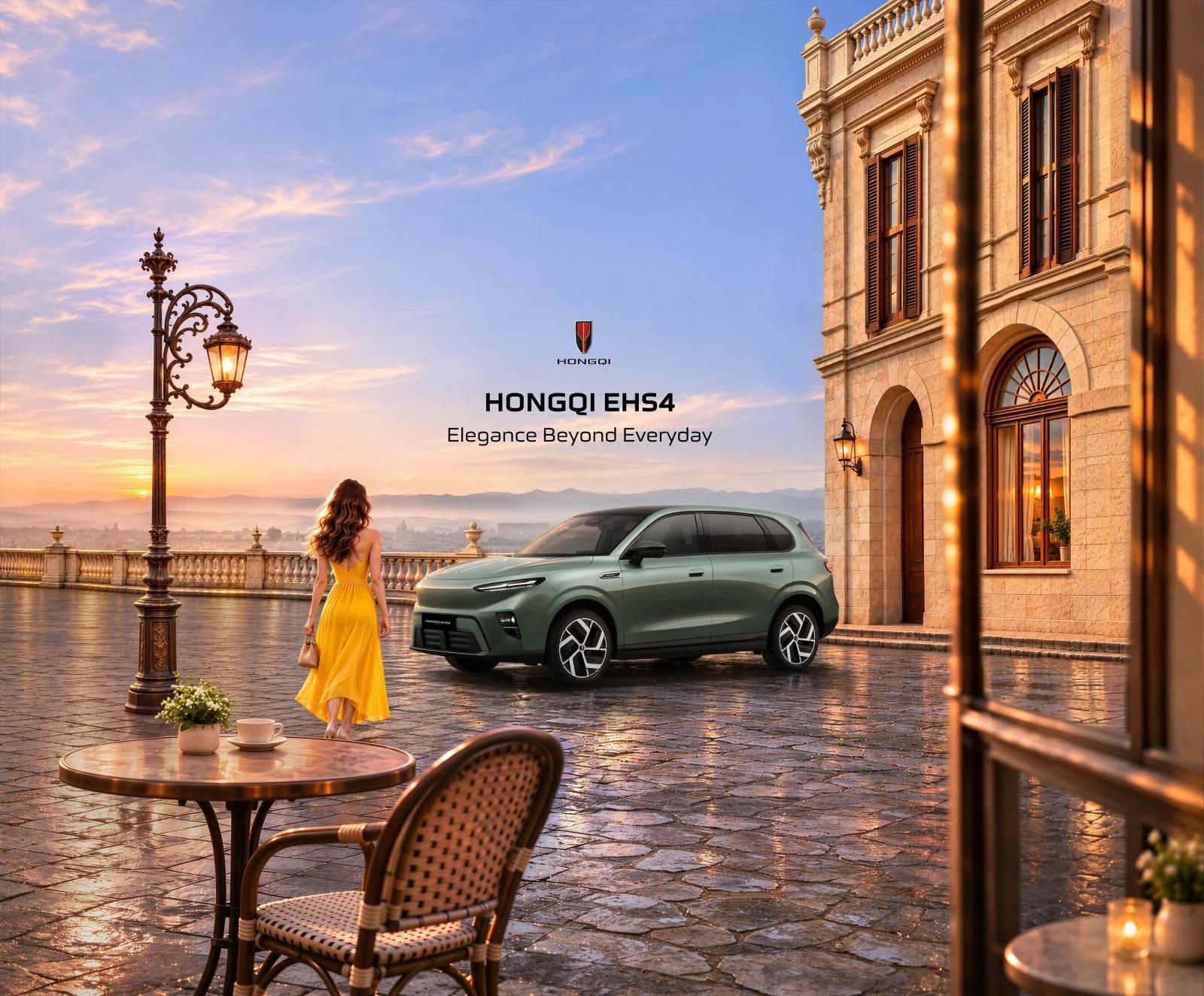
Hongqi has launched the electric EHS4 in Italy from €32,900, using a Leapmotor platform according to Reuters. The SUV made its European debut in Venice on 16 November 2026 with a manufacturer claim of up to 470 km of range and an approximately 20-minute fast-charging time. Neither figure can yet be treated as a complete European specification because Hongqi’s release does not identify the range test cycle, battery capacity, charging window or peak DC power.
The EHS4 is the first vehicle Hongqi describes as specifically developed around European customer requirements. It is also a practical example of the March 2025 engineering agreement between state-owned FAW Group, which owns Hongqi, and Leapmotor. A range-extender version is due in 2027, although no technical data or market list has been announced for it.
What Hongqi has confirmed
The launch took place at the Scuola Grande di Santa Maria della Misericordia in Venice. Hongqi says the EHS4 has seven airbags, driver-assistance functions and an interior space-utilisation ratio of 87.4%. The company does not explain how it calculated that percentage, so it cannot be compared directly with another manufacturer’s packaging claim.
The brand’s Munich Advanced Design Centre contributed to the vehicle. The launch car wears a colour called Celadon, while the cabin includes a rotary “Crystal Control Knob”. These are identifiable product details, but the first release leaves out several figures buyers normally need: external dimensions, kerb weight, boot volume, usable battery capacity, motor output, WLTP consumption and market-by-market standard equipment.
Reuters reports an Italian starting price of €32,900 and says a range-extender model will follow next year. The combustion engine in a range-extender generates electricity rather than necessarily driving the wheels, but Hongqi has not described the EHS4 system. Its engine size, fuel tank, electric range and total range therefore remain unknown.
The Italian price should not be presented as a single European price. Tax, equipment, freight, warranty and dealer arrangements differ between markets. Hongqi has not announced a Romanian launch, importer or local price list, and the Venice event does not by itself establish availability across the European Union.
The relationship with Leapmotor B10
Reuters identifies the EHS4 as based on a Leapmotor platform. The corporate link is documented. FAW Group and Leapmotor signed a memorandum on 3 March 2025 to jointly develop new-energy passenger vehicles and components. Leapmotor later told the Hong Kong exchange that their first jointly developed vehicle project had started. In December 2025, FAW’s investment arm agreed to subscribe 3.74 billion yuan in Leapmotor shares.
Leapmotor’s relevant European product is the B10, a C-segment electric SUV on the LEAP3.5 architecture. The official B10 specification lists a length of 4,515 mm, width of 1,885 mm, height of 1,655 mm and wheelbase of 2,735 mm. Its rear motor produces 218 hp and 240 Nm. European buyers can choose 56.2 kWh and 67.1 kWh batteries, officially rated at up to 361 km and 434 km WLTP respectively.
Those numbers belong to the B10, not automatically to the EHS4. Sharing a platform does not prove identical battery modules, motor calibration, body structure, suspension tune or safety equipment. Hongqi’s higher 470 km claim could involve different hardware, different calibration or a different test cycle. The launch material does not provide enough information to choose between those explanations.
Leapmotor quotes up to 168 kW DC charging for the B10 and a 30–80% time of 20 minutes. Hongqi uses a similar approximate duration for the EHS4 but does not state the percentage window or power. Until a homologation sheet and charging curve appear, the two 20-minute claims are not directly comparable.
European manufacturing is a plan, not an allocation
Xiao Xiao, FAW’s head of international business and the executive overseeing Hongqi’s European expansion, told Reuters that localisation, including production, is a strategic priority. Hongqi prefers to work with existing European factories rather than buy or build its own plant.
Stellantis and Volkswagen were named among possible partners, but the positions are not symmetrical. A Volkswagen Group China spokesperson told Reuters that there were no talks between Volkswagen and FAW about producing cars in Europe. Xiao said Hongqi was evaluating several partners and declined to identify sites, model allocations, investment or timing.
Stellantis already has an industrial and distribution relationship with Leapmotor. Leapmotor’s March 2026 filing said a Spanish CKD project for B10 and B05 had been approved, with B10 pilot production under way. That does not confirm EHS4 production at the same location. Hongqi requires a separate agreement, and none has been announced.
Local assembly could reduce logistics exposure and change how tariffs affect the car. The European Commission imposed definitive countervailing duties on China-built battery-electric cars for five years from October 2024. Rates range from 7.8% to 35.3%, with 20.7% assigned to other cooperating companies. The exact treatment of a vehicle depends on the exporter and customs documentation; Hongqi has not broken down how duties are reflected in its Italian price.
Ten models are targeted for 2027
Hongqi says it operates across 27 European countries and regions through 90 dealerships and wants more than 150 outlets by the end of 2027. The product target is ten European models in 2027 and 11 by 2028, spanning saloons, SUVs and MPVs with combustion, hybrid, battery-electric and range-extender powertrains.
These are company targets rather than confirmed launch dates for every country. Xiao did not provide sales or market-share goals. That restraint matters because dealer count and model count do not show how many vehicles will be registered, how quickly spare parts will move or whether service coverage will be consistent.
For the EHS4, the next useful documents are the European type-approval data, full price lists, warranty conditions and a confirmed production decision. Until they arrive, the strongest verified comparison with the Leapmotor B10 is the shared-platform report and the separate published figures. Treating every B10 specification as an EHS4 specification would fill genuine gaps with assumptions.
Sources
- Hongqi: official EHS4 Venice debut release
- Reuters via Euronext: Hongqi’s European production search and Italian price
- Leapmotor / Stellantis Media: official European B10 specifications
- Leapmotor HKEX filing: FAW cooperation and industrial projects
- European Commission: countervailing duties on China-built BEVs