Kia has confirmed a B-segment electric hatchback for Europe in 2027, describing the project internally as the “B-HB EV” and as its first software-defined vehicle. The company has not confirmed the EV1 production name, a price, battery capacity, range, dimensions or final design. The dark silhouette in Kia’s own investor presentation is a line-up marker, not a reveal photograph.
The distinction matters because the latest reports mix an official model programme with details that remain predictions. At its CEO Investor Day on 9 April 2026, Kia said it would introduce its first SDV B-segment hatchback in Europe and complete development of its first SDV by the end of 2027. That establishes the vehicle’s segment, body style, market and development window. It does not establish when orders or customer deliveries will begin.
What Kia has actually announced
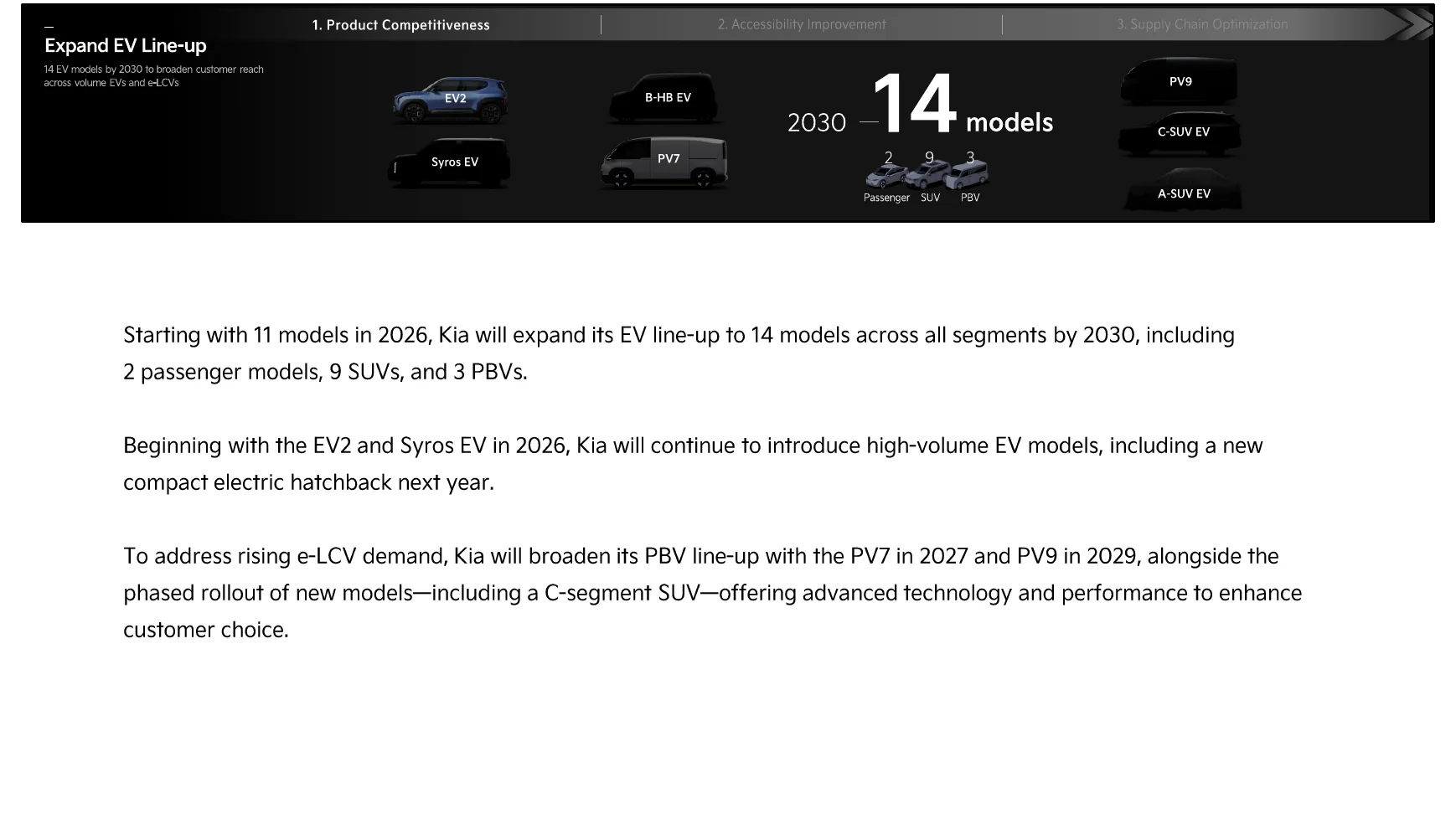
Page 53 of Kia’s investor presentation places the B-HB EV beside the EV2, Syros EV and PV7. The accompanying text says a new compact electric hatchback is coming “next year”, meaning 2027 from the document’s 2026 date. A regional strategy table separately identifies it as Kia’s first SDV B-segment hatchback for Europe.
Kia has published no exterior dimensions, wheelbase, boot volume or kerb weight. There are no official figures for motor output, acceleration, usable battery capacity, WLTP range, energy consumption or DC charging. The company has not shown the cabin. It has also not used EV1 as the model name in either the newsroom release or the investor slides.
EV1 fits the numerical pattern of Kia’s dedicated electric range, which currently runs through names such as EV2, EV3, EV4, EV5, EV6 and EV9. That logic makes the badge credible as a media shorthand, but it does not turn it into a manufacturer announcement. Until Kia publishes the name, searches for “Kia EV1” lead to a vehicle that officially remains B-HB EV.
The same caution applies to appearance. Kia’s slide shows a blacked-out profile with no usable detail for lamps, surfaces or interior layout. Magazine illustrations are independently created interpretations rather than official design material. They cannot verify that the production car will look like a smaller EV2 or EV3.
This is separate from the Kia EV2
Kia unveiled the EV2 at the Brussels Motor Show in January 2026. It is officially a B-segment SUV, with an upright body, sliding rear bench and two battery choices. Kia quotes anticipated WLTP range of up to 317 km from the 42.2 kWh battery and 448 km from the 61.0 kWh pack. The stated 10–80% charging times are 29 and 30 minutes respectively.
Those figures provide useful scale for Kia’s small-EV strategy, but they do not describe the 2027 hatchback. B-HB identifies a different body type, and Kia’s 2030 product plan counts two electric passenger cars, nine SUVs and three PBVs. The compact hatchback is part of the effort to add conventional car shapes alongside a heavily SUV-led EV range.
No public document says the B-HB EV will share the EV2’s packs, motor or charging hardware. Kia is developing a next-generation EV platform and says it is targeting better performance and cost competitiveness across future products. The CEO Investor Day release lists potential platform-level improvements, including higher battery capacity and energy density, but it does not allocate those figures to this hatchback. Converting broad technology targets into a supposed EV1 specification would be misleading.
What “software-defined vehicle” does and does not promise
A software-defined vehicle places more vehicle functions under software control and is designed to evolve through updates after production. It can support new services, revised interfaces and changes to control functions without replacing physical components. The label alone says nothing about battery size, ride quality or price, and it is not a synonym for autonomous driving.
Kia’s timeline separates the two. The company plans to complete its first SDV by the end of 2027, while Level 2++ assisted-driving technology is scheduled for early 2029. Kia also discusses sensor and system standardisation, a partnership with NVIDIA and in-house end-to-end driving models based on vehicle data. It has not yet named the B-HB EV’s processors, operating system, update-support period or paid software features.
That missing detail will matter to buyers. A long support commitment and transparent update policy can be more valuable than a long feature list at launch; paid functions and regional restrictions can have the opposite effect. At present, there is no basis for saying which approach Kia will take with this car.
A 2027 programme is not a firm delivery date
Kia uses two related but not identical milestones: introducing a new compact electric hatchback in 2027 and completing development of its first SDV by the end of 2027. The wording allows for a concept, reveal or production announcement during the year. It does not confirm simultaneous sales across Europe, and homologation, production and national launches may follow separate schedules.
The factory is also unconfirmed. Kia’s current strategy explicitly assigns European production to EV2 and EV4, but it does not allocate B-HB EV to a named plant. Kia builds European models in Žilina, Slovakia, yet that fact is not evidence that this project will be assembled there. A site needs a separate company announcement.
Kia’s regional targets explain why the programme exists. The manufacturer wants EVs to rise from 23% of its European sales in 2025 to 66% in 2030, when it targets 746,000 total vehicles in the region. A hatchback below the EV4 and distinct from the EV2 SUV gives Kia another route into high-volume European segments. Whether it can do that at scale depends on the figures still missing: price, usable range, interior space, efficiency and charging performance.
There is no confirmed Romanian price or launch schedule, and there is no official pan-European starting price. Any figure circulating before a market price list should be treated as a target or report, not an offer. Tax, standard equipment, warranty and battery choice can produce materially different national prices.
The next reliable evidence will be an official concept, development prototype, type-approval document or Kia specification sheet. Until then, the accurate description is Kia B-segment electric hatchback or B-HB EV. “EV1” remains an unconfirmed name attached to an otherwise confirmed 2027 programme.