Lamborghini will reveal a new model in Los Angeles on November 18, 2026, at 8:00 p.m. The manufacturer's teaser gives the date, time and city but does not identify the car. A separate official release narrows the field: the first derivative of the Temerario family is due for its world premiere that week. Calling it the Temerario Spyder remains a well-supported expectation rather than an announced model name.
What Lamborghini has actually announced
The public message says “Save the date” and lists November 18, 8:00 p.m., Los Angeles. Interpreted as local California time, that corresponds to 4:00 a.m. GMT and 6:00 a.m. in Romania on November 19. Lamborghini has not yet published an order date, production schedule, price or market rollout for the unnamed model.
The firmer product link appears in Lamborghini's November 11 release for the optional Akrapovič titanium exhaust. That document says the system will be introduced on “the first derivative of the Temerario family,” scheduled to make its world premiere the following week. It confirms that the reveal concerns a Temerario derivative. It does not use the word Spyder, describe a convertible roof or publish any derivative-specific performance figure.
That distinction is more than cautious wording. Before the reveal, the roof mechanism, structural changes, kerb or dry weight and aerodynamic figures are unknown. The teaser can support an informed expectation, but it cannot serve as the technical specification for the production car.
Why a Temerario Spyder is the leading explanation
An open version is the most conventional first body derivative for Lamborghini's smaller series-production supercar. The company also prepared the ground with two official heritage stories in early November: one traced the origin of Lamborghini Spyders, while another marked 50 years since the Silhouette, its first series-production open-top V8 model.
The wording in the exhaust announcement points to a proper family derivative rather than a colour package for the coupé. A Spyder would fit that description because it requires a different upper structure, roof system and aerodynamic development. Even so, Lamborghini may reserve the production name and exact roof concept for the presentation. Claims of a fabric roof, a 17-second operating cycle or a particular weight increase are not supported by the teaser.
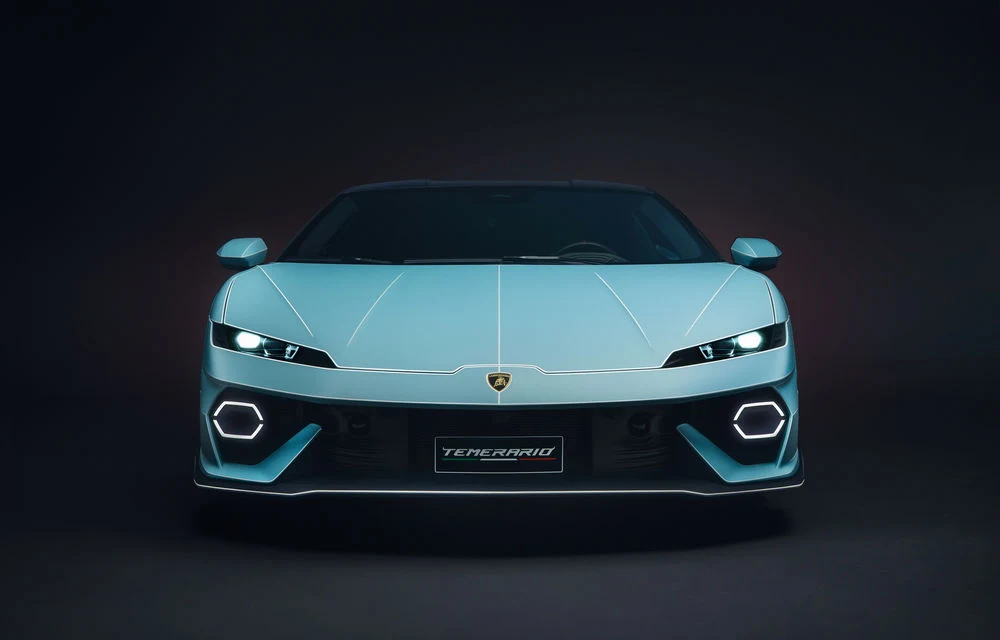
The selected image shows a blue Temerario head-on, with the hexagonal daytime-running-light graphics illuminated. Its roof area is deliberately dark. This angle does not show whether the panel is fixed, removable or retractable, so the photograph should be treated as a branded clue, not visual confirmation of the body style.
The Temerario coupé establishes the baseline
Until Lamborghini publishes a separate data sheet, the existing coupé provides the only official technical benchmark. Its plug-in hybrid system combines a 3,995.2 cc twin-turbo V8 with three electric motors. Combined output is 677 kW, or 920 CV. The combustion engine alone produces 800 CV between 9,000 and 9,750 rpm and 730 Nm from 4,000 to 7,000 rpm, with a 10,000 rpm ceiling.
An eight-speed dual-clutch transmission and electric front axle provide all-wheel drive. Lamborghini quotes 0–100 km/h in 2.7 seconds and a 343 km/h top speed for the coupé. Those numbers cannot be assigned to the new derivative in advance. An open car generally needs structural reinforcement around the sills, floor and windscreen area, while a roof mechanism adds hardware and can alter cooling and airflow.
The 2026 official brochure lists weighted WLTP consumption for the coupé at 11.2 l/100 km plus 4.3 kWh/100 km, with 272 g/km of CO₂. With the traction battery discharged, the stated combined fuel consumption is 14.0 l/100 km. A different body configuration will require its own homologated values, even if the basic powertrain is shared.
One confirmed option for the new derivative
Lamborghini has already identified one piece of equipment that will cross over. The Akrapovič titanium exhaust introduced for the Temerario Coupé will also be available on the first derivative. The assembly weighs 11.40 kg, which Lamborghini says is 12 percent less than the standard exhaust.
Its construction uses high-grade titanium alloys, larger-diameter pipework, dedicated manifolds and a revised silencer layout. Lamborghini says its noise, vibration and harshness engineers tuned selected frequencies to move from deeper notes at low engine speeds to a sharper character near 10,000 rpm. The option belongs to the Accessori Originali catalogue and is also offered as a retrofit for existing coupés.
The compatibility confirms continuity with the high-revving V8 architecture. It does not prove that the derivative will retain the coupé's full 920 CV system output without revision. The launch data must establish the final calibration and any changes associated with packaging or cooling.
A V8 open-top line stretching back to 1976
If the car is the Temerario Spyder, it will revive a compact open-top V8 formula absent from Lamborghini's range since the Jalpa ended production in 1988. The earlier Silhouette debuted at the 1976 Geneva Motor Show as the company's first series-production open car. It combined a transverse mid-mounted 3.0-litre V8 with a removable targa panel, and just over 50 examples were built through 1979.
The Jalpa developed the concept from 1981 until 1988. Lamborghini later returned to a smaller open supercar with the Gallardo Spyder in 2005, but that model used a V10 and an automatic fabric roof. The Huracán Spyder retained the V10 formula, while open Diablo, Murciélago, Aventador and Revuelto models occupied the V12 line.
A new Temerario Spyder would therefore combine an open body with a V8 again, this time within a plug-in hybrid architecture. That historical connection says nothing about whether Lamborghini will choose a fabric hood or removable hard panel in 2026. Both names and mechanisms remain matters for the launch.
The questions the reveal must answer
The official name and roof design come first. Beyond those headline points, the useful figures will be the derivative's mass, torsional-rigidity strategy, luggage capacity, roof operating time and whether the mechanism can be used while the car is moving. The correct performance comparison is against the coupé's official 2.7-second 0–100 km/h time and 343 km/h maximum.
Price and European availability are also unknown. Lamborghini's teaser image cannot answer them, and the coupé's data should not be recycled as if it already described the derivative. Until November 18, the precise conclusion is limited: Lamborghini is revealing the first Temerario derivative, while a Temerario Spyder is the strongest explanation, not yet a confirmed badge.
Sources
- Automobili Lamborghini — official website and reveal teaser
- Automobili Lamborghini — Akrapovič exhaust and first Temerario derivative
- Automobili Lamborghini — official Temerario Coupé specifications
- Automobili Lamborghini — the origins of its Spyder models
- Automobili Lamborghini — Silhouette and the first series-production open V8