
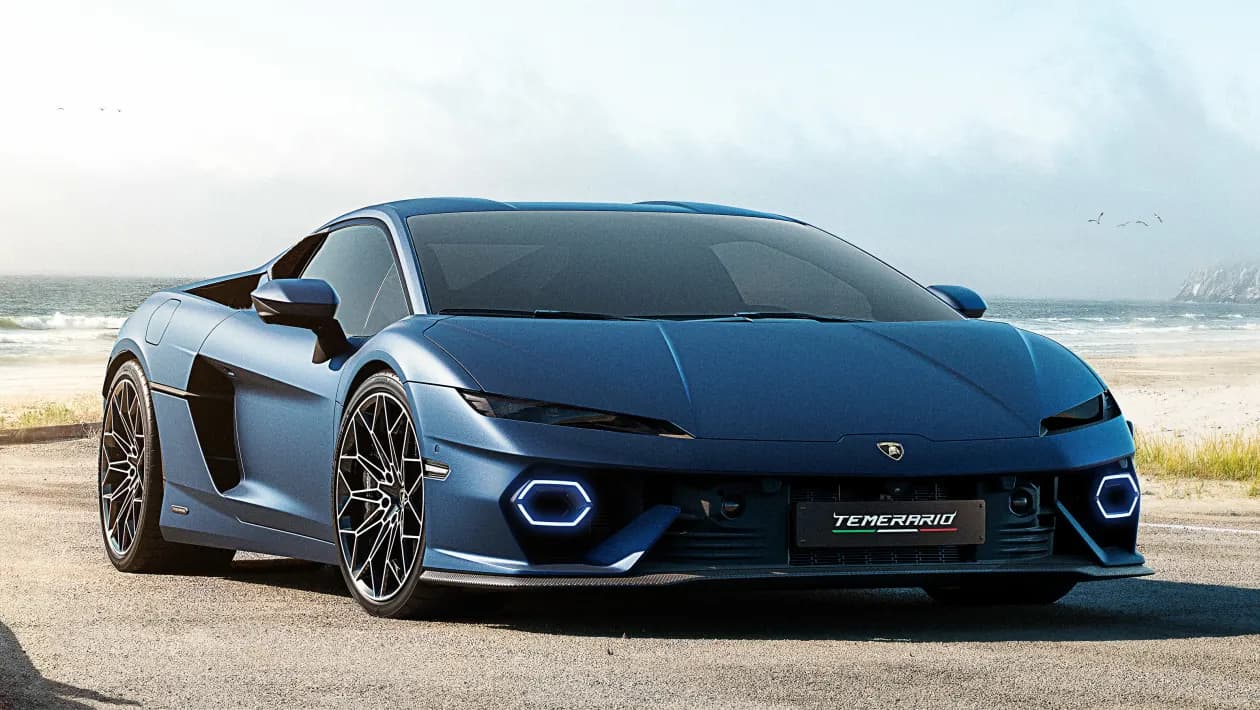
Lamborghini believes that outright speed is no longer enough to define a supercar. Paolo Racchetti, the company’s Temerario model line director, told CarExpert in Milan, in comments reported by Motor1, that performance remains necessary but must be accompanied by sound, emotion and convincing dynamic behaviour.
The point matters because electrification has made very strong acceleration easier to achieve. Electric motors deliver torque immediately, while hybrid systems can combine that response with the character of a combustion engine. Lamborghini is not stepping away from performance. It is arguing that the number at the end of a timed acceleration run is only one part of what a customer experiences.
Performance is still the entry ticket
Racchetti’s position is not that speed has become irrelevant. A Lamborghini still has to be fast. The distinction is that acceleration, top speed and power no longer explain the whole product. A supercar must also communicate what the driver is doing and make its performance usable, predictable and memorable on a road or circuit.
The Temerario provides a clear technical example. Lamborghini pairs a newly developed 4.0-litre twin-turbo V8 with three electric motors and an eight-speed dual-clutch transmission. The official combined output is 920 CV, and Lamborghini quotes 0–100 km/h in 2.7 seconds. The V8 can rev to 10,000 rpm, an unusually high figure for a modern production engine.
Those figures satisfy the traditional performance brief. They do not, by themselves, explain the character of the car. The hybrid system can influence throttle response, torque delivery and the way the car exits a corner. The driver’s impression depends on how those systems work together, not only on their maximum combined output.
Why sound and feedback matter
Lamborghini’s official Temerario material describes different sound experiences across the driving modes and the possibility of quiet electric running in the urban-focused Città mode. In the more performance-oriented modes, the V8’s rising revs and engine note become part of the interaction. The company treats sound as part of the car’s communication with its driver rather than as a by-product that can simply be hidden.
That approach is relevant in a category where customers are not buying only a measured result. Steering accuracy, brake feel, the response of the accelerator, gearshift timing and the information coming through the seat all shape whether a car feels engaging. A vehicle can be faster on paper and still feel less convincing if its responses are difficult to read or excessively filtered.
There is no confirmed return to a manual gearbox. The statement attributed to Racchetti says some customers continue to ask for one, but Lamborghini is developing its current architectures in another direction. The Temerario uses a dual-clutch automatic transmission, while the electric motors add more opportunities to control traction and torque in real time.
Lamborghini’s current range is hybrid
The comments should also be read alongside Lamborghini’s product strategy. The Revuelto, Temerario and Urus SE all use hybrid powertrains. Electrification is therefore no longer an isolated technology experiment for the brand; it is part of the current model range.
The Temerario is Lamborghini’s second high-performance electrified vehicle after the Revuelto. Its twin-turbo V8 works with electric motors that can add immediate response and allow lower-emission operation in appropriate conditions. Lamborghini presents this combination as a way to meet performance expectations while adapting to tighter environmental requirements.
The future model question remains less settled. Lamborghini introduced the Lanzador as an electric 2+2 Gran Turismo concept and as a preview of a fourth model. The official material available for the concept describes an electric vehicle. Motor1 reports that the production plan may move towards a plug-in hybrid powertrain, but Lamborghini has not confirmed that change in the official material used here. The final architecture and timing should therefore be treated as unconfirmed.
A broader definition of supercar performance
Racchetti’s argument points to a shift from chasing one headline number to shaping the quality of the entire drive. Manufacturers can now deliver extremely rapid acceleration, but they still need to decide how a supercar retains a recognisable identity when batteries, software and electric motors change familiar sensations.
For Lamborghini, the answer is to combine hybrid performance with a high-revving engine, an engineered sound experience, selectable driving modes and chassis behaviour aimed at the driver. Speed remains part of the promise, but it no longer carries the promise by itself. Until the company confirms the next model’s final powertrain and specifications, the precise balance between electric efficiency and mechanical theatre remains open.


