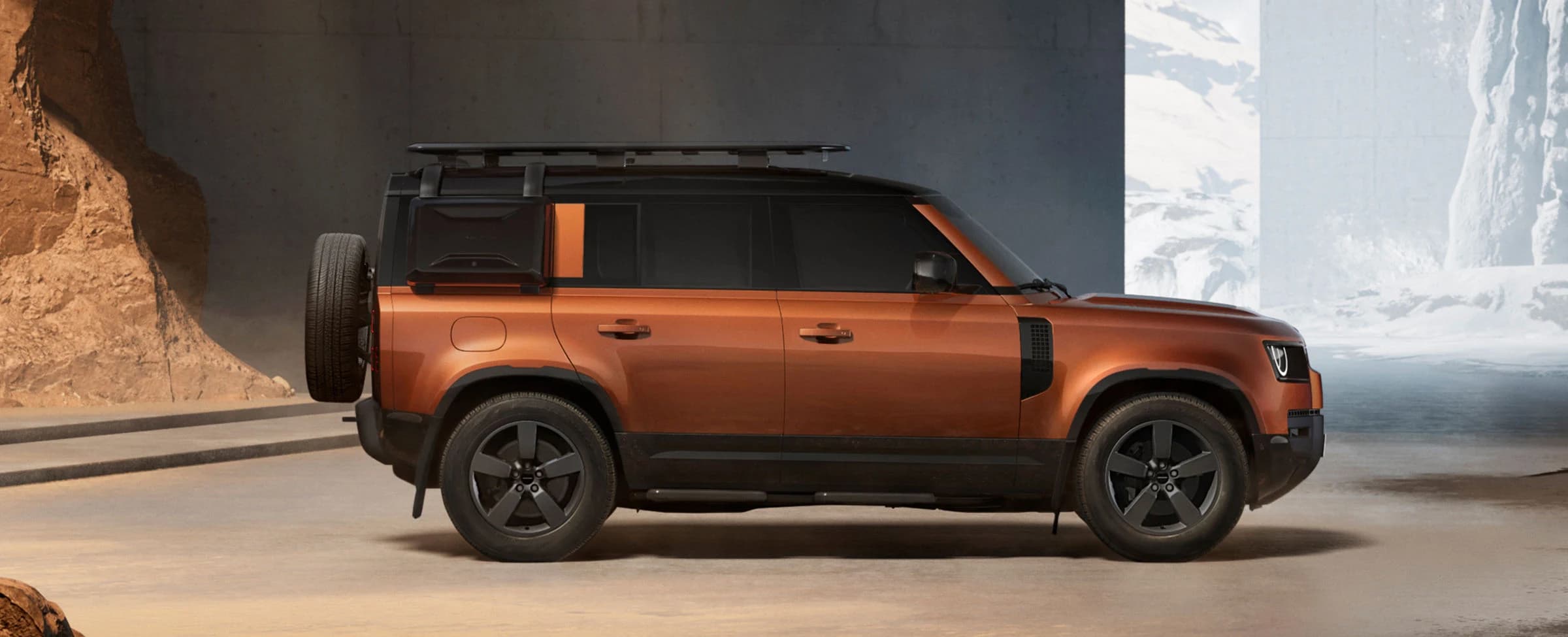
Land Rover has found an unusual way to make the Defender easier to place in a city parking space: remove the spare wheel from the rear door. The Edition 53 accessory kit can be specified for the Defender 90, 110 and 130, apart from the Defender OCTA. It does not create a new body shell or a shorter wheelbase. Instead, it removes the externally mounted spare wheel and its carrier, reducing the vehicle’s overall length by 26 cm.
A city-oriented change for a recognisable feature
The spare wheel has long been part of the Defender’s visual identity. It also has a clear practical role when the vehicle is used away from paved roads. Edition 53 asks owners to decide which of those roles matters more in their regular use. Without the wheel on the door, the rear profile becomes cleaner and the total vehicle length is reduced.
Land Rover connects the idea with the Series I Station Wagon from 1953. That early vehicle used a side-opening rear door without a spare wheel attached to it. The modern Edition 53 kit borrows that visual reference, while the company presents the result as a way to make the Defender more convenient in urban driving.
The 26 cm figure refers to the complete vehicle with the spare wheel mounted. It should not be read as a change to the Defender’s wheelbase or as a 26 cm reduction in the metal body. The basic dimensions and the driving character of the chosen Defender 90, 110 or 130 remain those of the regular model.
The wheel is removed, not abandoned
Choosing the option does not mean that the owner permanently loses the spare wheel. Land Rover says that the wheel can be stored and installed again when required. Removal and refitting are handled by an authorised Defender partner. On the German Land Rover website, the company says the wheel can be stored with the preferred partner or at home and can be refitted later.
That arrangement matters because a spare wheel is more useful on a remote trail than in a supermarket car park. On the other hand, storing it away from the vehicle means that it is not available immediately if a tyre is damaged during a journey. A repair kit, compressor or roadside assistance may cover some situations, but they do not replace a full-size spare wheel in every off-road scenario.
Land Rover also points to accessory compatibility. With the spare wheel removed, owners can use important adventure equipment such as a bicycle carrier without having to work around the wheel mounted on the rear door. The exact fit still depends on the carrier and vehicle specification, so the accessory list should be checked with a retailer.
Available across three Defender body styles
Edition 53 is listed for the Defender 90, Defender 110 and Defender 130, while the Defender OCTA is excluded. The option therefore covers the three main body lengths in the family, but it does not turn any of them into a small SUV. The Defender 110, for example, remains a large vehicle with a high seating position and substantial exterior dimensions even after the spare wheel is removed.
The practical benefit is concentrated at the rear. A driver approaching a wall, barrier or another vehicle gains a smaller overhang to account for when reversing. The change may also make the side-hinged rear door easier to use in a narrow space, depending on the position of the obstacle. It does not remove the need to account for the Defender’s width, turning circle or tall body.
Land Rover’s current Defender 110 information lists up to seven seats and as much as 2,279 litres of load volume in the relevant configuration. Those figures belong to the broader Defender range and should not be interpreted as an Edition 53-specific measurement. The accessory changes the outside rear arrangement, not the interior architecture described in the vehicle specifications.
The trade-off is clearer for off-road drivers
The option makes the most sense for an owner who spends much of the week in town and wants the Defender’s design without the spare wheel dominating the rear door. A shorter total footprint can be useful in tight parking spaces, although the SUV remains large by city-car standards. The cleaner rear view may also help in some manoeuvres.
For drivers who regularly travel far from tyre services, the trade-off is harder to ignore. The spare wheel is no longer mounted on the vehicle and must be retrieved from storage or carried separately if it is needed. The fact that it can be refitted is useful, but it also means that the owner has to plan the vehicle’s configuration around the next trip.
The option’s price and availability are market-specific. Land Rover’s configurator pages state that features can vary by model, powertrain and market, and the official pages consulted do not publish a Romanian price for the Edition 53 kit. Buyers should therefore confirm the exact specification, storage arrangement and accessory compatibility with an authorised retailer.
A design reference with a practical consequence
Edition 53 is not a new Defender generation and it is not a mechanical upgrade. It is an accessory choice built around one visible component. Its appeal comes from combining a 1953 design reference with a measurable urban benefit: 26 cm less total length when the spare wheel is removed.
The decision is consequently specific to the owner’s routine. For urban use and frequent parking, the missing wheel can make the rear of the Defender easier to manage. For long-distance off-road travel, keeping the wheel available on the vehicle may remain the more sensible arrangement. The same Defender can support both uses, but the owner has to choose which one receives priority.