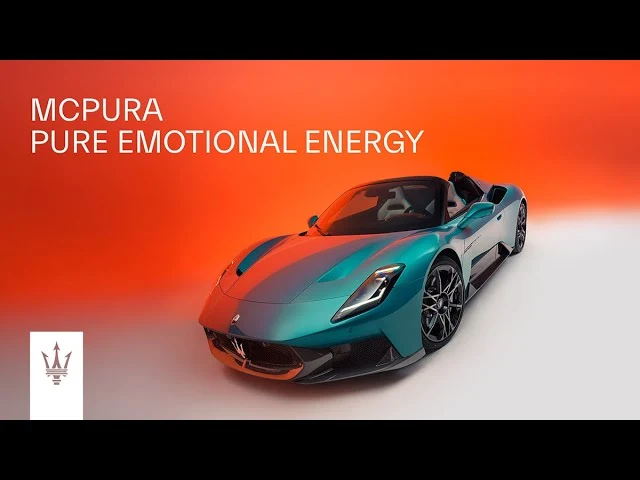
Maserati designer Alessandro Conte used an Autostyle 2026 presentation to explain why the MCPURA does not advertise every aerodynamic device. The large Trident, oval grille and relationship between nose, cabin and tail establish the identity first. Intakes, cooling paths and underbody devices are then incorporated without turning the exterior into a catalogue of exposed hardware. The MCPURA remains an evolution of the MC20 rather than an unrelated new platform.
The architecture established the proportions
The carbon-fibre monocoque and rear-mid-mounted engine dictate where the occupants sit and how much visual mass remains behind them. Conte described the balance among the front volume, cockpit and tail as an early design decision, preceding details such as lamp graphics and grille texture.
Maserati divides the car conceptually into an upper and lower zone. Smooth, hand-shaped surfaces dominate the upper body. The technical work is concentrated below, where the MCPURA has vortex generators, a faired floor, channels behind the front wheels and a rear diffuser with passages of different depths.
The manufacturer credits more than 2,000 wind-tunnel hours and over 1,000 CFD simulations during development with Dallara. Those are Maserati's development figures, not a Carboratory aerodynamic test. They help explain why the bonnet and side intakes appear to disappear from some angles even though they feed the engine, intercoolers and heat-management system.
The visual update from MC20 is concentrated low down
MCPURA replaced the MC20 name in 2025 with revised front and rear treatment. Its front bumper takes cues from the GT2 Stradale but uses a less aggressive interpretation. The lower fascia can be specified in gloss black, matte Hyper Dark Myron or exposed carbon fibre. Maserati says the new floor-facing shapes improve aerodynamic performance, without publishing a before-and-after drag or downforce figure.
At the rear, an oversized GT2-derived wing is optional. The regular shape relies on a restrained spoiler and the underfloor airflow for much of its aerodynamic load. Butterfly doors remain, providing a wide entry and exposing the carbon tub, front wheel and side structure when open.
The Cielo applies the same language to a convertible monocoque whose carbon lay-up differs from the coupé. Its retractable PDLC glass roof opens in 12 seconds and can switch between clear and opaque in one second. These features change the structure and thermal management requirements, but Maserati says the two body styles were developed together to preserve aerodynamic efficiency.
Familiar Nettuno hardware sits beneath the new surfaces
The 3.0-litre twin-turbo Nettuno V6 remains in place with dry-sump lubrication and pre-chamber combustion. Maserati quotes 630 CV at 7,500 rpm and 720 Nm in its headline material, sent to the rear wheels through an eight-speed dual-clutch transmission. Some official technical tables state 730 Nm, an unresolved documentation discrepancy rather than evidence of a separate engine tune.
For the European coupé, Maserati lists 1,475 kg, 0–100 km/h in under 2.9 seconds and a maximum speed above 325 km/h. The Cielo is listed at 1,560 kg and above 320 km/h. Both measure 4,667 mm long and 1,965 mm wide without mirrors. These are manufacturer figures; Carboratory has not independently weighed or performance-tested the car.
The deep side channels are therefore functional as well as visual. Air reaches the engine intake and intercoolers through body openings shaped into the flanks, while the sill area draws flow into the engine bay. The front-floor hump increases flow towards vortex generators, and the outlet behind each front wheel helps create vertical load around the axle, according to Maserati.
Interior materials carry part of the design argument
Alcantara covers the seats, door panels, dashboard and sections of the steering wheel. Maserati attributes greater grip, lower mass and breathability to the material compared with leather. Those benefits are the manufacturer's claims; long-term wear and cleaning demands depend on use and cannot be determined from a design presentation.
The new GT2-inspired steering wheel has a flat top, column-mounted paddles and integrated Start and Launch Control buttons. Coupé buyers can add shift lights and carbon sections. A 10.25-inch digital cluster and 10.25-inch centre screen sit at similar heights, while performance pages show turbo, torque, oil-pressure, brake-temperature and transmission-temperature data.
The centre tunnel retains a physical drive-mode selector. WET, GT, SPORT, CORSA and ESC Off alter accelerator response, shift strategy, exhaust valves, suspension and stability-control intervention. This functional separation is relevant to the cabin design: the principal dynamic control remains a tactile rotary device rather than another touchscreen menu.
Fuoriserie changes interpretation, not hard points
Maserati's Fuoriserie programme uses themes including Corse, Futura and Unica, plus fully commissioned Bespoke projects. At Autostyle, examples included the Bauhaus-influenced MCPURA Cielo “Less is More...?” and Tributo 1926, whose graphics refer to the Tipo 26 and Maserati's centenary.
Paint, graphics, upholstery and trim can make two cars read very differently while the carbon structure and core proportions stay fixed. That boundary is central to Conte's explanation: recognisable architecture survives personalisation because customers modify materials and visual emphasis rather than relocate the cabin or reshape every aerodynamic hard point.
MCPURA and the Nettuno engine are built in Modena. The Autostyle discussion offered a design rationale, not another derivative, additional horsepower or a new market price. Its useful conclusion is narrower: Maserati intends the silhouette and grille to carry the identity, leaving much of the performance work underneath.