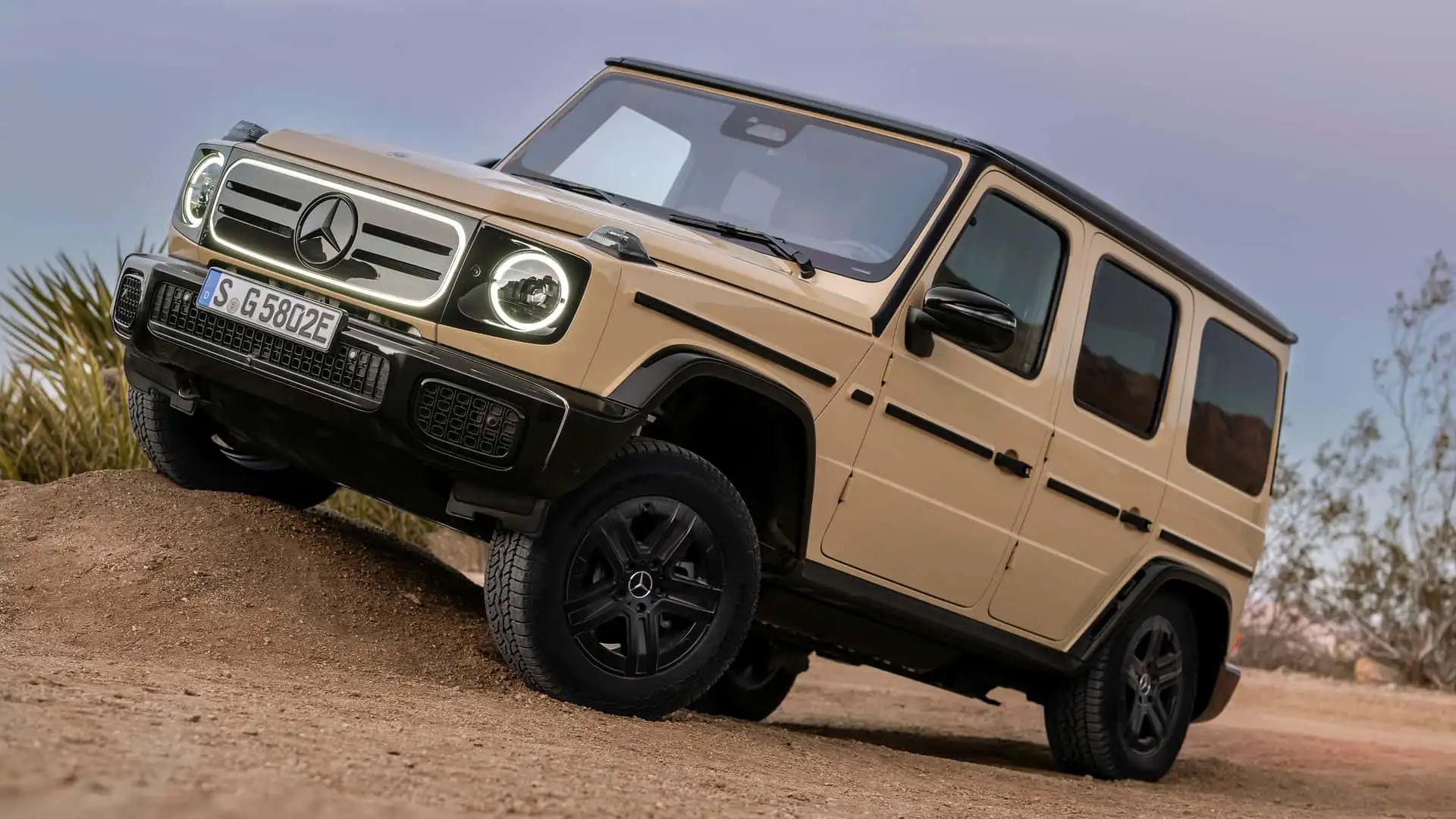
The patent does not name the G-Class, but describes a two-axle vehicle able to cross water by floating. Photo: Mercedes-Benz.
Mercedes patents an SUV that can float and use its wheels as paddles
Mercedes-Benz has filed a patent application in Germany for a system that would allow an off-road vehicle to enter a watercourse, float, move using its wheels and then return to dry land on its own. The solution combines individual wheel control, active suspension, navigation and several sensors in a mode dedicated to water crossing.
The document does not announce a new model and does not mention the G-Class. It describes a generic two-axle, four-wheel vehicle. Association with Mercedes’ off-roader is natural, but it remains an interpretation until the manufacturer confirms a production application.
How the water mode would work
After the special mode is selected, the system would coordinate all stages of the crossing: approaching the bank, entering the water, floating, holding direction and exiting onto solid ground. Instead of a propeller or a water jet, the vehicle would use tyres rotated like paddles.
Each wheel could receive a different rotational speed. The computer would thus compensate for current and correct direction, in a manner similar to the torque distribution already used by electric cars with several motors. Control would not chase speed, but slow, stable movement towards the chosen point on the opposite bank.
The patent also describes a function similar to a virtual anchor. Using GPS position and sensor information about the current, the vehicle would orient itself against the water and rotate the wheels in the direction needed to stay roughly in the same place.
Active suspension would stabilise the body
The wheels would not be used only for propulsion. Individually controlled suspension could change the position of each wheel to limit body roll and oscillation. The system would take into account the direction of the current and the vehicle’s movement.
For flotation, Mercedes proposes detachable foam elements or inflatable structures mounted in the wheel arches. These would increase the volume that displaces water and reduce turbulence around the tyres. Some variants could be kept in the boot and fitted only before the crossing.
This part of the patent also shows the practical limit of the idea: an ordinary SUV does not automatically become amphibious just because it can control the motors separately. Body sealing, buoyancy, mass distribution and the water resistance of electrical components are distinct requirements.
Exiting the water is controlled separately
The transition from floating to driving on land is one of the most difficult stages. The wheels can touch the bank one after another, and grip changes suddenly. The system described by Mercedes would detect the moment each tyre finds support and adjust torque to avoid excessive wheelspin.
Such a function would need cameras, position sensors, information about body lean and fine control of propulsion. The patent does not set a maximum depth, a speed of travel on water or a safe duration of flotation.
The patent is real, but the car is not confirmed
The German application has the number DE 10 2026 127 610.5 and was filed on 3 July 2026 by Mercedes-Benz Group AG. The German patent office published the document on 20 August 2026, with the identifier DE102026127610A1. On 8 September, the file was listed as under examination.
The official title refers to control units for entering and leaving water, carrying out flotation, and to a buoyancy device for a two-axle vehicle. The inventor named is Jörg Kneip, from Graz, the city where the G-Class is produced.
These details do not prove that the technology will reach a commercial model. Manufacturers frequently patent solutions to protect their research, even if projects do not pass the experimental stage. The patent protects the technical idea; it is not a launch promise.
Why it would suit an electric G-Class
The current Mercedes-Benz G 580 electric has four motors, one for each wheel. The architecture allows separate torque control and functions such as near-spot turning on low-grip surfaces. From a control standpoint, that is a logical base for the system described.
Even so, the production model is homologated for fording, not for navigation. The ability to pass through water with the wheels on the ground is different from floating, and trying to exceed the limits in the handbook can cause serious damage and put occupants at risk.
Mercedes has in the past experimented with portal axles and extreme suspension on variants such as the G 500 4x4² and the EQC 4x4² prototype. The new patent takes the idea further through software and buoyancy, without necessarily requiring a mechanical marine transmission.
Would it have use beyond demonstrations?
For most drivers, the ability to float would be rarely used and hard to justify by cost. The system could, however, have applications for rescue, intervention in flooded areas, the military or expeditions, where crossing a watercourse can avoid a large detour.
Even in those fields, any production version would need strict procedures. Current, waves, water temperature, submerged obstacles and the angle of the bank can quickly turn a crossing into a dangerous situation. Automation can help, but it does not remove the vehicle’s physical limits.
Frequently asked questions
Has Mercedes confirmed a floating G-Class?
No. The company has filed a patent for the technology, without confirming the model on which it might be fitted or series production.
How would the car move on water?
The wheels would be rotated and controlled individually to function as paddles. A separate propeller is not provided.
What role does active suspension play?
It would change the position of each wheel to stabilise the body and to help the vehicle enter and leave the water.
Can the current electric G-Class float?
It is not homologated for that. Official fording capability must not be confused with operating as an amphibious vehicle.