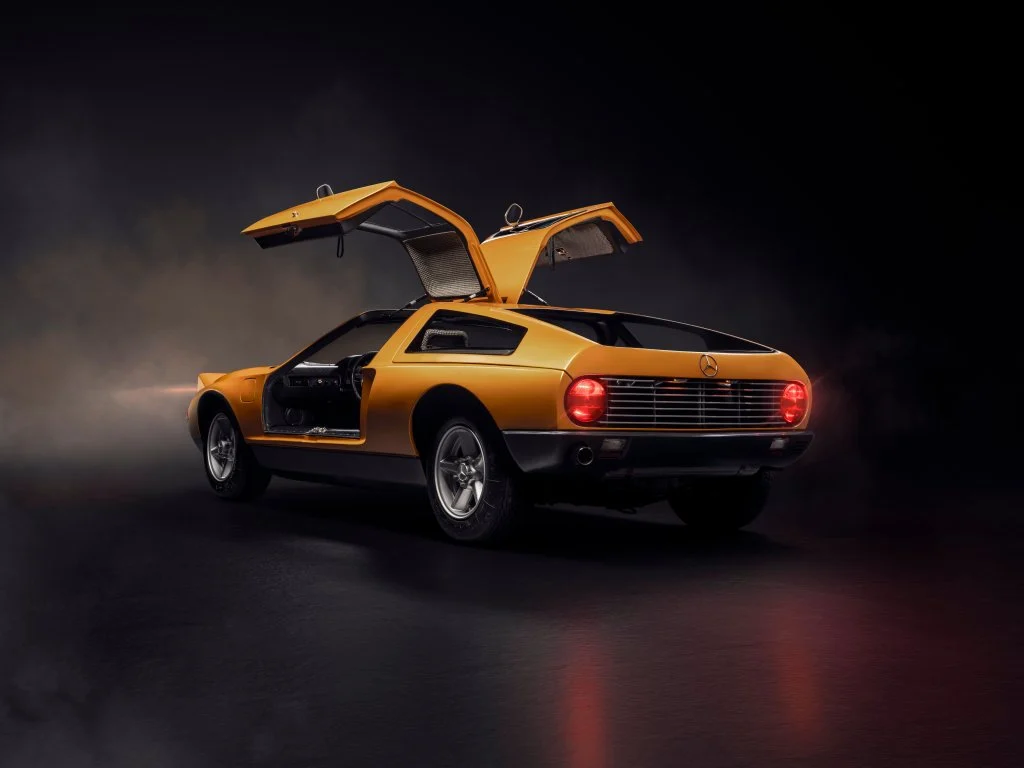
Mercedes-Benz is putting a C 111 into private hands for the first time. The company’s 1970 C 111-II Car 33, complete with its 2.4-litre four-rotor Wankel engine, will be auctioned by RM Sotheby’s at the Palais du Louvre in Paris on 3 February 2027, alongside the Rétromobile show.
No estimate has been published. Bidders must register in advance and accept additional conditions for this particular lot. RM Sotheby’s says bids may be placed in person or by telephone, but not through its normal online system. Mercedes-Benz has also contractually committed not to sell another C 111 for at least 25 years.
Car 33 is a working development vehicle
The car is not a recreation or a later road conversion. Mercedes lists number 33 as the third C 111-II built and the second example to enter its test fleet. Construction began in March 1970 and moved among the company’s Sindelfingen, Untertürkheim and Rastatt facilities as the chassis, powertrain, body, paint and trim were completed.
In August 1970, Mercedes installed the mid-mounted M 950 W 48 rotary engine. Its four rotors provide a quoted geometric capacity of 2.4 litres and official output of 257 kW. The current Mercedes release describes that as 345 hp, while other period material and the auction catalogue use the rounded figure of 350 horsepower. A five-speed ZF transaxle sends power to the rear wheels.
Mercedes and RM Sotheby’s quote a kerb weight of 1,240 kg, 0–100 km/h in 4.8 seconds and a maximum speed of 300 km/h. Those are historic manufacturer figures for the C 111-II configuration, not fresh Carboratory measurements. The rotary engine is also said to have a 9,000 rpm redline, a remarkable figure for a Mercedes development car of the period.
The glass-fibre-reinforced plastic body is attached to a sheet-steel underframe. Car 33 retains the metallic orange “Weißherbst” finish closely associated with the C 111, a grey-and-white houndstooth interior, a four-spoke safety steering wheel and a vertically installed Becker Europa radio. Its odometer showed 24,766 km when catalogued. That number reflects a life of testing, demonstration and exhibition, rather than ordinary private ownership.
Testing included a piece of butter in the luggage bay
Car 33 joined the development fleet with the registration S-Y 6200. RM Sotheby’s records use at the Hockenheimring and a practical luggage-temperature check associated with Mercedes engineer Rudolf Uhlenhaut. A piece of butter was placed in the rear luggage compartment and the car was driven quickly; if the butter did not melt, the insulation between the mid-mounted engine and the luggage space was doing its job.
The anecdote is useful because it distinguishes the C 111 from a static motor-show shell. Engineers examined visibility, heat management, aerodynamics, luggage capacity and everyday usability alongside performance. Mercedes says the C 111-II could carry one large and two small fitted suitcases. Compared with the first C 111, the second iteration received a larger windscreen, lower beltline, revised roof and rear deck, and open rear buttresses. Wind-tunnel work reduced drag by a claimed eight per cent.
Car 33 was shown at London’s Science Museum in 1999 and became part of the Mercedes-Benz Museum’s Fascination of Design display from 2006 until January 2024. Mercedes-Benz Classic then inspected and recommissioned it after more than 20 years without running. It appeared at the 2024 Pebble Beach Concours d’Elegance and subsequently at Rétromobile and several British events. Buyers will still need to review the technical file and the auction conditions; a factory recommissioning is not a substitute for a current independent inspection.
Why Mercedes never produced the C 111
The first C 111 appeared at the Frankfurt motor show in September 1969. The extensively revised C 111-II followed at Geneva in March 1970. Mercedes used the programme to explore rotary engines, composite bodywork, aerodynamics and computer-assisted engineering. Its archive describes the C 111 as the first car designed entirely by computer at Mercedes, using an early finite-element method that could also calculate dynamic loads.
Demand was not the problem. Mercedes records an offer of up to half a million Deutsche Marks from a prospective buyer in London in 1969 and says blank cheques later arrived in Stuttgart. Yet the board decided in November 1971 not to proceed with series production. The auction catalogue points to rotary-engine emissions, forthcoming US impact standards and the extensive redesign that would have been required to install a larger conventional engine.
The C 111 name continued on diesel-powered record cars. In 1976, the C 111-II D set 16 records, including three world records, and averaged 251.798 km/h over 10,000 miles. That achievement belongs to a separate turbodiesel configuration, not the four-rotor vehicle now offered for sale. Mixing the records together would exaggerate the provenance of Car 33.
Seventeen prototypes, and no second sale for 25 years
Mercedes says it built 17 C 111 prototypes across the experimental and record-car programme. RM Sotheby’s states that 13 survive and that, before this auction, every survivor remained in the manufacturer’s collection. Car 33 therefore comes with uninterrupted factory ownership and documented use rather than a chain of private restorations.
The 25-year no-sale undertaking makes the offering unusual, but it does not establish a market value. Nor does it guarantee appreciation after the auction. It means only that Mercedes does not intend this sale to begin a recurring disposal of C 111s. The actual price will be set by the registered bidders in Paris.
Proceeds are earmarked for the Mercedes-Benz Museum 2.0 project. Mercedes says the programme will update the Stuttgart museum and develop a digital twin that allows people outside Germany to explore its collection. The company has not disclosed a reserve or a target sum, so comparisons with the €135 million Mercedes-Benz 300 SLR Uhlenhaut Coupé sold in 2022 remain context, not a valuation for the C 111.