Mercedes-Benz does not appear ready to abandon coupe SUVs. Christoph Starzynski, the company’s vice president for product strategy and product steering, told Motor1 that he sees strong demand for the coupe body style and described its audience as a fan base. The comment comes after reports that Mercedes might remove some less differentiated models while simplifying its range.
The product evidence points in the same direction. Mercedes-Benz has officially presented the 2027 GLE Coupe, with revised styling, updated software and an electrified six-cylinder powertrain. A new model cannot prove that every coupe SUV will remain forever, but it does show that Mercedes is still willing to invest in the formula.
What Mercedes is actually confirming
Starzynski’s comment is a statement about customer demand, not a published sales study. Mercedes-Benz has not supplied a separate global sales total for the GLC Coupe or GLE Coupe in the material connected with the interview. It has also not announced a long-term product timetable for every body style. The safe reading is therefore narrower: Mercedes sees enough interest to keep the format in its current product strategy.
That distinction matters because coupe SUVs are often discussed through rumours rather than model-by-model sales data. A report about a possible cancellation can describe an internal proposal, a market-specific decision or an early development programme. None of those automatically becomes a confirmed withdrawal. In this case, the 2027 GLE Coupe is a confirmed counterexample to the idea that Mercedes has already decided to leave the segment.
Why buyers choose the shape
A coupe SUV starts with a familiar trade-off. The driver gets the seating position, access and general presence associated with an SUV, while the roof falls more sharply towards the rear. The result is a more car-like silhouette, but potentially less headroom and a less square loading area than the conventional SUV on which it is based.
That compromise is not accidental. Some buyers want a premium SUV that looks lower and more dynamic, even if they do not need the maximum possible cargo volume. Others prefer the conventional body because it is easier to load, offers a clearer view through the rear window or gives better value at a similar mechanical specification. The continued existence of the coupe version suggests that both preferences can coexist inside the same showroom.
Mercedes’ current position
Motor1 described Mercedes-Benz as offering three coupe SUVs at the time of its report, alongside three four-door models marketed as coupes. The exact range differs between markets and model years, so a vehicle shown in the US catalogue should not automatically be treated as available in the United Kingdom, Europe or Romania.
The GLC Coupe sits below the GLE Coupe in size and positioning. The GLE version targets customers looking for a larger luxury SUV with a sportier roofline. Both are related to conventional SUV variants, but their body proportions and chassis tuning are not identical. Mercedes-AMG versions add another layer, with higher outputs and different equipment depending on the market.
The 2027 GLE Coupe in official figures
Mercedes-Benz USA lists the 2027 GLE 450 4MATIC Coupe with a 3.0-litre inline-six engine. The stated output is 375 hp, roughly 279 kW, and torque is listed at 413 lb-ft, approximately 560 Nm. Mercedes estimates 0–60 mph in 4.9 seconds and gives an electronically limited top speed of 130 mph, or about 209 km/h. These are manufacturer figures, and the acceleration value is explicitly an estimate rather than an independent test result.
The company also says that the Coupe’s wheelbase is 2.4 inches, or about 61 mm, shorter than the GLE SUV. Its steering ratio is more direct, while the standard suspension and optional AIRMATIC air suspension are described as firmer and sportier than before. These changes are intended to create a distinct driving character rather than simply change the roofline.
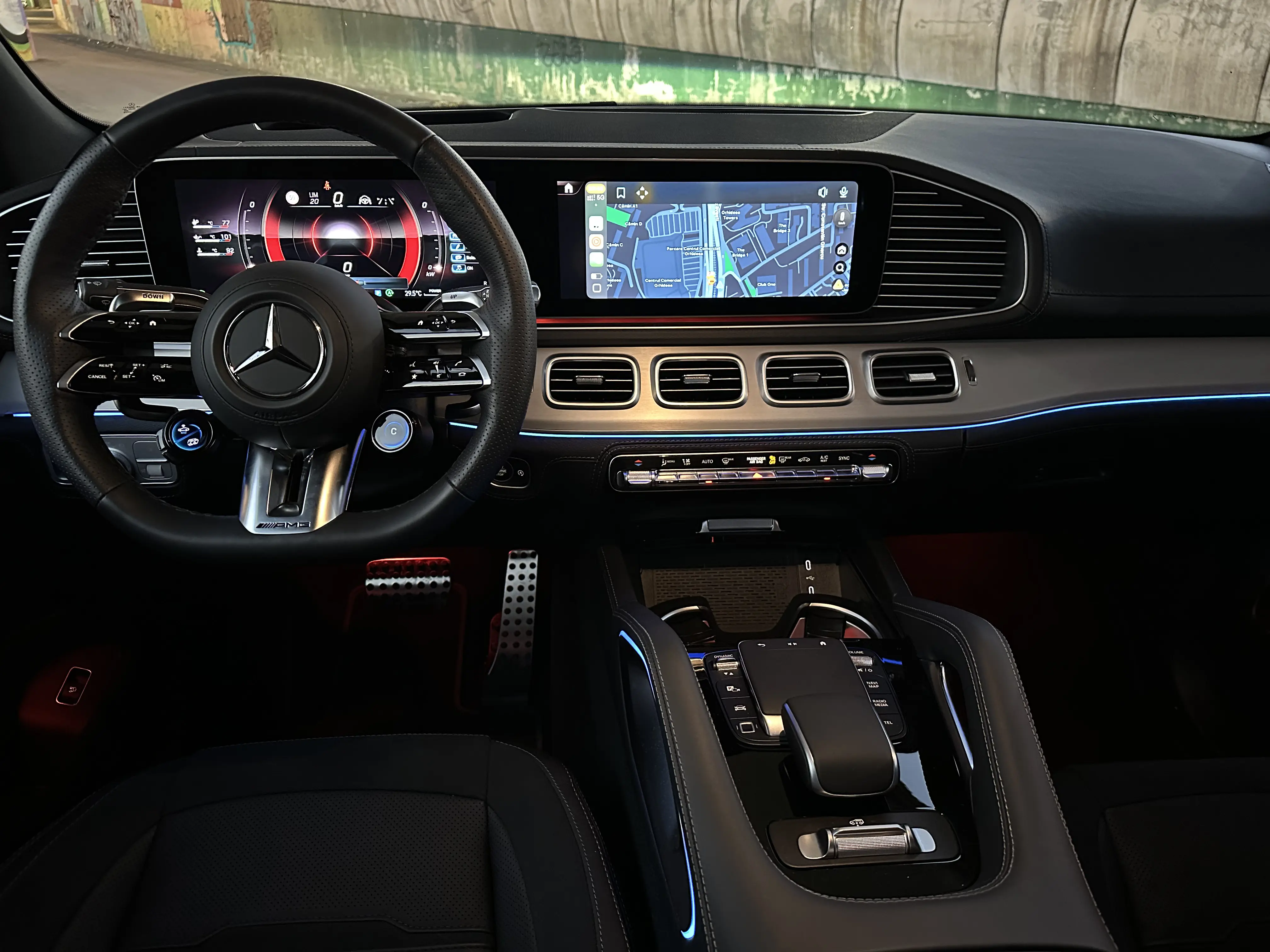
The interior receives a standard MBUX Superscreen with three 12.3-inch displays under a continuous glass surface. MB.OS is designed to manage vehicle functions and support over-the-air software updates. Mercedes also advertises an AI-enabled MBUX Virtual Assistant, but digital functions can depend on equipment, subscriptions, connectivity and country.
Assistance technology is not autonomy
The official release lists ten exterior cameras, up to five radar sensors and 12 ultrasonic sensors. They support the MB.DRIVE assistance systems and automated parking functions. Mercedes’ own disclaimer remains important: the driver is responsible for monitoring the vehicle, the manoeuvre and the surrounding environment.
The European media material also warns that some plug-in hybrid consumption and emissions figures are provisional forecasts until final type approval. This is a useful reminder when comparing markets. A US press release, a European media page and a Romanian configurator may show different equipment, measurements or availability.
The wider market is mixed
Mercedes is not alone in the segment. Audi sells the Q5 Sportback and Q8, BMW offers coupe derivatives such as the X4 and X6, Genesis has the GV80 Coupe, and Porsche sells the Cayenne Coupe. At the same time, Infiniti discontinued the QX55 after a short run, while Volkswagen ended ID.5 production in Europe as it reshaped the ID family.
The lesson is not that coupe SUVs are guaranteed to grow. It is that manufacturers are making different decisions about a body style that carries both a visual appeal and a packaging penalty. Mercedes’ current decision is to keep offering the choice. The 2027 GLE Coupe is the clearest official evidence, while the claim of strong demand remains an attributed executive statement rather than a public market statistic.