Mercedes-Benz says its electric GLC is sold out in Europe for the rest of 2026, with the order book extending into 2027. The same official statement covers the electric CLA family, GLB and GLA. For buyers, the practical issue is the allocation and delivery schedule of a particular car, rather than assuming that a new factory order can arrive before year-end.
The confirmation appears in the manufacturer's third-quarter sales release dated 7 October 2026. It establishes the European demand position described by Mercedes-Benz, but does not give every customer the same delivery month. Nor is it an inventory report showing whether each dealer has a previously allocated vehicle available.
Orders stretching into 2027 are not individual delivery promises
Sales board member Mathias Geisen says the electric GLC's third-quarter sales more than tripled compared with the second quarter. The release does not attach an individual GLC unit total to that statement. A growth multiple should therefore remain a growth multiple, rather than becoming an invented model sales figure.
An order book, sales recorded in a quarter and the delivery date of one configured vehicle answer different questions. The manufacturer's sold-out wording does not, on its own, show the build week for a new order. Buyers need to establish whether an offer concerns an existing allocation or a configuration waiting for a production slot.
The October statement also does not turn 2027 into one universal deadline. A model range can be sold out for the remainder of one year while different customers have different arrangements in the following year. A written schedule for the specific version and equipment is more useful for planning a replacement car than treating a regional headline as a contractual delivery date.
The electric sales record has a defined scope
Mercedes-Benz Cars sold 68,400 battery-electric vehicles worldwide in the third quarter of 2026. That was 61% more than a year earlier and 29% above the second quarter. BEVs accounted for 16.8% of the passenger-car business's global sales, a company quarterly record.
The group figure is different: 78,100 BEVs includes the Vans business as well as Cars, with year-on-year growth of 52%. Combining that larger total with the 61% passenger-car growth rate would mix two reporting scopes. Neither number is the electric GLC's individual sales total.
In Europe, Mercedes-Benz Cars reported BEV sales up 78% year-on-year and 24% quarter-on-quarter. Yet total worldwide passenger-car sales fell 8% to 407,200, showing that stronger electric demand did not mean growth across the whole business. Mercedes defines Europe in the release as the EU, UK, Switzerland and Norway; the figures are rounded and preliminary.
Bremen builds the electric GLC alongside other powertrains
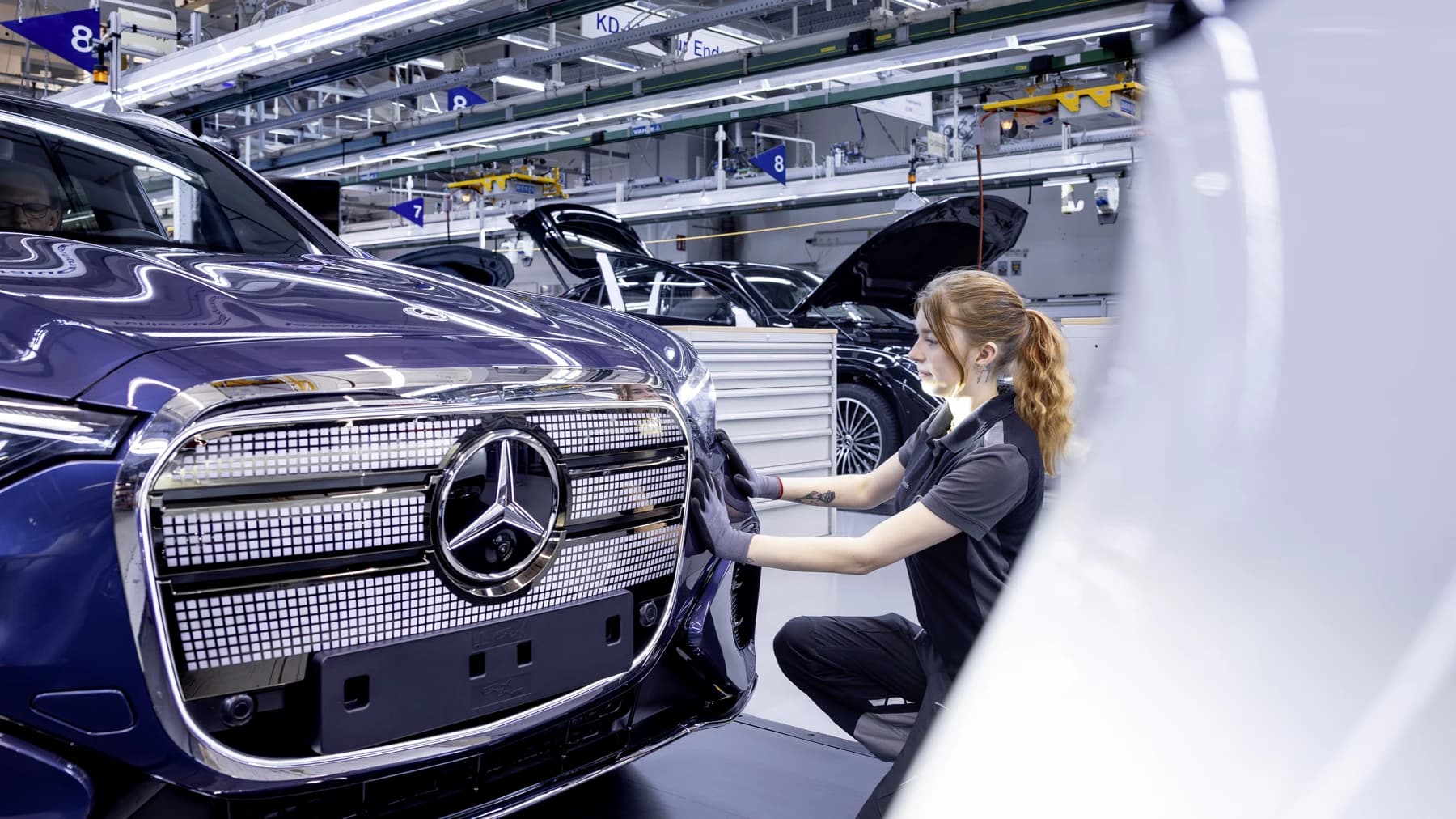
The manufacturer's industrial update of 6 May 2026 places electric GLC assembly in Hall 9 at Bremen. The SUV shares a flexible production line with combustion and hybrid GLC models and the EQE. Hall 9 is the plant's largest production hall and had already operated on three shifts for more than a decade.
The October sales release says Bremen, Rastatt and Kecskemét are running three-shift schedules to meet demand for the new electric portfolio. That does not establish that Hall 9's shift pattern was newly introduced in response to the latest order book. It also does not quantify the number of GLC slots available in any particular week.
Mercedes-Benz says ACCUMOTIVE in Kamenz has supplied the new battery generation to Bremen since 2026. Hamburg contributes electric-axle and other powertrain components. The network explains why a finished vehicle depends on several sites, without identifying any one of them as the cause of a delay in a particular customer's order.
Romania supplies complete electric drive units
Star Assembly in Sebeș officially started assembling electric drive units for the new GLC on 13 October 2025. Mercedes describes the unit as combining an electric motor, power electronics and a transmission section. These elements are assembled into a complete system in Romania and sent to Bremen for vehicle production.
The investment includes a hall of more than 30,000 square metres integrating assembly and logistics functions. Sebeș is the second site in Mercedes-Benz's global network, after Untertürkheim, to supply vehicle plants with electric drive units. The industrial role should not be confused with a promise that customers in Romania automatically receive preferential vehicle allocations.
GLC charging figures depend on the version
The official Romanian product page checked on 5 November lists GLC 250, GLC 300 4MATIC and GLC 400 4MATIC. It gives useful battery capacities of 85 kWh for the first two and 94 kWh for the GLC 400. Published power outputs are 260 kW, 310 kW and 360 kW respectively.
Maximum DC charging is listed at 320 kW for the 250 and 300, and 330 kW for the 400. The page quotes 22 minutes for a 10–80% charge under the manufacturer's applicable conditions. A maximum charging-power figure is a peak, rather than a promise of that rate throughout the session. These are official specifications, not Carboratory test results.
Those product details identify what is being ordered; they do not establish a delivery date or matching availability in every European country. Buyers should keep the exact powertrain and specification attached to the dealer's allocation and timetable. The GLC name now spans different propulsion types, while the European sold-out statement specifically concerns the electric model.
Official archive photograph: Mercedes-Benz, 26C0149_014, published with the Bremen production release on 6 May 2026. It does not document a current bottleneck. Resized and converted to WebP; editorial use. Mercedes-Benz Media.