European carmakers are tying AI suppliers into distinct parts of their businesses: Mercedes-Benz is developing local voice intelligence with Liquid AI, BMW is working with Mistral AI on crash-simulation analysis, and Stellantis has expanded its Mistral collaboration across operations. A potential correction in the AI market would therefore raise questions about partner continuity and project economics, rather than automatically removing the underlying uses of the technology.
That is a risk scenario, not evidence that these partners have failed or that the programmes have been interrupted. The useful distinction is between a financial-market narrative, a signed technology collaboration and a feature customers can actually use. Official announcements and two recent industry surveys show how different those stages can be.
Mercedes-Benz's local AI project has a defined market
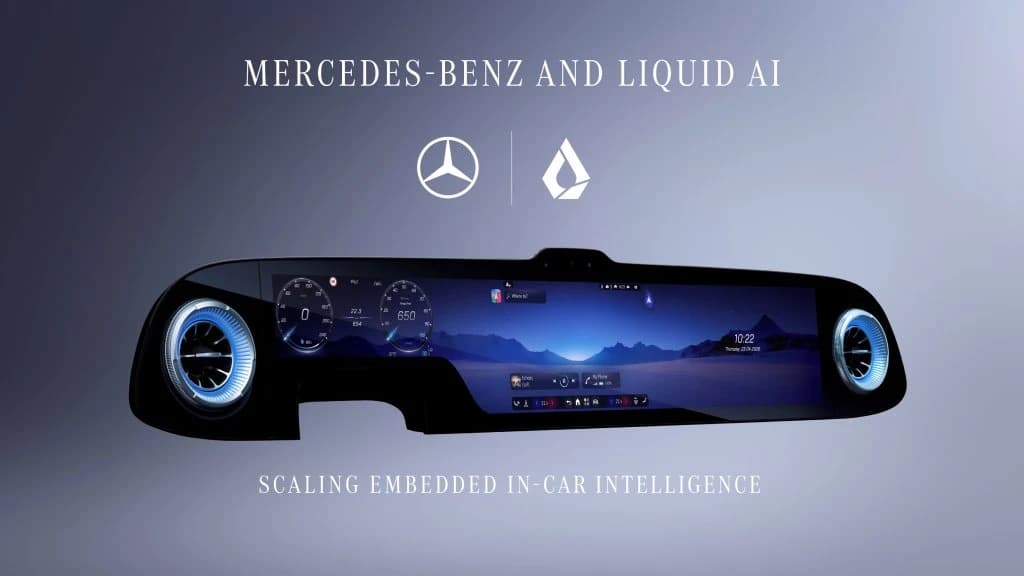
Mercedes-Benz announced a multiyear Liquid AI partnership on 23 April 2026 for North American models with third- and fourth-generation MBUX. It focuses on embedded, on-device intelligence, including speech recognition, language understanding and reasoning for the in-car interaction system.
The manufacturer says Liquid's models are designed to run inside the vehicle without continuous exchanges with cloud infrastructure. It presents this as complementary to existing cloud-based language models and computing ecosystems. The statement is not a claim that every connected service becomes independent of the internet, nor an independently measured assessment of response speed or privacy performance.
The announcement targeted a first production deployment of advanced speech technology in the second half of 2026. A target published in April should not be turned into proof that every eligible car already has the software. The geography also matters: a North American partnership does not establish matching availability, language support or timing for a European customer.
BMW's industrial model works behind the scenes
BMW and Mistral AI announced their crash-simulation collaboration on 28 May 2026. BMW says it runs thousands of virtual crash simulations each week and has accumulated more than a petabyte of historical data. The information captures vehicle structures and material behaviour, providing engineering material for specialised model training.
The technical approach centres on Large Industry Models, or LIMs, trained on domain-specific engineering and simulation information. BMW identifies improved quality, accuracy and speed in complex development work as the objective. The announcement does not provide an independently verified percentage improvement in road safety or say that physical crash tests will be abolished.
This programme is different from putting a conversational assistant in a dashboard. Its immediate users are development teams, and its inputs include the manufacturer's own engineering knowledge. For an owner, the announcement is not a new menu option or a confirmed vehicle software update. It concerns how cars are developed before they reach customers.
Stellantis is extending AI into operations
On 1 October 2025, Stellantis and Mistral announced an expansion from pilot work towards company-wide adoption. Their stated structure includes an Innovation Lab to co-develop tailored solutions and a Transformation Academy to support scaling and the move from prototypes into production.
Sales and aftersales were identified as initial areas of focus, alongside using customer feedback and data intelligence to improve development and quality. The announcement describes an operating model and intended applications. It does not publish a verified saving per vehicle or establish that every proposed use case has been deployed across every Stellantis brand.
These three examples illustrate different supplier relationships. An embedded voice system, an engineering model and an enterprise workflow can all use AI while depending on different data, deployment arrangements and responsibilities. Treating them as one interchangeable product would obscure the practical question of what a partner is being asked to deliver.
Productivity gains belong to a specific survey group
Capgemini Research Institute's release dated 12 October 2026 reports findings from a July survey of 800 senior automotive executives in 12 countries across North America, Europe and Asia-Pacific. The sample comprised 400 respondents from manufacturers, 160 from tier-one suppliers and 240 from technology providers. Researchers also conducted 24 in-depth interviews.
In that sample, 33% of organisations were using agentic AI for product development and 35% were piloting it. Only 5% reported fully mature AI governance. These are survey findings across the sampled organisations, not a census of every automotive company or an independent audit of deployed systems.
The group Capgemini identifies as generating the greatest value reports development cycles 17% faster, engineering productivity 19% higher and time to market 19% shorter. Those results belong to the high-value group. They are not an industry-wide average or a guarantee that any new AI contract will bring a vehicle launch forward by the same percentage.
Shared accountability remains uncommon
Only 10% of organisations in the Capgemini research had established shared lifecycle accountability across their ecosystem. Thirty per cent reported co-development models based on shared outcome metrics. The institute links stronger performance with data foundations, clearer business cases and more disciplined governance and operating models, rather than with adoption alone.
PwC's separate Global Automotive Sector Outlook, published on 24 September 2026, surveyed 720 executives at manufacturers and tier-one suppliers in 33 countries during March and April. Fifty-one per cent ranked AI among their top three technologies for strategic goals over the following five years. That measures strategic priority, not realised financial return.
Together, the disclosures support a narrower conclusion than either universal AI optimism or a prediction of collapse. Announced partnerships need defined applications and responsibilities, while reported benefits need their sample and conditions attached. For a customer comparing connected cars, the relevant evidence remains the confirmed feature, supported market and actual service included with the vehicle, rather than the prominence of an AI supplier's name in an announcement.
Official graphic: Mercedes-Benz, Liquid AI partnership announcement, 23 April 2026. Illustrates the North American collaboration, not confirmed availability in every market. Converted to WebP; editorial use. Mercedes-Benz Media.