Ferrari has allocated every Luce it plans to sell in 2027, chief executive Benedetto Vigna told analysts on 3 November. The first fully electric Ferrari is in production, with a small number of cars expected on the road before the end of 2026. International media drives are scheduled for the first quarter of 2027, followed by drives for clients.
That is a specific statement about next year’s planned allocation. It does not establish that the entire 2028 production run has been sold. Vigna separately said Ferrari’s overall order book extends into 2028. Keeping the model-level allocation apart from the company-wide backlog avoids turning two different pieces of information into an unsupported delivery promise.
Allocation is not a disclosed production total
Asked about the Luce, Vigna said a new customer would have to wait around a year. Ferrari did not give the number of cars behind its 2027 plan in that answer. Without a disclosed production target, the allocation announcement cannot be converted into a unit-sales figure or compared numerically with another manufacturer’s electric car programme.
The cars in question are planned sales for next year, rather than vehicles already handed over to their owners. That distinction matters when considering the financial results released at the same event. Ferrari’s third-quarter reporting period ended on 30 September; the first Luce deliveries are scheduled later, in the final quarter of 2026.
Nor does an overall waiting-time indication establish a contractual date for a particular country, specification or purchaser. A buyer needs confirmation of the individual allocation and the local commercial terms from the dealer. The statement to analysts identifies the state of the order plan, without publishing a country-by-country schedule or a new price list for every market.
The car reached customers in person before the wider drive programme
Vigna described more than 50 local premieres and private viewings across the United States, Europe, the Middle East and Asia-Pacific. Ferrari also held five public events, including a temporary museum exhibition. These appearances gave prospective buyers an opportunity to inspect a car whose exterior, interior and interface were developed as a single design project.
The chief executive argued that seeing the Luce physically helps people understand it better than a digital presentation. That is management’s interpretation of the events, rather than independently measured evidence of how each viewing translated into an order. Ferrari did not publish a numerical split between returning clients and first-time Ferrari buyers in the call.
The distinction will become easier to examine once the drive programme begins. A static viewing and a road drive allow different judgements about the car: cabin layout can be inspected while parked, but torque delivery, suspension behaviour and sound require driving. Ferrari’s timetable places the international media programme in early 2027 and the client sessions after it.
Five seats change the Ferrari package
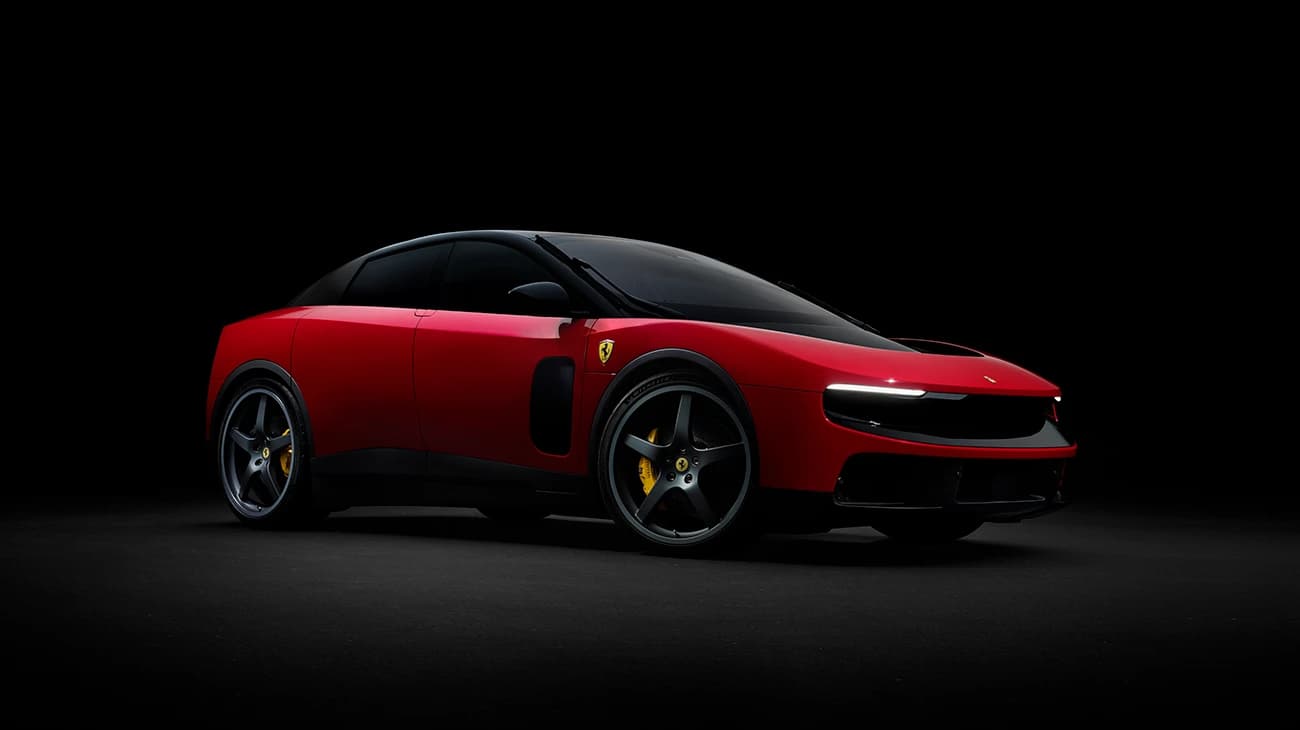
The Luce made its full public debut at Rome’s Vela di Calatrava–Città dello Sport on 25 May 2026. It is Ferrari’s first fully electric car and its first five-seat series-production model. Four doors and all-wheel drive accompany a dedicated platform with four electric motors, one for each wheel. LoveFrom, led by Jony Ive and Marc Newson, worked on the design.
Official dimensions put the car at 5,026 mm long, with a 2,961 mm wheelbase and a 597-litre luggage compartment. Ferrari lists a kerb weight of 2,260 kg, with the specification footnote referring to optional equipment. Those measurements establish the scale of the package without implying that the Luce has been independently assessed for ride comfort or luggage usability here.
Maximum output is listed as 772 kW, or 1,050 metric horsepower, in Launch Control mode. Ferrari quotes 0–100 km/h in 2.5 seconds, 0–200 km/h in 6.8 seconds and a top speed of 310 km/h. The mode qualification belongs with the power figure: it should not disappear when the headline number is used to describe the car.
The 530 km range remains an estimate
The battery has 122 kWh of gross capacity, rather than a published usable-capacity figure in the cited specification. Its 210 cells are arranged in 15 modules, with 13 in the floor and two beneath the rear seats. Ferrari says the pack is designed, validated and built in Maranello and forms part of the vehicle’s structural system.
The electrical architecture operates at up to 800 volts. Maximum DC charging power is 350 kW, while Ferrari describes adding 70 kWh in 20 minutes using a suitable fast charger. The maximum power is not a promise that the battery will take that rate throughout an entire session. AC charging capability is up to 22 kW.
Crucially, the technical sheet labels the 530 km range as an estimate under homologation, and WLTP consumption as under homologation too. It therefore should not be described as a final certified result or a motorway range guarantee. Buyers comparing the Luce with another EV need to match the certification status as well as the battery-capacity definition.
A growing order book alongside fewer quarterly shipments
Ferrari’s interim report records 3,368 vehicle shipments in the third quarter of 2026, compared with 3,401 a year earlier. Net revenue rose from €1.766 billion to €1.896 billion, while operating profit reached €563 million. The company attributes the automotive revenue improvement to a richer model mix, supported by the F80, and higher personalisation revenue.
These are group results covering the quarter ended in September, not earnings from next year’s allocated Luce deliveries. They show why a full order plan and quarterly shipment figures answer different questions. For the electric model itself, the next announced milestones remain the first cars before year-end and the international drive programme in early 2027.
Image: © Ferrari, official press material from the manufacturer’s media centre, converted to WebP for editorial use. Rights remain with Ferrari. Ferrari Media Centre.