BMW's latest financial report confirms weaker revenue from selling vehicles returned at the end of leases, while Volkswagen's accounts show how movements in used-car prices can affect earnings through residual-value protection agreements. Both disclosures put the second-hand market inside the manufacturers' financial results, rather than treating depreciation solely as an owner's problem.
The figures need careful separation. BMW reports actual segment performance and an outlook for remarketing income. Volkswagen also publishes a hypothetical price sensitivity. Neither document is a model-by-model depreciation ranking, and neither establishes a uniform price fall for every combustion or electric vehicle in Europe.
BMW's leasing business grew, but remarketing revenue stayed lower
In its quarterly statement released on 4 November 2026, BMW says a larger portfolio and higher interest income helped Financial Services in the third quarter. Revenue from selling returned lease vehicles nevertheless remained lower. The combination explains why growth in financing activity does not necessarily produce a matching improvement in the proceeds from cars coming back into stock.
Financial Services generated third-quarter profit before tax of €639 million, compared with €644 million a year earlier, a decline of 0.8%. For January to September, profit before tax was €1.647 billion, down 10.3% from €1.836 billion. A near-stable quarter and a larger nine-month decline describe different periods and should not be presented as interchangeable figures.
BMW names an increase in an existing provision for a UK motor-finance customer compensation scheme as a major reason for the nine-month earnings reduction. That addition occurred in the first quarter of 2026. It would therefore be misleading to attribute the entire 10.3% decline to lower resale values, or to claim that it measures losses on a particular powertrain.
The group expects the downward price trend in pre-owned markets to continue during 2026, leading to a further year-on-year reduction in revenue from remarketing lease returns. That is management's full-year expectation. It is separate from the already reported nine-month results and does not specify a depreciation percentage for an individual used BMW.
The contract figures measure activity, not retained value
BMW Financial Services signed 1,292,663 new credit and leasing contracts in the first nine months, up 1.3%. New leasing contracts increased 2% to 509,821, representing 39.4% of all new business by contract count. The combined financed and leased vehicle portfolio reached 5,052,016 at 30 September, 2.5% above the end of 2025.
The latest quarter was weaker than the nine-month comparison. New credit and leasing contracts declined 5.4% to 426,575 in July to September. BMW identifies lower Chinese sales as a factor weighing on new business. The year-to-date increase does not mean that the most recent quarter also grew.
Another comparison requires a methodological qualification. BMW's nine-month financing and leasing penetration rate was 53.7%, but from 2026 that measure includes qualifying young used vehicles sold to retail customers for the first time in the reporting year. BMW says these contribute approximately three percentage points. The change in coverage makes a simple comparison with the published 2025 percentage incomplete without the footnote.
Volkswagen's €438 million figure is a sensitivity, not a booked loss
Volkswagen's January–September interim report explains that residual-value risks can arise from agreements with dealerships. Under these arrangements, the group bears part of the earnings effect from market movements affecting vehicles subject to lease-related repurchase obligations. Used-car prices are the key variable for valuing the associated options.
For the vehicles covered by that residual-value protection model, a hypothetical 10% reduction in used-car prices at 30 September 2026 would have lowered earnings after tax by €438 million. A 10% increase would have raised them by €436 million. These are dated sensitivity calculations for a defined accounting exposure.
They do not mean Volkswagen has recorded a €438 million loss from a universal 10% fall in its used cars. Nor does the calculation forecast such a fall. Extending it to all European second-hand vehicles, or directly applying it to one model's advertised price, would change both the scope and the meaning of the disclosure.
Electric demand and resale exposure are different earnings channels
BMW delivered 110,257 battery-electric vehicles worldwide in the third quarter, 7.2% more than a year earlier. BEVs represented 20% of global deliveries and 34.7% of European deliveries. Those figures describe new-car demand; they are not evidence of a measured resale-value advantage or disadvantage for every electric BMW.
Volkswagen's 29 October results announcement identifies negative residual-value effects in its Progressive brand group, alongside lower volumes in China and North America. Separately, CFO Arno Antlitz says the growing electric share of vehicle sales weighs on profitability because the group currently earns less from electric cars than from combustion models. That is a manufacturing and sales-mix issue, distinct from what happens when a leased car is resold.
The same announcement puts electric vehicles at around 40% of Volkswagen's European order bank at the end of September. An order-bank share is not a share of used-car transactions. It can help explain the direction of new demand without establishing the resale price of a specific petrol, diesel or electric vehicle.
For buyers considering a used BMW or Volkswagen, the reports support a practical distinction: a finance company's residual-value assumption belongs to a particular contract and risk structure. It is not automatically a guaranteed purchase offer for any subsequent owner. The vehicle's actual asking price and the terms governing its return or repurchase need to be assessed directly, rather than inferred from a group profit percentage or a hypothetical accounting sensitivity.
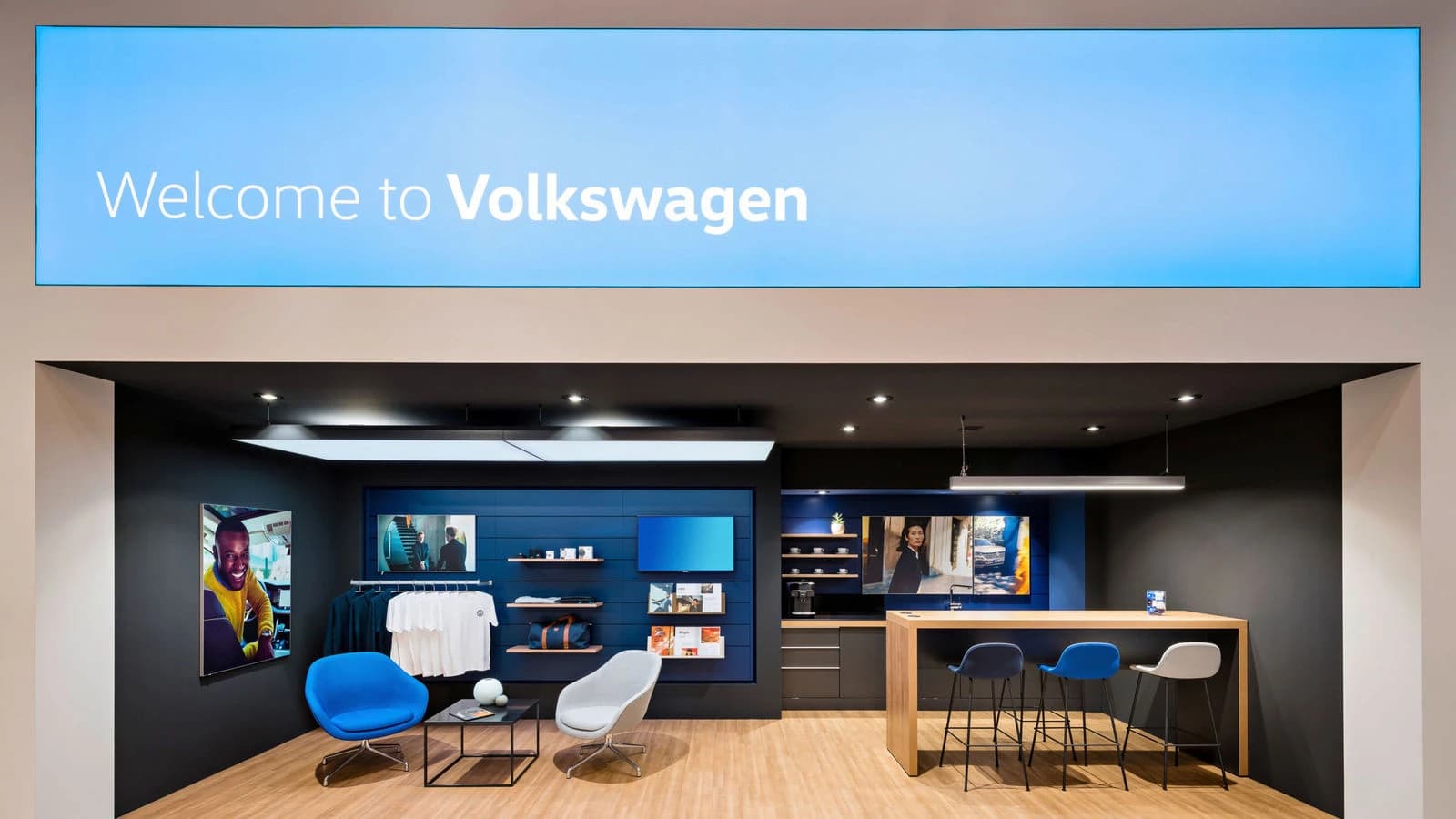
Archive image: Volkswagen AG, DB2019AL01929, published 9 September 2019. Dealer reception design illustration, not a photograph of returned lease stock. Converted to WebP; free editorial use. Volkswagen Newsroom.