Mercedes-Benz is restoring selected physical controls to new cars after customers objected to touch-heavy interfaces. Chief executive Ola Källenius acknowledged during a public Reddit question-and-answer session on 16 November 2026 that moving a function into software does not automatically improve it. The company is not abandoning large displays: its current answer combines tactile steering-wheel controls with MBUX screens, voice input and the MB.OS software platform.
The electric GLC and new GLB show what that compromise means in production. Both use a rocker for the speed limiter and DISTRONIC driver-assistance settings, plus a roller for audio volume. Capacitive panels remain alongside them. Drivers therefore regain a control that can be found by touch, while less frequent settings and flexible digital services stay in menus.
What Källenius actually conceded
One Reddit user asked when physical buttons would return, describing the need to look away from the road to change simple settings. Källenius said repeated themes in customer feedback deserve attention, even though Mercedes cannot follow every online opinion. He added that he personally likes a well-made rocker and roller on a steering wheel.
His broader answer was deliberately more nuanced than a rejection of touchscreens. Moving towards digital controls felt right and, in his view, remains broadly right for modern cars. Mercedes learned, however, that digital does not necessarily mean better. Extensive internal work on human factors, distraction and ease of use cannot reproduce every lesson that emerges when owners use a car every day.
The company has already acted on that distinction. Källenius pointed to the electric GLC unveiled in September 2025, where buttons, rockers and rollers returned where Mercedes believed they made sense. He also defended voice interaction as a way to keep a driver's hands on the wheel. That claim should be read as the manufacturer's design direction, not proof that voice control is equally reliable in every language, accent or noisy cabin.
A 99.3-centimetre screen and a volume roller can coexist
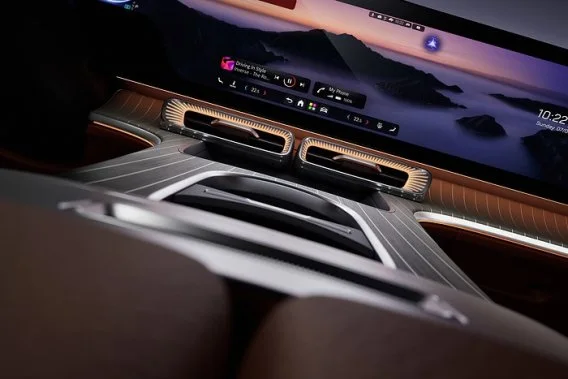
The electric GLC makes the apparent contradiction visible. Its optional MBUX Hyperscreen measures 99.3 cm across and was described by Mercedes at launch as the largest display fitted to one of its production cars. It uses matrix backlighting with more than 1,000 LEDs and permits separate dimming of display zones.
Yet the same cabin includes a hard-key strip on the console, including the hazard-warning switch, as well as the revised steering-wheel controls. The return of a roller does not reduce the screen's physical presence. Instead, it changes which operations demand visual attention.
Volume is a good candidate for a tactile control because it is adjusted frequently and has a simple direction: up or down. A rocker similarly suits a limited set of cruise-control functions. Navigation, personal profiles, entertainment apps and configurable vehicle settings have more possible states, so a digital interface can present them without filling the dashboard with permanent switches.
Mercedes has not published a timed comparison proving that every restored control reduces task time by a stated amount. It would therefore be inaccurate to turn the design change into an independent safety result. What is confirmed is the reason Mercedes gives: customer demand prompted the return of these specific controls.
The GLB follows the same split
Official material for the latest GLB describes the steering wheel as more ergonomic and intuitive, again citing customer feedback for the limiter and DISTRONIC rocker and the volume roller. Capacitive panels include tactile guides intended to help orientation.
The rest of the dashboard remains strongly digital. The optional MBUX Superscreen combines a 26 cm driver display with a 35.6 cm central screen behind one glass surface. A further 35.6 cm passenger display is planned as an option after market launch. Where that third display is not fitted, a trim panel continues the glass appearance.
This matters because “buttons are back” can create the wrong picture. Mercedes has not announced a dashboard filled with traditional switches, nor the end of Hyperscreen and Superscreen. It is reintroducing physical input for a small group of recurrent operations while keeping the wider software architecture intact.
Why the distinction matters to drivers
A touch surface can change function through an update and can display context-sensitive choices. Its weakness appears when a driver must locate a small target without tactile separation. A mechanical roller gives the finger a fixed reference, movement and resistance. Those qualities support muscle memory even though they do not solve every usability problem in the cabin.
Voice input offers another trade-off. It can be natural when the command is recognised immediately, but performance may vary with road noise, language support and phrasing. A driver may also prefer not to speak when passengers are resting or having a conversation. Keeping several methods available is more flexible than demanding one interface for every task.
Prospective buyers should test the exact model rather than judge from the width of its screen. Climate temperature, demisting, audio volume, driver-assistance settings and frequently used shortcuts are worth trying while the vehicle is stationary. Two Mercedes models with a similar visual theme can divide those functions differently.
The latest direction is therefore a correction, not a reversal. Mercedes still considers digital interaction central to the modern car. It has also accepted that a familiar roller or rocker can perform a narrow, frequently repeated job better than a featureless touch area. For customers, the useful question is no longer whether a cabin is digital or analogue, but whether each everyday function is assigned to the right type of control.