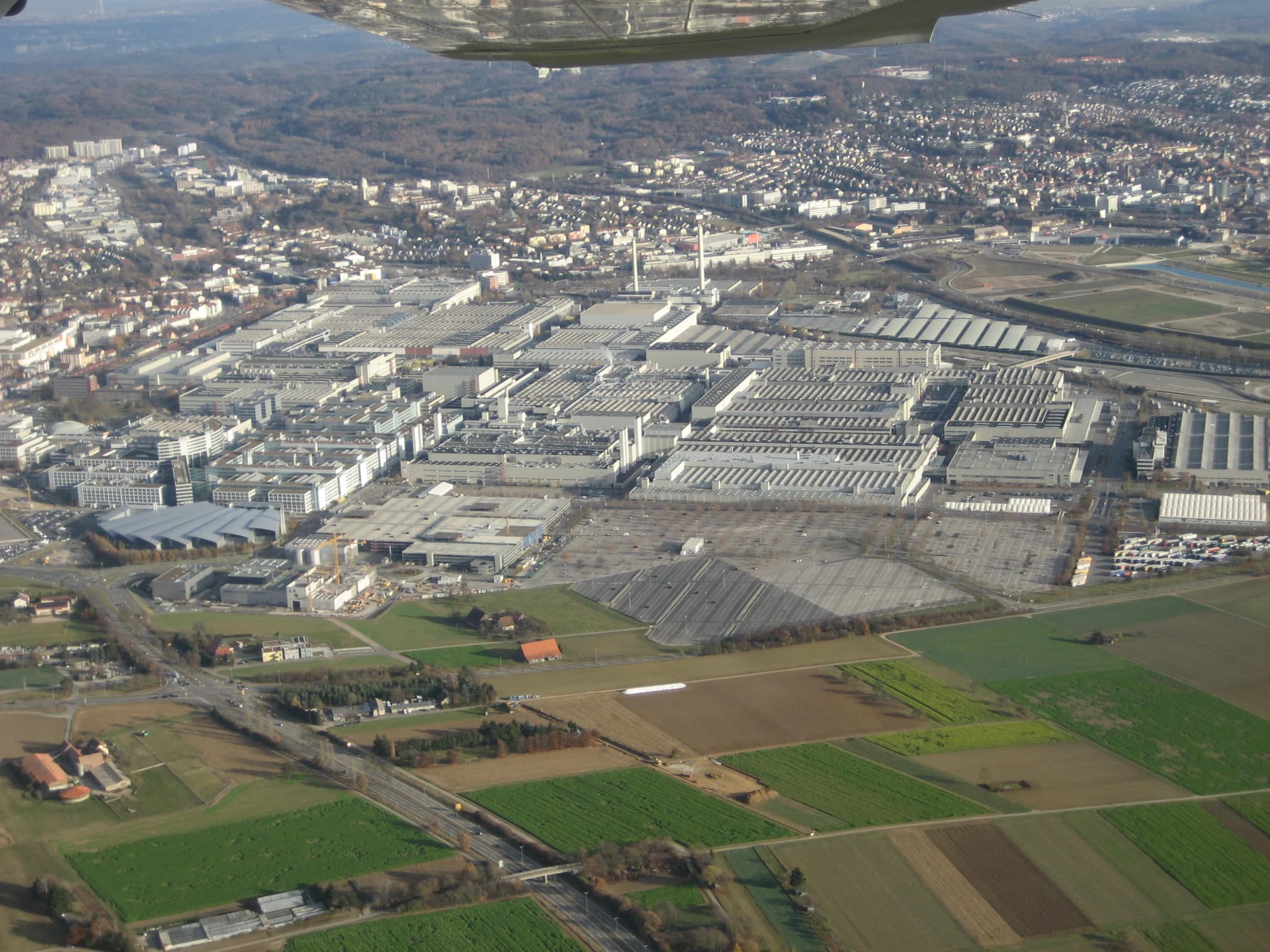
Mercedes-Benz has warned employees that keeping every German production site open can no longer be taken for granted. According to Reuters, the company’s production chief said that one assembly plant and one powertrain plant could close if labor costs do not fall enough to restore competitiveness.
This is not a plant-closure announcement. Mercedes has not named a site, given a decision date or disclosed a possible number of affected jobs. The company still says its aim is to retain all German locations. The new message is therefore a conditional warning, delivered against the background of a wider cost-reduction programme.
What the warning covers
Michael Schiebe, Mercedes’ production chief, made the remarks to employees in Sindelfingen. A company spokesperson confirmed the comments but did not provide a timetable for a decision. The distinction matters because the group’s German network contains several different types of facility, and their future would not necessarily be assessed in the same way.
Mercedes assembles passenger cars at Sindelfingen, Rastatt and Bremen. Its German powertrain network includes Untertürkheim, Affalterbach, Berlin, Hamburg, Kamenz, Kölleda and Arnstadt. None of those sites has been identified as a closure candidate. They are relevant because they show the scope of the network being reviewed, not because Mercedes has published a risk ranking.
A closure could also mean different things in practice. It might refer to a complete shutdown, a substantial capacity reduction or the transfer of individual operations. Until the company publishes a restructuring plan, it is not possible to say which interpretation applies. It is also too early to estimate the effect on suppliers, logistics companies or local economies.
The cost gap with Hungary
Mercedes has highlighted the difference between its German plants and the Kecskemét facility in Hungary. The company has said that cost levels at Kecskemét are roughly 70 percent lower than at German sites. That is a production-cost comparison, not a direct comparison of individual take-home pay and not a statement that all German output will move to Hungary.
The group’s official plans put German production capacity at about 900,000 vehicles, while Kecskemét could reach up to 400,000 units. Mercedes also intends to adjust global capacity to roughly 2.2 million vehicles by 2028. Another stated objective is a 10 percent reduction in production cost per vehicle from 2027 compared with 2024.
Capacity figures are planning parameters, not guaranteed sales volumes. A factory may be able to build a certain number of vehicles without operating at that level. Actual output depends on demand, model allocation, component supply and the ability to run different drivetrains on the same network. The figures explain the industrial framework, but they do not identify a future closure.
Germany’s role in the network
German plants remain central to Mercedes’ production system, yet the company has repeatedly described cost competitiveness as a priority. In earlier strategy communication, Mercedes said it had no plans to close German plants and wanted to balance the sites at an average capacity of about 300,000 vehicles. The new warning does not formally cancel that objective, but it shows that retaining every site is now presented as dependent on further savings.
The pressure is not limited to equipment. Mercedes is also changing its product mix and preparing plants for vehicles with combustion engines, hybrid systems and electric drivetrains. The company has not said that electrification alone is behind the two-plant warning. The public explanation is narrower: German production is not internationally competitive enough, particularly because of labor costs.
That issue is politically and socially sensitive. In July 2026, IG Metall criticised proposals linked to longer working hours and cuts to collectively agreed benefits, while calling for job protection. The union’s position does not prove that negotiations have failed or that a plant will close. It does show why any cost programme will involve difficult talks with employees and works councils.
Why the message matters beyond Germany
Large vehicle plants support much more than their own payrolls. Suppliers, freight operators, maintenance firms and local services can all depend on a stable production schedule. If Mercedes eventually reduces a site’s output, the regional impact could extend beyond direct employees. That remains a possible consequence, not a confirmed part of the current announcement.
The warning also matters to other European manufacturing locations. It shows that a premium carmaker is comparing plants across borders and linking the future of traditional industrial sites to measurable cost targets. Countries with lower production costs may become more important for additional capacity, while Germany could concentrate on higher-value models or operations that require specialised skills. Mercedes has not said that this will happen at a particular site, so it should be treated as context rather than a forecast.
For readers in Romania, there is no announced measure involving a Romanian Mercedes factory. The relevance is indirect: Romania’s automotive suppliers participate in European production chains, and changes in German volumes can eventually affect orders and logistics. No such effect has been confirmed in this case.
The verified conclusion is limited but significant. Mercedes says that two German plants could be at risk if costs do not fall: one assembly location and one powertrain location. The company has not named them, set a deadline or announced redundancies, and it continues to say that it wants to keep every German site open.
Image: Cdalkmann/Wikimedia Commons, CC BY-SA 4.0. The Sindelfingen photograph was converted and stored locally as WebP.