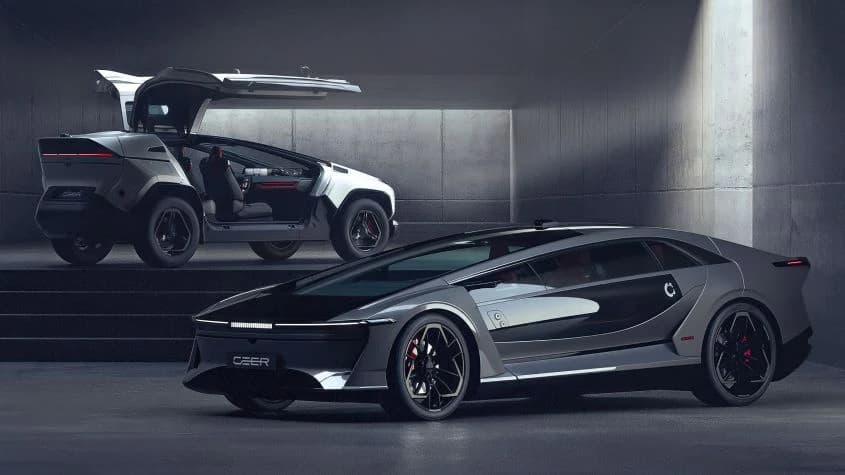
Photo: CEER, image taken from the Auto Express article.
Saudi electric-car brand CEER has revealed the EXOBOT sedan and EXOBOT SUV, its first two vehicles and the opening pair in a planned seven-model portfolio. The cars were shown at the CEER Manufacturing Complex in King Abdullah Economic City on 21 September 2026. CEER says both were designed and engineered in Saudi Arabia and will be built there.
The reveal does not amount to a confirmed European launch. CEER has not announced prices, a UK or EU launch date, a Romanian distributor or a service network outside its home market. The brand’s international website includes a market selector, but no export programme for EXOBOT has been confirmed. That distinction matters when reading the performance figures: the cars are public products, but not yet cars European customers can order.
A sedan and an SUV with different priorities
The sedan has a low roofline, a sharply angled windscreen and a long, smooth side profile. The SUV sits higher, with more ground clearance and heavily sculpted wheel arches. Images released for the reveal show slim lighting signatures on both, while the SUV also uses gullwing doors. CEER has not released full dimensions, kerb weights, boot capacity or detailed cabin measurements, so it is too early to place either vehicle accurately against established European models.
The two body styles are not simply cosmetic variants. Their official range figures are different, and the SUV’s higher body affects its stated acceleration and distance between charges. The available information does not say whether the battery pack, motors and suspension are identical. It also does not state whether the gullwing doors will remain unchanged on every production trim.
Manufacturer figures: 850 hp and NEDC range
CEER lists 850 hp for both EXOBOT variants. The sedan is quoted at 2.6 seconds for 0–100 km/h and an estimated 670 km of NEDC range. The SUV is quoted at 2.9 seconds and 560 km NEDC. Both are listed with an estimated 10–80 per cent charging time of 30 minutes.
These figures are official estimates, not Carboratory test results. CEER has not yet published battery capacity, peak DC charging power, energy consumption or detailed homologation data. NEDC is an older laboratory cycle and is not directly equivalent to a modern WLTP result. Ambient temperature, speed, tyres, traffic and heating or air conditioning can all move real-world range away from the headline number.
The sedan’s longer stated range is plausible for a lower and more aerodynamic body, but CEER has not supplied a drag coefficient or a WLTP estimate. The company also places an “IVM” label beside the acceleration data without explaining the measurement in the public specification page. Until a full technical sheet is released, the figures should be treated as the brand’s current claims rather than independently verified performance.
An international technology supply chain
CEER was launched in 2022 as a joint venture between Saudi Arabia’s Public Investment Fund and Foxconn. For EXOBOT, the company says it uses technology licensed from BMW, an electric vehicle architecture developed by Foxconn and high-performance drive units supplied by Rimac. The announcement does not identify each component in enough detail to establish how much of the platform is unique to CEER or shared with other vehicles.
The exterior design comes from Rob Melville, the former McLaren design chief associated with the P1, Senna, Speedtail and 750S. The connection explains the performance-oriented visual language, but it is not evidence of McLaren engineering involvement. No independent handling, braking, structural or durability results have been published.
Production and the seven-model plan
The EXOBOT sedan and SUV are planned for production at CEER’s manufacturing complex in King Abdullah Economic City on Saudi Arabia’s Red Sea coast. CEER says its future portfolio will reach seven models by 2030, including mid-size and compact vehicles with different propulsion options. The company is therefore presenting EXOBOT as the start of a local product programme rather than a standalone halo car.
That programme fits Saudi Arabia’s wider effort to develop domestic automotive manufacturing under Vision 2030. The industrial objective does not automatically translate into availability in other markets. CEER has not yet confirmed the regulatory work, distribution arrangements or warranty terms that would be needed for a European launch.
First Edition and the missing information
The First Edition is available in both body styles and is described as limited. Its published equipment includes Harrat Grey and White Musk paint, a black colour pack, red brake calipers, switchable lower-door tint, Nappa leather and a companion package. CEER lists a six-year or 200,000 km vehicle warranty and an eight-year or 200,000 km battery warranty. Scheduled service and roadside assistance are listed for six years, while home-charger installation is supported up to SAR 2,000.
Those terms are presented for the launch market and cannot be assumed for Europe. Price, production volume, battery size, Euro NCAP results and confirmed export markets are still unknown. For now, EXOBOT is best understood as the Saudi debut of a new EV manufacturer, with strong official performance claims and a manufacturing plan that still needs to be followed by full specifications and market information.