Nissan’s next GT-R may use round lights, but the company has not confirmed round headlights, a finished R36 design or even R36 as an official production code. Matthew Weaver, Nissan’s new global design head, gave Japan’s Best Car a deliberately conditional answer: if Nissan were to make an R36, it would have round lights. The original Japanese wording does not specify whether those lights are at the front or rear.
That ambiguity matters more on a GT-R than it would on most cars. The earliest Skyline GT-Rs had four circular headlights, while four round taillights became the family’s enduring signature from the Skyline era through R32, R33, R34 and the standalone R35. English-language coverage has interpreted Weaver’s phrase as headlights; another Japanese report treated it as a reference to taillights. Nissan has issued no design release that settles the question.
A design hint, not a production reveal
Best Car published its interview on 11 November 2026. Asked about the future car commonly called R36, Weaver said that if it were built it would have round lights, then declined to add detail. The conditional construction is central to the meaning. It is not accompanied by a sketch, prototype photograph, approved launch date or technical programme.
Weaver formally became Nissan’s Corporate Executive for Global Design on 1 October 2026, succeeding Alfonso Albaisa. Nissan’s appointment notice says he joined the company in 2001 and contributed to Qashqai, Juke and other projects across Europe and Japan. Best Car also identifies him with the R35’s distinctive C-pillar treatment. He therefore speaks with direct design authority, but a teasing interview answer is still different from an official model announcement.
Nissan has not publicly applied the R36 code to a production car. It is the logical and widely used successor label after R35, yet no current Nissan release defines a vehicle under that name. The final badge, platform, body, powertrain, price and launch markets remain unpublished.
Headlights and taillights lead to different histories
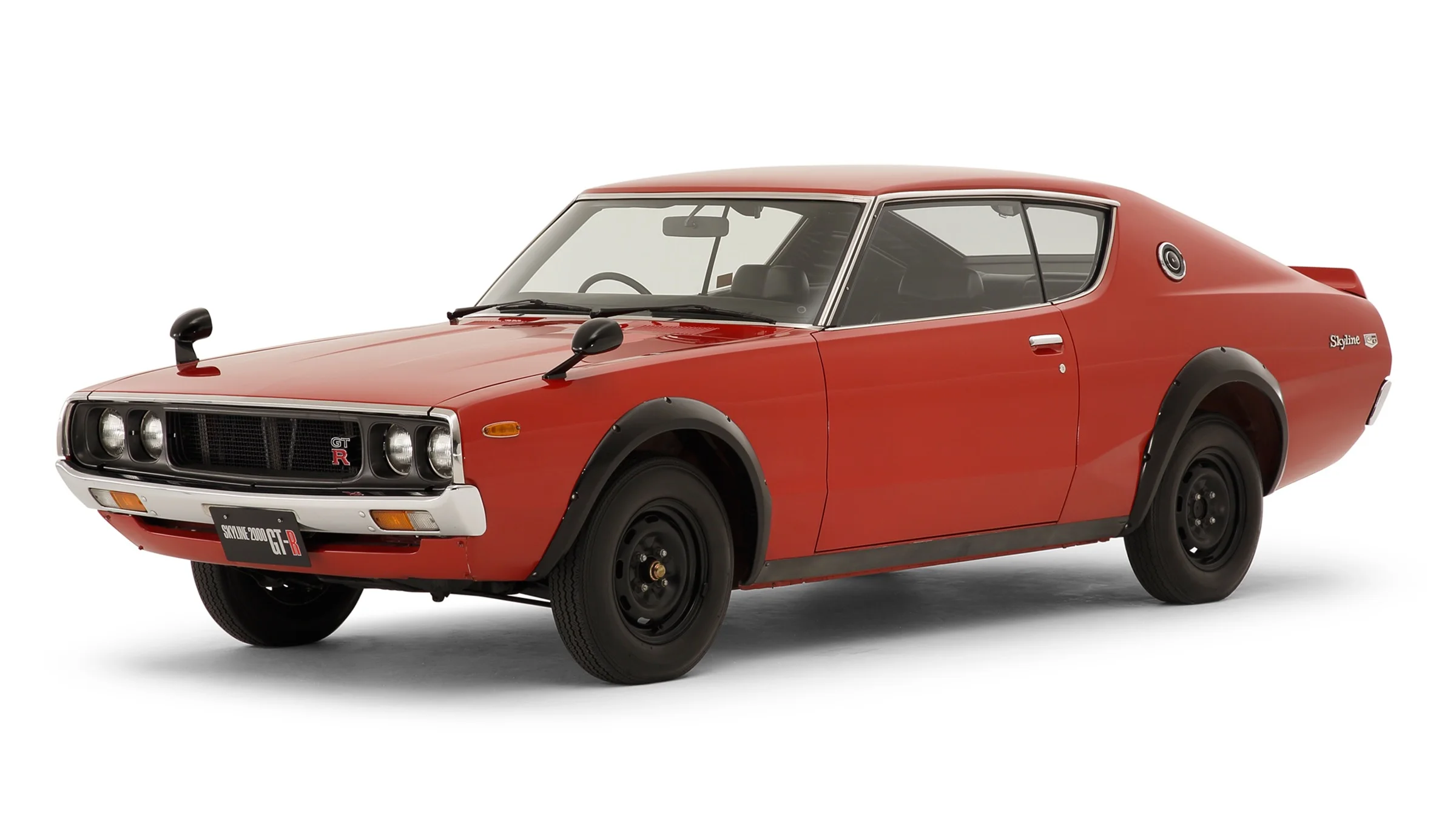
The phrase printed by Best Car is “marui light”: round lights. Motor1 translated this into round headlights, which creates a clear connection with the first Skyline GT-R generations. The 1969 C10 and the 1973 KPGC110 placed four circular lamps across their fronts. The official Nissan Heritage photograph used here shows the 1973 car, not a future GT-R or an R36 preview.
The KPGC110 is a particularly specific reference. Nissan’s Heritage Collection says the fourth-generation Skyline GT-R was made for only four months, from January to April 1973, with fewer than 200 produced. Its 1,989 cc S20 straight-six delivered an official 118 kW, and the car weighed 1,145 kg. None of those mechanical details points to a modern successor; the visual link is the four-lamp face.
Round rear lamps offer an equally credible interpretation. Nissan’s own history says the C110-generation Skyline introduced four ring-shaped taillights inspired by jet-engine nozzles. That arrangement became one of the clearest GT-R identifiers, surviving repeated changes in body shape and technology. A designer discussing the car’s protected identity could therefore be referring to the rear rather than proposing retro front lamps.
Even if Weaver did mean headlights, “round” does not require four exposed sealed-beam-style units. Modern circular elements can sit inside an angular housing or be expressed through daytime-running-light graphics. Claims that the next GT-R will look like a modernised Kenmeri go beyond the available evidence.
What Nissan has confirmed about the GT-R’s return
R35 production ended at Nissan’s Tochigi plant in August 2025 after an 18-year run and approximately 48,000 cars. The last vehicle was a Midnight Purple Premium Edition T-Spec for a Japanese customer. In the official farewell release, CEO Ivan Espinosa said Nissan wanted the GT-R name to return, while stating that no precise plan had been finalised at that point.
Espinosa went further in an April 2026 interview with The Drive, saying work on the GT-R was already under way. Nissan North America planning chief Ponz Pandikuthira discussed possible concrete announcements in 2028 and hoped to see the next car before the decade ends. Those are on-record executive expectations, not a published order date or a guaranteed production schedule.
The R35 establishes the engineering burden facing its replacement. Nissan’s official retrospective records 353 kW at launch in 2007, rising to 419 kW from the 2017 model year, while GT-R Nismo reached 441 kW. The VR38DETT twin-turbo V6, ATTESA E-TS all-wheel drive and continual model-year development mattered more than any single styling theme. Nissan has not said which of those technical elements will continue.
There is likewise no official weight, battery, motor, engine, gearbox or performance target for the next car. Reports of a hybrid configuration and a heavily revised VR38-derived engine come from executive interviews rather than a final Nissan specification. They should be treated as a development direction that can change as regulations and investment decisions evolve.
Hyper Force is context, not the R36 specification
Nissan unveiled the Hyper Force at the 2023 Japan Mobility Show as an all-electric high-performance concept. The company described up to 1,000 kW, a conceptual solid-state battery, e-4ORCE all-wheel control, active aerodynamics and light signatures paying homage to Nissan performance cars. Its visual references encouraged immediate GT-R comparisons.
Nissan did not call Hyper Force the next GT-R. Its claimed output and battery cannot be assigned to a future production model, and its heavily digital cabin and extreme aero are concept-car ideas rather than homologated equipment. It demonstrates that Nissan designers have explored a new performance flagship, not that R36 will be a 1,000 kW EV.
The same limit applies to magazine renderings. They may combine the Hyper Force, R35 and historic Skyline cues convincingly, but they are not Nissan images. A render with four round headlights cannot turn Weaver’s ambiguous phrase into a fixed design decision.
What buyers still need to know
There is no confirmed European price, Romanian allocation or market launch. Nissan has not said whether a successor will be sold wherever R35 was available, and low volumes, emissions rules and development cost could shape regional access. “Before the end of the decade” remains an executive aspiration rather than a customer delivery promise.
The useful conclusion is narrow. Nissan is working toward a future for GT-R, and its design chief wants round lighting to preserve a recognisable link with the nameplate’s history. Whether that means headlights, taillights or both will require an official image. Until Nissan publishes one, “R36 with round headlights” is an interpretation of a conditional comment, not a confirmed description of the next GT-R.
Sources
- Best Car: original interview with Matthew Weaver
- Nissan: Matthew Weaver’s appointment as global design chief
- Nissan: the end of R35 GT-R production
- Nissan Heritage Collection: 1973 Skyline 2000GT-R KPGC110
- Nissan Heritage Collection: the C110 Skyline’s four ring-shaped taillights
- Nissan: official Hyper Force concept release
- The Drive: Ivan Espinosa interview on the future GT-R