Opel is offering a 22 kW on-board charger across the Grandland Electric, Electric Long Range and Electric AWD variants. Announced on 3 November 2026, the change concerns alternating-current charging at a suitable AC point. Opel identifies the Grandland as its first passenger car available with an on-board charger of this rating.
The practical benefit depends on the power reaching the car. A compatible 22 kW supply can shorten an AC stop, but an 11 kW charging point remains limited to its available output. This is an update aimed at home, workplace and public AC charging, rather than an announcement of a higher DC rapid-charging rate.
What Opel’s time comparison actually says
For the Grandland Electric and Electric AWD with a 78 kWh battery, of which 73 kWh is usable, Opel compares approximately five hours at 11 kW with just over two and a half hours at 22 kW. The wording is approximate; it does not promise exactly two hours and 30 minutes in every session.
For the Long Range, with 96.9 kWh of usable battery energy, the stated comparison is six and a half hours versus three hours and 15 minutes. These are manufacturer figures rather than independent measurements from a Carboratory charging test.
The announcement does not attach a specific starting and finishing battery percentage to those times. They should therefore not be relabelled as confirmed 0–100% or 10–80% figures. A comparison with a time from another specification sheet requires the same state-of-charge window, as well as compatible charging conditions.
Opel lists station type and output, outside and battery temperature, battery condition and state of charge, vehicle equipment and vehicle settings among the factors affecting charging power and duration. The quoted reduction is conditional on the infrastructure supporting the higher power, alongside those other variables.
The hardware change concerns AC conversion
An EV battery is charged with direct current. At an AC point, the on-board charger converts the supply into DC inside the vehicle. Bosch’s technical explanation describes this unit as the interface that performs power conversion and controls charging according to battery-management requirements and available grid power.
With DC rapid charging, the conversion equipment is outside the car, in the charging infrastructure. The supply bypasses the on-board AC conversion stage. Consequently, increasing the AC charger rating does not automatically increase the vehicle’s DC charging capability. These are separate limits in separate charging paths.
The distinction also explains why a higher-rated public point alone is insufficient. A car fitted with an 11 kW AC charger cannot automatically use all the output of a 22 kW point. The new Grandland equipment removes that particular vehicle-side restriction where the rest of the charging arrangement supports the higher rating.
Power and energy should remain separate in the figures. The 22 kW number describes charging power, while 73 kWh and 96.9 kWh describe usable battery energy. Opel is not announcing a 22 kWh battery. Nor does the charger rating by itself establish a larger usable battery or a longer distance on a full charge.
Three electric variants, with different drivetrain figures
The announcement covers the Grandland Electric, Electric Long Range and Electric AWD. The 239 kW output and up to 509 Nm of torque quoted elsewhere in the release belong to the AWD version. They should not be applied to every Grandland that has a battery with 73 kWh of usable energy.
The AWD has two electric motors and four driving modes: Normal, Eco, Sport and 4WD. Opel says both motors operate continuously in 4WD. Sport changes the steering and accelerator response through a specific setting. Maximum power and torque are available in these two modes, according to the company.
The international announcement gives maximum WLTP ranges of 519 km for the Grandland Electric and 691 km for the Long Range. Those figures describe the configurations in that release; they are not an AWD range claim or a promise for every equipment combination. Actual distance depends on driving style, route, temperature, heating, air conditioning and thermal preconditioning.
The other equipment mentioned in the announcement
Opel also identifies Frequency Selective Damping as standard on the all-electric Grandland variants. The company describes different damping characteristics in response to the situation and road inputs, favouring comfort with short, higher-frequency impacts and a more direct connection with the road at lower frequencies.
That is the manufacturer’s explanation of the chassis system, rather than an independently established ride-quality verdict. Its inclusion provides context for the electric range but should not be confused with the charging change. The AC rating and damping characteristics address different parts of how the vehicle is used.
The international release does not give a Romanian price for the 22 kW equipment, a complete Romanian trim allocation or a retrofit programme for already delivered cars. It also does not establish that existing vehicles can gain the new rating through a software update. Local ordering specification and the charging supply need to be checked separately.
For a buyer, the useful comparison is therefore between the car’s stated AC equipment and the infrastructure used during ordinary stops. Where only 11 kW is available, a 22 kW on-board charger does not double the station’s output. Where the full supply is available, Opel’s comparison indicates the shorter parking period the new hardware is intended to enable.
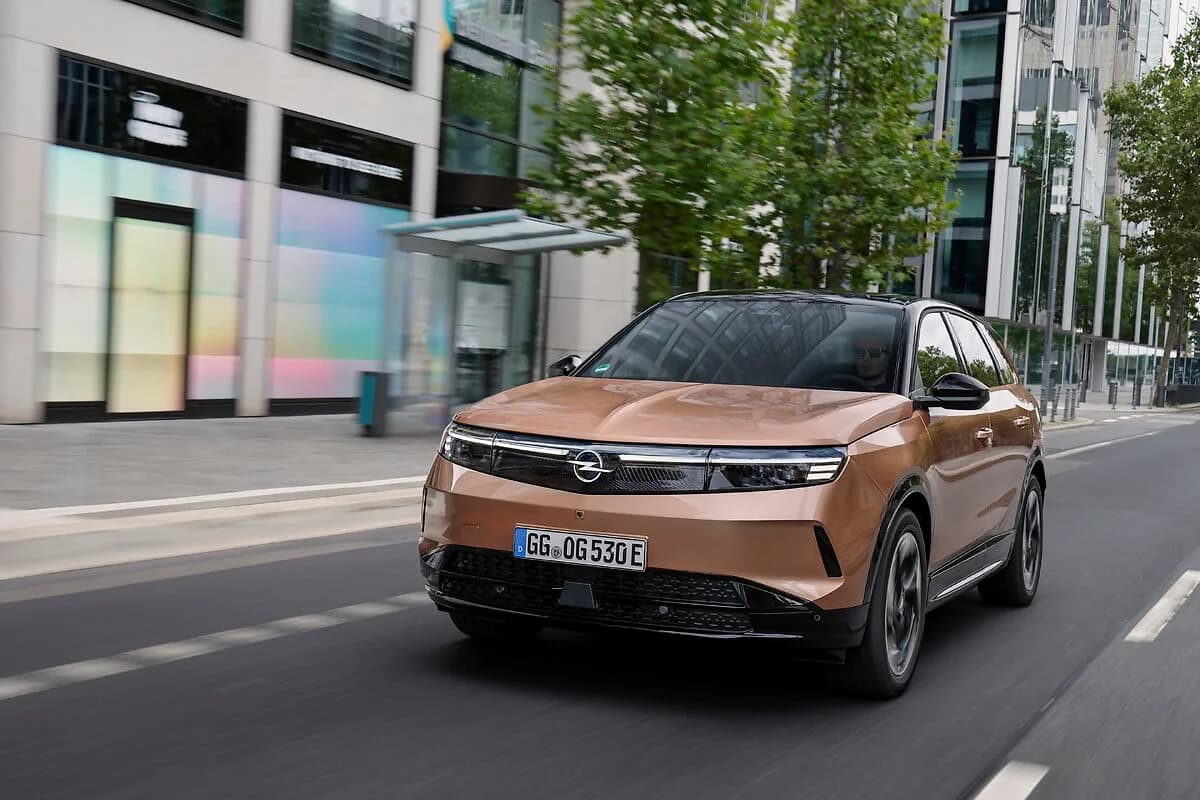
Official Opel Grandland Electric press image; exterior appearance does not confirm an individual car’s AC charging equipment. © Opel / Stellantis Media.