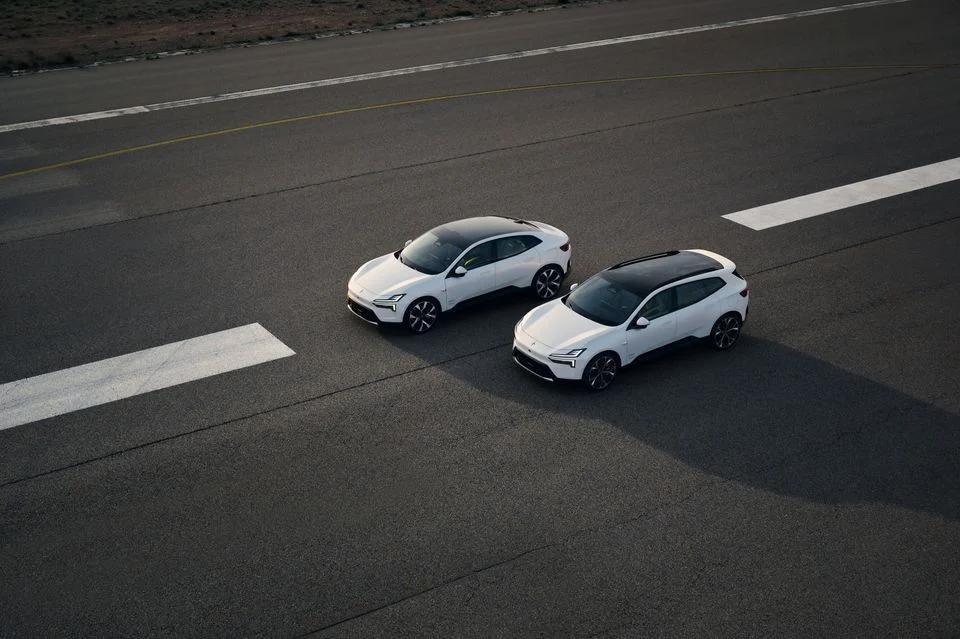
Polestar is rolling out one of the most substantial software updates yet for the Polestar 4. Version P4.3.0 adds Vehicle-to-Load power export, a dedicated Camping Mode, Android Automotive OS 15, a digital key for compatible Google and Samsung phones, and a group of convenience and driver-assistance changes. New Polestar 4s will leave the factory with the software already installed.
The update is intended for every Polestar 4, but that does not mean every car receives an identical feature set. Polestar says functionality can vary with market, model year and options. Hardware is particularly important for the new automated parking function, while V2L is excluded in three named markets. Owners should therefore check their car’s release notes rather than treating the headline list as universal.
V2L supplies up to 3.3 kW through the charge port
Vehicle-to-Load allows the traction battery to power external electrical equipment. The Polestar 4 can supply up to 3.3 kW at 230 V and 16 A on one phase through a compatible adaptor connected to its charging port. That output is suitable for camping equipment, laptops, lights, consumer appliances and some power tools, provided their combined demand stays within the system’s rating.
The adaptor is separate hardware, not a cable already built into every car. Polestar lists a compatible accessory in its Extras shop and instructs owners to use the approved unit. The manual also warns against using it when wet or damaged. To start a transfer, the car must be in Park, switched on and unlocked. A pulsing blue charge-port light identifies active discharge, while the central and driver displays show its status.
Drivers can choose a lower battery limit between 20 and 100 per cent. Twenty per cent is both the default and the lowest allowed setting. Power export stops when the battery reaches that figure, preserving a planned reserve for driving. It remains the driver’s job to choose a sensible margin for the distance to the next charger, the weather and expected consumption.
V2L should not be confused with Vehicle-to-Home or Vehicle-to-Grid. Polestar is offering a high-output mobile power socket, not announcing an approved system for feeding a house or the public grid. Any connection to a building installation requires dedicated equipment and electrical safeguards that are outside this update.
Camping Mode keeps climate control and outlets running
Camping Mode organises the functions needed during an extended stop. It maintains the selected cabin temperature and keeps the V2L connection, USB ports and 12 V socket available. Ambient lighting, media, climate settings and door locks are grouped for easy access. The mode is for a stationary vehicle and requires Park to be selected before activation.
To reduce light and energy use, the central and driver displays go to sleep 20 seconds after the last interaction. Touching the central screen wakes them and resets the timer. When battery charge reaches 20 per cent, Camping Mode shuts down automatically and the windows open to maintain air quality.
Polestar does not quote a universal number of camping hours. Consumption depends heavily on outside temperature, desired cabin temperature and the equipment drawing power. Heating the cabin through a cold night can use considerably more energy than ventilation in mild weather, so an owner planning an overnight stop should preserve enough charge for the following journey.
The practical gain is integration. Climate control and outlets no longer need to be managed as unrelated functions with different timers. The car maintains a predictable parked state and applies a clear minimum-charge safeguard.
Android 15 and a digital key for more phones
P4.3.0 upgrades the infotainment system to Android Automotive OS 15. Polestar says this improves overall responsiveness and performance, although it has not published comparative benchmark data. The package also improves display start-up after the car has been parked, remote controls in the Polestar app and Google Maps energy estimates. Those estimates can now account more accurately for instantaneous consumption and accessories such as load carriers or trailers.
Digital Key support expands to compatible Google and Samsung devices after previously reaching eligible Apple hardware. A configured phone can lock, unlock and start the car. Activation will be phased by market, and the primary driver needs a special code sent when the function is released locally. “Android support” does not mean that every Android handset is compatible.
The home screen gains nine positions for favourite shortcuts and apps, up from six. Available shortcuts include Car Wash Mode, Keep Climate, Animal Mode, Camping Mode, the front and rear defrosters and a headlight-off control. Approach unlocking and walk-away locking become separate settings, giving owners more control over proximity behaviour.
Valet Mode arrives, but automated parking needs newer hardware
The new Valet Mode restricts access to vehicle functions when another person is using the car. Owners can set a maximum speed and lock the glovebox, while the display allows only basic driving adjustments. It is a useful privacy layer for valet parking or a workshop handover, though it is not a substitute for removing valuables.
Park Assist Pilot is more limited. It is introduced for model-year 2026 and 2027 cars equipped with the Pilot Pack. At speeds up to 30 km/h, the system can identify perpendicular spaces, present them in the camera view and, once the driver confirms a space, control steering and braking during the manoeuvre. Model-year 2025 cars do not receive it because of hardware differences. It is also unavailable while the towbar is extended.
The update contains revisions to Pilot Assist, Lane Keeping Aid, rear-collision warning and mitigation, parking assistance and Lane Change Assist. A full pull of the indicator stalk now activates assisted lane changing, while a short pull temporarily suspends steering assistance for a manual change. These remain assistance systems; P4.3.0 does not make the Polestar 4 autonomous.
V2L availability is broad, but not global
Polestar says V2L will be offered in most of its markets, with the United States, Canada and South Korea explicitly excluded. That is an important regional distinction, because the rest of P4.3.0 can still reach cars in those countries. European owners are within the announced V2L area, subject to their individual car and availability of the adaptor.
The rollout is staged. The appearance of release notes does not guarantee that every vehicle receives the download on the same day. The car notifies its owner when the OTA package is ready, and the installed version can be checked under Settings, System and Software updates. Polestar also notes that some releases can reach workshops before they become available over the air.
P4.3.0 does not increase motor output, battery capacity or rated driving range. Its value lies elsewhere: the battery becomes useful away from a charger, the cabin is easier to manage during a long stop, and digital access covers more devices. For owners who camp, travel with equipment or work remotely, those changes may affect daily usefulness more than a minor specification increase would.