Renault Group’s new futuREady strategy places partnerships at the centre of its attempt to remain competitive through 2030. François Provost, who became Renault Group chief executive in 2025 after leading procurement, partnerships and public affairs, is using collaborations with other carmakers, suppliers and technology companies to shorten development cycles and spread industrial risk.
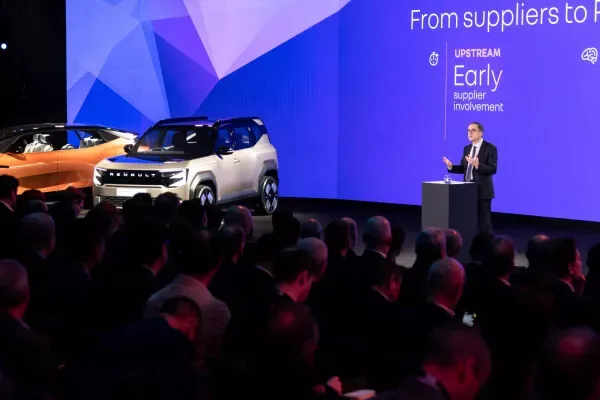
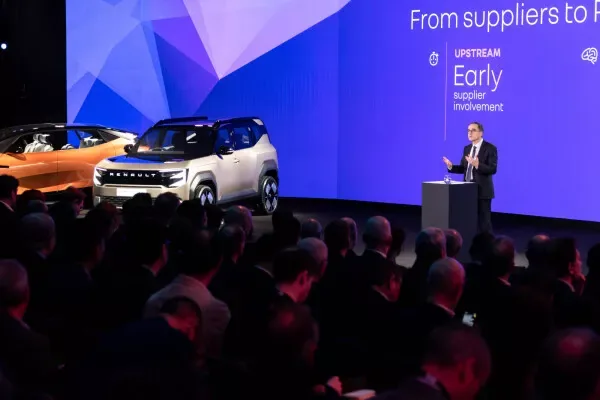 Renault Group / Wlad-Fisheye image from the futuREady supplier event. Used to illustrate the subject under the Renault Group media material’s conditions.
The strategy does not turn every cooperation into one alliance. Renault’s agreements have different purposes: Geely supports international and industrial projects, Ford is linked to electric vehicles built in France, Nissan and Mitsubishi remain part of the long-running alliance, and Volvo Group and CMA CGM were involved in the Flexis electric-van venture. The company also wants suppliers to contribute earlier to vehicle programmes.
What futuREady is designed to do
Renault Group launched futuREady in March 2026 as a medium-term plan following the Renaulution transformation that began in 2021. The group says the objective is to turn a successful turnaround into a repeatable system that can perform in a more volatile and competitive industry.
The plan has four pillars: growth-ready, tech-ready, excellence-ready and trust-ready. Growth-ready covers a second product offensive, with 36 launches planned by 2030. Tech-ready focuses on key technologies and targeted partnerships. Excellence-ready addresses costs, quality and industrial efficiency. Trust-ready covers relationships with employees, dealers, suppliers and other partners.
Renault wants to become a European automotive reference with global reach. That is a strategic ambition, not an achieved market position. The company reports that its operating margin rose from 3.6% in 2021 to 6.3% in 2025, while automotive free cash flow reached €1.5 billion in 2025. Those results give the group a stronger base, but they do not prove that every future partnership will be profitable.
Why Provost’s background matters
Renault appointed Provost chief executive in July 2025 for a four-year term. Before taking the role, he spent 23 years at the group and had been chief procurement, partnerships and public affairs officer. Renault highlighted his international operational and strategic experience when announcing the appointment.
That background helps explain the emphasis on cooperation. A partnership can provide access to technology, improve factory utilisation, increase purchasing volumes or share the cost of a new platform. It can also create dependencies. Partners may have different product priorities, financial targets and speed of decision-making. A cooperation therefore has to be measured by launches, costs, quality, volumes and cash flow rather than by the announcement alone.
Geely across several markets
Renault continues to develop its cooperation with Geely in South Korea and South America. The futuREady plan says the group wants to use the partnership to support international growth. In Brazil, Renault and Geely have announced cooperation involving distribution and the expansion of complementary vehicle portfolios. In South Korea, Geely owns a 34% stake in Renault Korea, where the partnership is connected to local production and access to models.
Geely is an important partner, but it is not a takeover of Renault Group. Renault remains a separate company, and the structure differs from one market to another. The potential benefit comes from combining platforms, factories and sales networks. The risk is that the two partners may not have identical priorities in every region.
Ford and electric vehicles in France
Renault has announced a strategic partnership with Ford covering electric vehicles and commercial vehicles. Renault’s futuREady materials say its European industrial expertise is already attracting Nissan, Mitsubishi Motors, Volvo Group through Renault Trucks, Geely and Ford. The group aims to produce more than 300,000 vehicles a year for other manufacturers by 2030.
That target is a plan, not an existing production result. The Renault–Ford cooperation has been described as involving smaller electric cars for Europe, with production at Renault facilities in France, and commercial-vehicle projects. The exact final models, volumes and timing remain subject to the partners’ programmes. It would therefore be inaccurate to describe the cooperation as a completed product launch.
The strategic logic is clear. Ford can use Renault’s European engineering and manufacturing capacity, while Renault can increase factory utilisation and spread development costs. Both companies also face competition from Chinese manufacturers and the high cost of creating affordable electric vehicles alone.
Nissan and Mitsubishi remain part of the ecosystem
Renault’s relationship with Nissan and Mitsubishi has a different structure from a single supply contract. The alliance includes shared technology, purchasing, platforms and market projects, although each company retains its own management and commercial priorities. Renault’s strategy documents continue to list the alliance as part of its partnership expertise.
The arrangement does not mean that every brand will sell identical vehicles or that all decisions are made by Renault. Its value lies in dividing costs and using scale where it makes sense. Renault’s 2030 production ambition for other manufacturers includes Nissan and Mitsubishi, but the final volumes will depend on confirmed programmes and market demand.
Flexis and electric vans
Flexis is a separate example of partnership-led industrial development. Renault Group, Volvo Group and CMA CGM created the joint venture in 2024 to develop a new generation of electric vans. In 2026, the companies signed an agreement that would allow Renault Group to take full ownership of Flexis, subject to antitrust approvals.
Full ownership could simplify decisions and give Renault more direct control over the product and manufacturing roadmap. It does not erase the contribution of the original partners. Volvo Group, through Renault Trucks, is expected to continue marketing the vehicle from 2027, while CMA CGM brought logistics expertise and investment interest to the original project. The first family is linked to the electric Trafic, Estafette and Goelette programmes.
Suppliers are being treated as strategic partners
FutuREady also changes the way Renault says it wants to work with suppliers. At a March 2026 supplier event, the group said key partners should be involved earlier in programmes involving strategic components and technologies. The stated aims are shorter development times, lower costs, more innovation and a more resilient supply chain.
Renault recognised Bosch, CATL, Google, Iberdrola and Valeo for specific contributions. CATL was recognised for the LFP battery pack intended for the Twingo E-Tech electric. Google was linked to connected services and openR Link. Iberdrola supports renewable energy, electrification and charging projects, while Valeo was recognised for software-defined-vehicle and cost work. These awards demonstrate cooperation; they do not mean Renault owns or controls the companies.
The risks behind the model
Partnerships can accelerate Renault, but they can also make the organisation more complex. The futuREady plan will be judged by the delivery of 36 new models, margins, factory utilisation, quality and cash generation. A larger network of partners does not remove the need to make difficult choices about platforms, brands and markets.
The confirmed facts are that Renault has made partnerships a formal strategic pillar, that Geely, Ford, Nissan, Mitsubishi and Volvo Group appear in its industrial roadmap, and that Flexis is moving to a new ownership phase. Open questions concern final vehicle volumes, exact model specifications, production timing and commercial performance.
Renault’s partnership strategy is therefore less a single deal than an operating model. Provost is betting that a focused European manufacturer can compete more effectively by combining its own strengths with the technology, capacity and market access of selected partners.