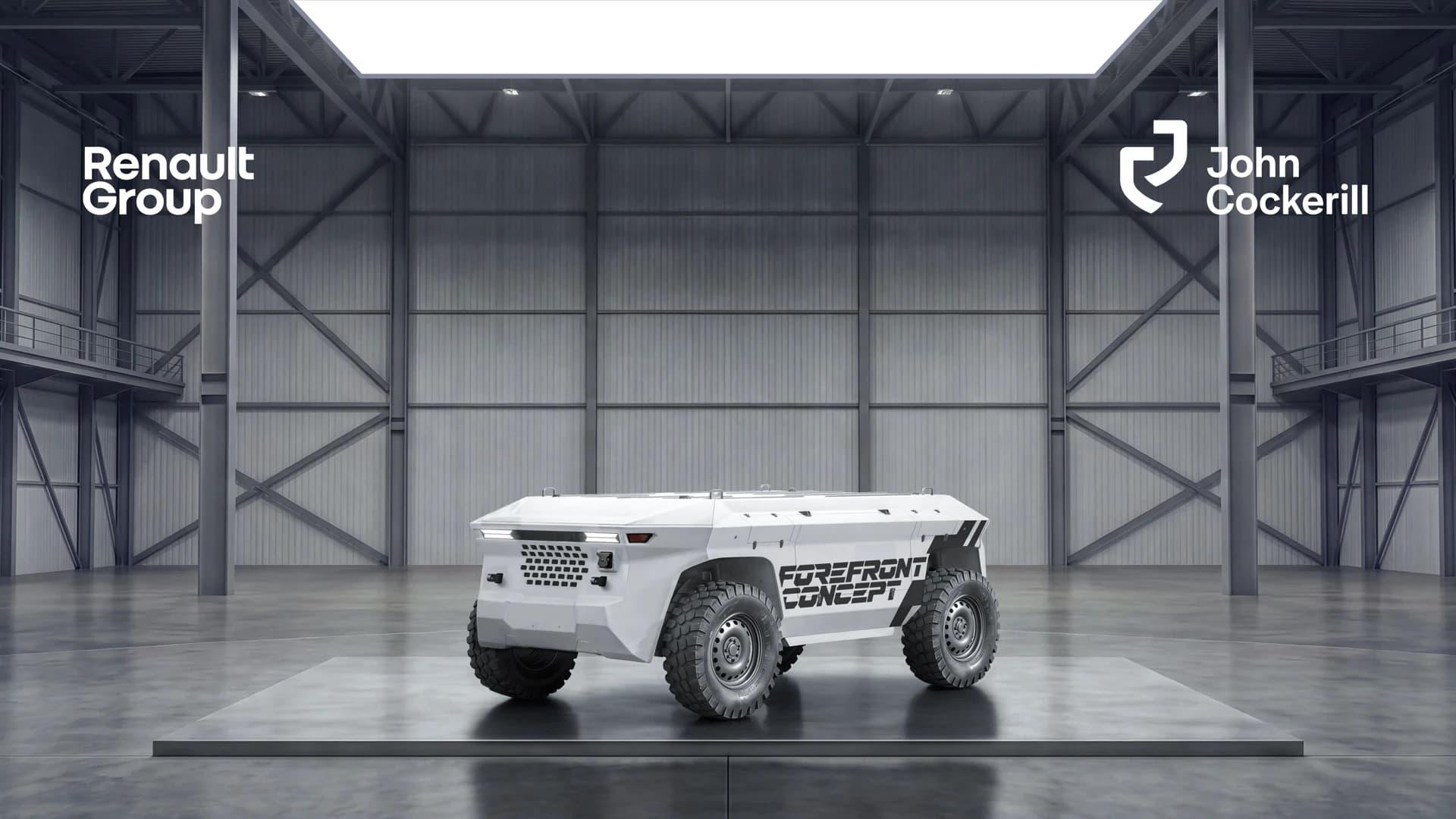
Renault Group and Belgian engineering group John Cockerill have unveiled Forefront Concept, a remotely operated ground vehicle intended for civilian and military work in hazardous or difficult-to-reach locations. Announced on 3 November 2026, the platform combines four-wheel drive, four-wheel steering and two electric motors. Its developers target approximately 400km of operating range and payload capacity of up to one tonne, rather than publishing independently verified production-vehicle results.
The joint announcement was issued from Boulogne-Billancourt in France and Seraing in Belgium. Forefront was developed with input from the French armed forces and is scheduled to participate in exercises and trials in the weeks following its presentation. The release does not announce series production, a procurement contract with a named military customer or a unit price.
A shared platform for different kinds of work
Forefront is described as modular, allowing the ground platform to carry equipment for different missions. The civilian applications listed by the partners include logistics, civil protection and interventions in constrained or hazardous working environments. Renault’s accompanying explanation also mentions critical-infrastructure security. These are proposed applications, without a named civilian customer receiving a production fleet in the announcement.
For defence, the release lists logistics support, intelligence and reconnaissance, counter-drone operations, fire support and evacuation. That list outlines the intended versatility of the platform. It does not establish that every illustrated configuration has completed validation or entered operational service. John Cockerill presents reduced personnel exposure to danger as an objective, without publishing a measured operational-risk reduction for the concept.
The images similarly show possible uses of the design. They should not be read as photographs documenting completed deployments or results from the coming trials. The distinction is especially relevant when a civilian logistics illustration and a military configuration use the same underlying vehicle architecture: a common base does not demonstrate that each mission system has already been qualified.
Range and payload remain development targets
Four driven and four steered wheels accompany the twin electric motors. The companies associate that arrangement with manoeuvrability and the ability to cross challenging terrain. Renault’s technical overview also states a claimed gradient capability of up to 60%. That is a percentage gradient, not a 60-degree slope, and the published material does not provide an independent mobility-test protocol.
The joint release describes an operating-range target of approximately 400km, extendable through a range extender. It does not disclose battery capacity, motor output, energy consumption, a measurement cycle or the effect of different loads on that figure. It therefore cannot be presented as a WLTP range, or as a guaranteed battery-only distance under every mission condition.
The target payload of up to one tonne is not the vehicle’s own weight. Nor does it guarantee the same operating range when carrying the maximum load. The announcement supplies no performance matrix covering each payload, surface or mission module. Those missing details matter when comparing a concept’s headline targets with the specifications of vehicles already being delivered to customers.
Renault supplies the mobile industrial foundation
Renault designed the mobile platform and contributes experience in modular architectures, electric powertrains, batteries and large-scale automotive industrialisation. The group says the project reuses proven automotive components and applies design-to-cost and design-for-manufacturing principles from the outset. The intention is to reduce development time and technical risk while preparing for production supported by an established supply chain.
That approach does not identify a particular Renault or Dacia passenger-car platform as the complete donor. The partners do not name an assembly plant, annual output or confirmed production-start date. Their statements about rapid industrialisation describe an intended capability, rather than evidence that a customer production line is already operating.
Renault chief executive François Provost frames the collaboration as an application of the group’s industrial and technological expertise to a sector with both civilian and military uses. His statement explains Renault’s intended contribution; it is not a purchase order or a revenue forecast. No programme budget or price for a finished Forefront vehicle accompanies it.
Remote operation and full autonomy are different stages
John Cockerill designed the remote-operation and autonomy functions for complex environments. It also contributes experience in vehicle militarisation, mission-system integration and operational support. The joint release describes modular, scalable solutions intended ultimately to allow fully autonomous operation while maintaining system safety and security requirements.
That wording is narrower than claiming the concept can already operate without supervision in every environment. Remote operation describes the central platform presented, while full autonomy is an intended development direction. John Cockerill chief executive Jean-Luc Maurange presents the combination of mobility, autonomy and defence expertise as the basis of the project. The announcement does not supply independent certification covering all possible operating scenarios.
Renault’s accompanying explanation sets boundaries around its defence involvement. The group says projects must be overseen by the French Ministry of the Armed Forces, involve French or European defence partners, generate activity for its sites in France and preserve its investment capacity. It also states that defence is not included as a growth driver in its automotive futuREady plan. For Forefront itself, the next announced step remains exercises and trials, with the concept refined using feedback from users.
Official illustrations: Renault Group / John Cockerill. Concept visuals, not photographs documenting completed missions. Resized and converted to WebP for editorial use.
Official concept visuals
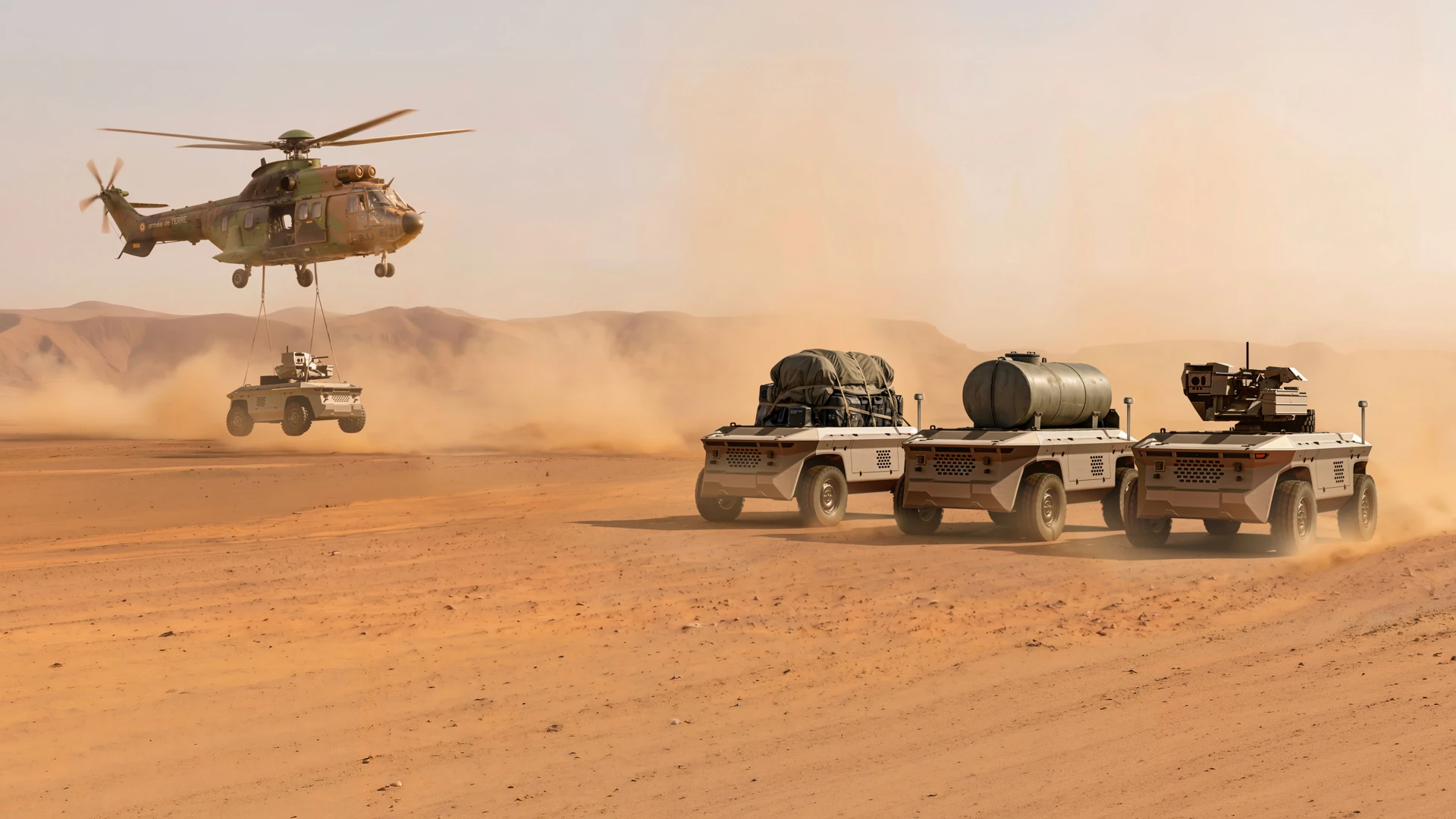
Illustrated military-use scenario for Forefront; this is not documentation of an actual operation. © Renault Group / John Cockerill.
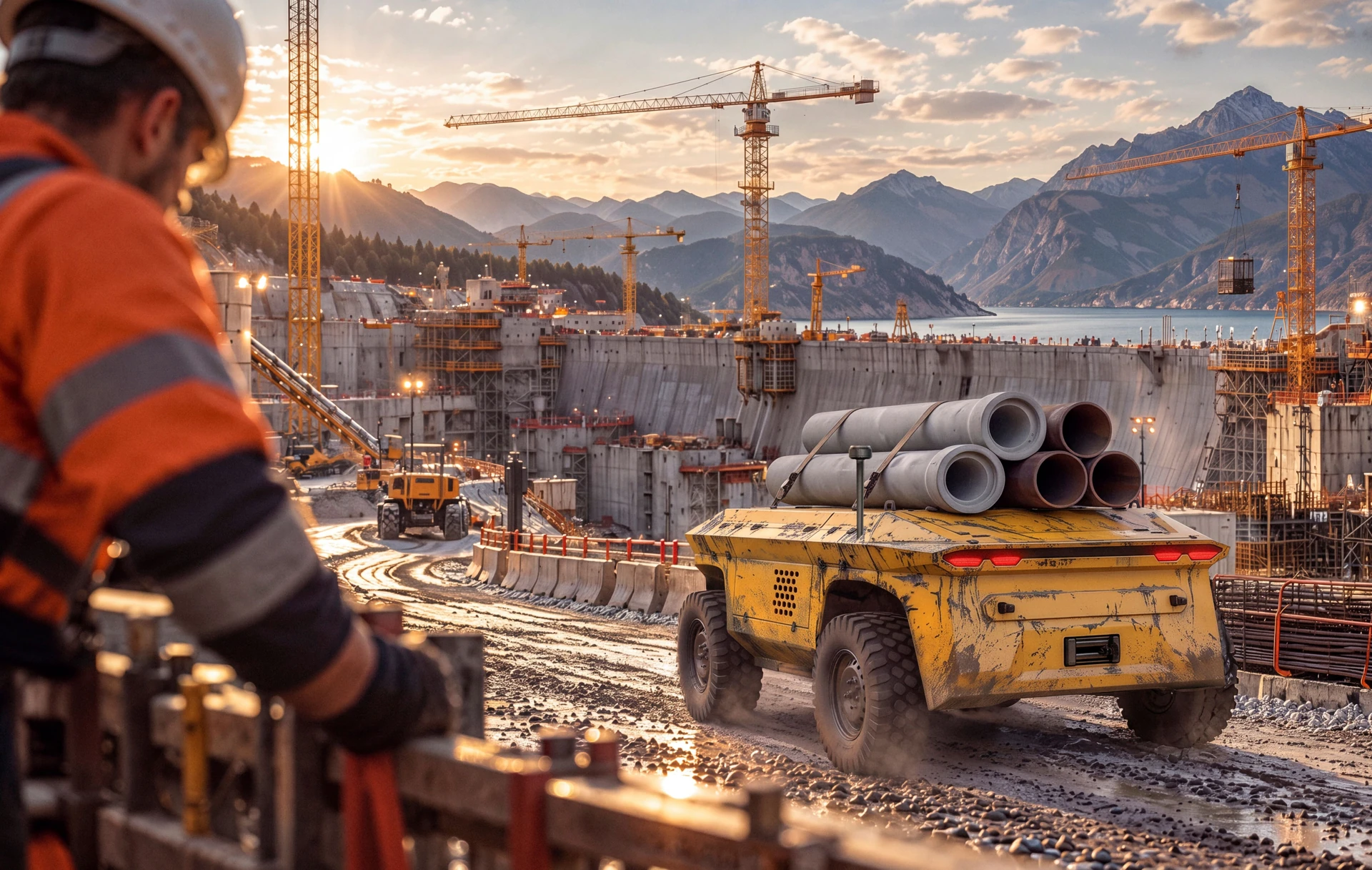
Illustrated civilian materials-transport scenario on a construction site. © Renault Group / John Cockerill.
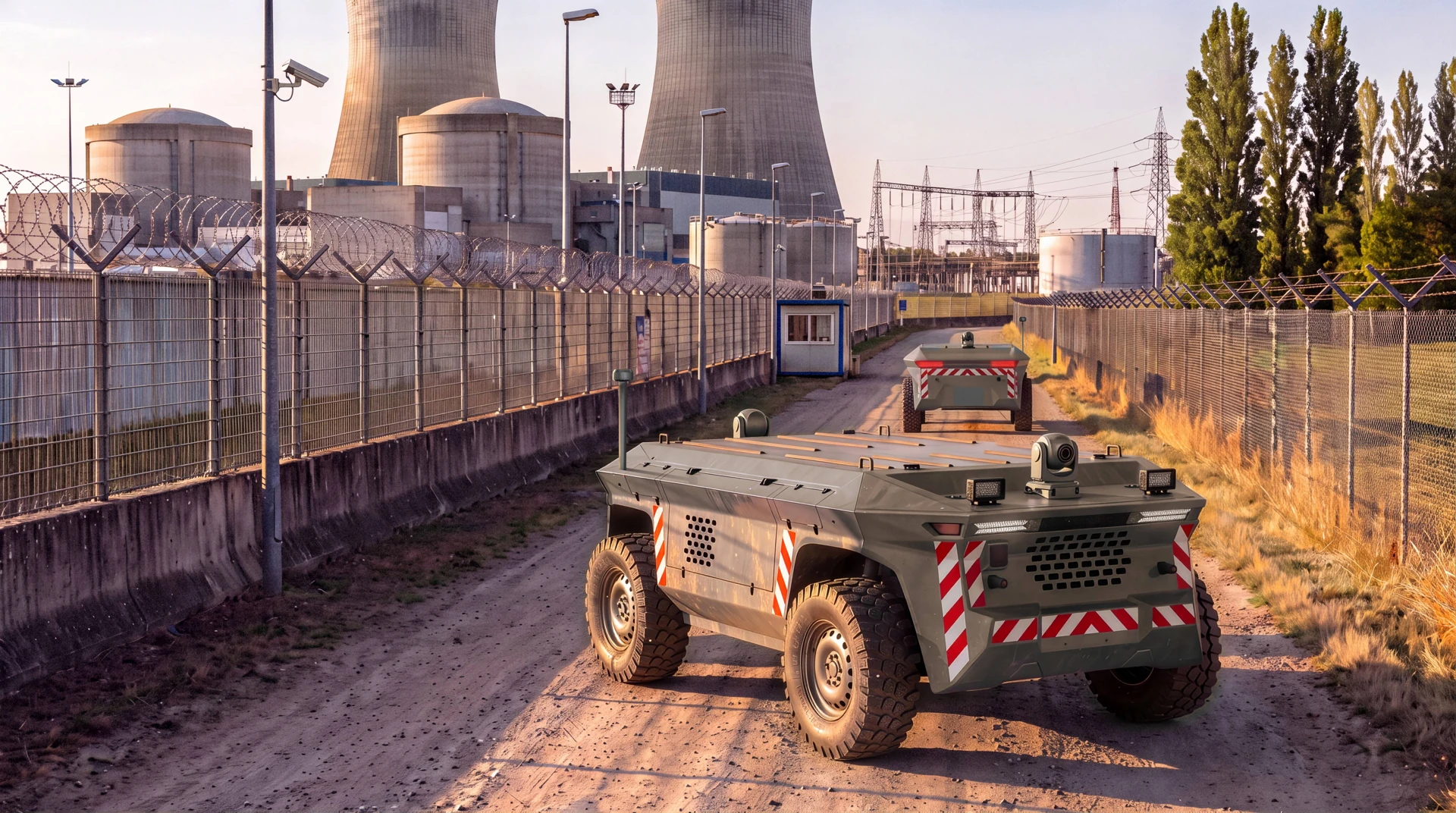
Illustrative infrastructure-security scenario, rather than a documented mission or field-test result. © Renault Group / John Cockerill.