
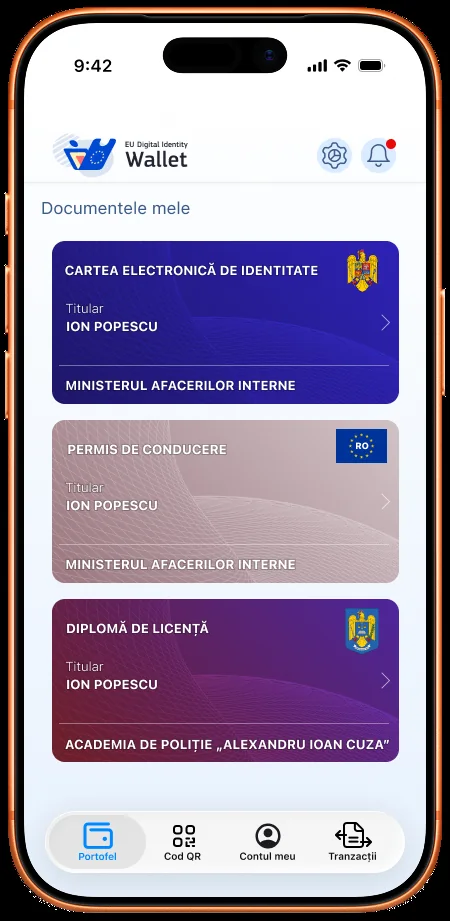
Official RO Wallet illustration. The project website says this is illustrative and not the final application interface.
Romania is preparing to move driving licences and identity documents onto smartphones through RO Wallet, the country’s digital identity wallet. The Ministry of Internal Affairs has described a phased public rollout beginning in January 2027. The first people expected to enrol remotely are holders of the electronic identity card, while holders of the traditional identity card are scheduled for a later, in-person verification stage.
That distinction matters. The announcement does not mean that every Romanian driver will immediately be able to leave the physical licence at home. The first phase depends on having a Romanian electronic identity card, a phone with NFC capability and the PIN associated with the card. The second phase, planned for the third quarter of 2027, is intended to extend enrolment to people with the classic identity card through a physical verification process.
What RO Wallet is designed to do
The official RO Wallet website describes a free mobile wallet for identity documents issued by official institutions. It is intended to hold the identity card, driving licence, diplomas, certificates and other credentials, then present them to a public authority or private service when required. The concept is different from keeping a photograph of a licence in a phone gallery: the digital credential is meant to come from an authoritative issuer and to be verifiable in the wallet ecosystem.
Romania is building RO Wallet as its national version of the European Digital Identity Wallet. The MAI links the project to Regulation (EU) 2024/1183, which extends the eIDAS framework. The common European framework is meant to allow national wallets to work across borders and to use common technical and security requirements.
RO Wallet says that documents in the wallet will have the same legal recognition as paper documents and that the service will be recognised across the European Union. The practical experience will still depend on each document type, verifier and integration. A wallet can be legally recognised while a particular company or checkpoint is still completing its technical connection. For that reason, the physical documents remain important during the transition.
The Ministry also presents the wallet as optional. People who do not want to use it can continue to rely on physical documents. This is relevant to drivers who travel, rent cars or cross borders: until the relevant verification process is available for a particular journey, carrying the physical licence and identity document remains the safer choice.
The rollout timeline
The MAI’s 6 October 2026 update describes several development milestones. A sandbox environment is planned for 31 October 2026 so integration partners can test their services. Stage one, beginning in January 2027, is based on remote enrolment for electronic identity card holders. The user reads the CEI chip over NFC and enters the card PIN to prove identity. Stage two is planned for the third quarter of 2027 for classic identity card holders, with in-person verification.
An information article published by the Ministry’s Revista Pentru Patrie gives more precise public milestones: a beta version on 22 December 2026 and an official launch on 14 January 2027. These dates should be read together with the staged access model. The launch date is not the same as universal access for every identity document.
The application is not yet available as a normal consumer download. The official site says that the app will be published in the stores at the official launch. Until then, images on the project website are demonstrations rather than proof of the final user interface or the final set of supported verification scenarios.
Driving licences are a central use case
The Ministry’s national survey, conducted from 13 to 27 September 2026 and based on 3,065 complete responses, shows why the project is relevant to motorists. Ninety-four percent of respondents identified the driving licence as a wanted document for the wallet, compared with 96% for the identity card and 92% for the health card.
Traffic checks were named by 89% of respondents as a desired use. Other proposed situations included public institutions at 84%, doctors or pharmacies at 79%, and banks at 78%. Use abroad or at a border was mentioned by 92%.
These figures describe expectations, not a promise that every scenario will work on launch day. For a traffic stop, a useful digital licence has to prove the holder’s identity and the validity of the entitlement to drive. It must be more than a static image. The verifier also needs an approved way to inspect the credential, whether online or through a supported offline process.
Selective disclosure and lost phones
RO Wallet is built around selective disclosure. The user is expected to decide which information is shared, with whom and for what purpose. The official website gives examples in which a person can prove a required condition without revealing every field in the identity document. That principle could make digital checks less data-heavy than presenting a complete physical card, although the exact fields will depend on the service.
The survey found that 84% of respondents wanted a history of sharing events, 80% wanted fingerprint or PIN unlocking, and 77% wanted to select the exact data and recipient. Those expectations are reflected in the project’s stated focus on consent and traceability.
The official FAQ says access is protected by a PIN, fingerprint or face recognition. If a phone is lost, the user must report the loss so the wallet can be deactivated. The credentials on that device then lose their validity until they are obtained again on a new phone. That procedure is important because it shows that a wallet credential is tied to a controlled identity system, not merely stored as an unprotected file.
For motorists, RO Wallet offers the prospect of a lighter digital wallet, but the first benefit will go to CEI holders who meet the technical requirements. Traditional identity card holders are scheduled for the later phase, and all drivers should keep physical documents until the relevant authority, service or border crossing confirms digital verification is available.


