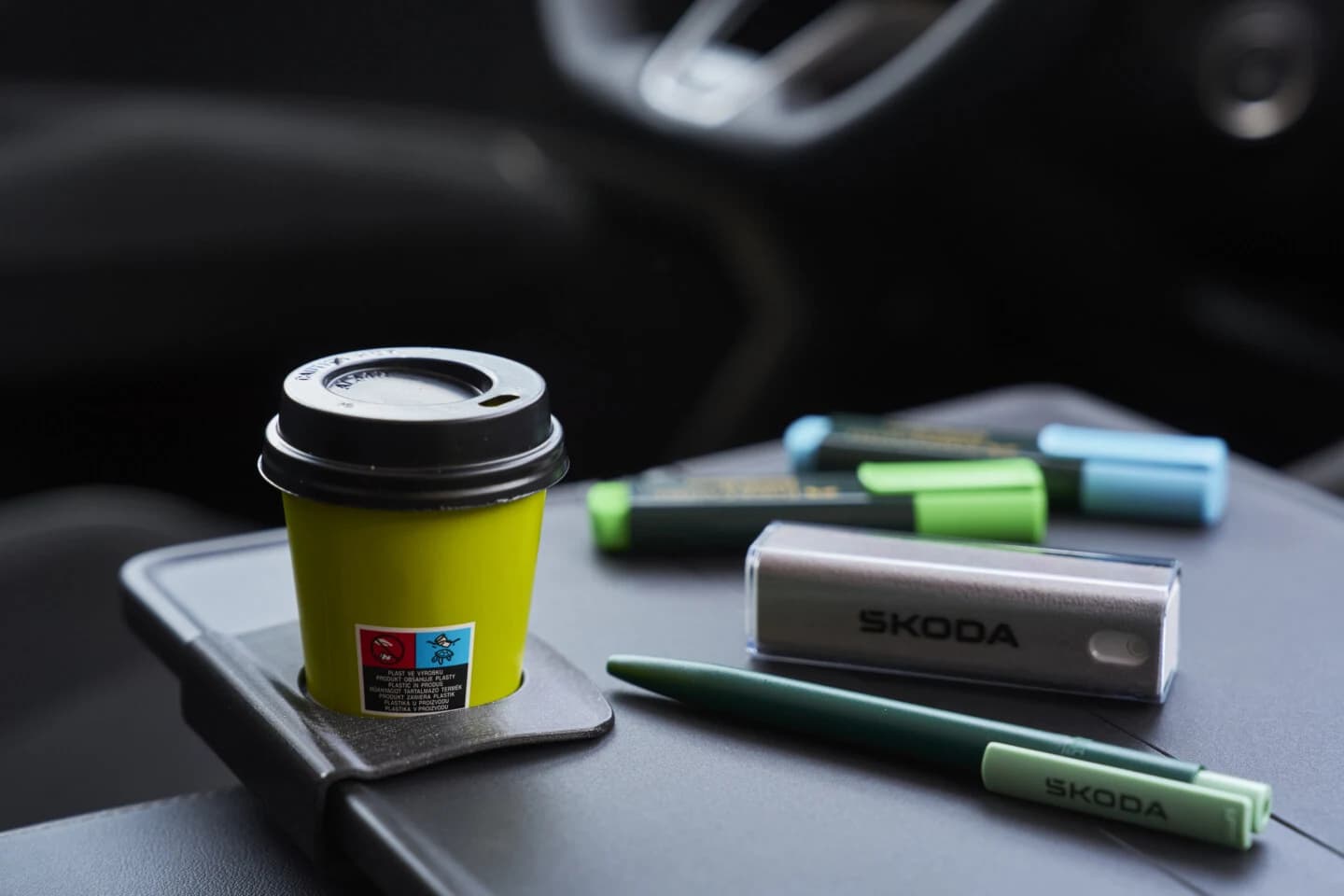
Škoda has launched an official library of files for car accessories that can be made with a 3D printer. The files are available free of charge through the brand’s Printables profile. The first selection includes cup holders, storage boxes, organisers, hooks and cable-management parts. It is intended for current cars as well as several models that are no longer in production.
The project extends the company’s Simply Clever philosophy into a digital format. Škoda has long used small storage solutions and practical details as part of its cabin design. With this initiative, some of the accessory production happens only when an owner needs it. The user downloads a file, checks the intended vehicle and part, and then prints it at home or orders the piece from a specialised service.
What is in the library
The catalogue is not limited to one universal accessory. Škoda lists cup holders, cable-management tools, coin boxes, USB cable hooks for the rear pockets of the front seats, phone brackets and hooks for the upper tether area. Several designs are meant to use storage spaces that already exist in the vehicle. An organiser can fit into a console, while a box can occupy an unused compartment without requiring a permanent alteration to the cabin.
That detail matters for owners who want a more useful interior but do not want to drill the dashboard or replace an original trim panel. A digital file can also be easier to adapt to a small need than a conventional accessory programme. A part with a limited audience may not make sense as a mass-produced item, while a downloadable design can remain available for anyone who needs it.
Free access to a file does not mean that every print is universally compatible. Each design is associated with a vehicle or a particular storage area. Owners need to check the model, generation, trim and installation position before starting a print. A printer that does not hold the intended dimensions or tolerances may produce a part that looks correct but does not fit securely.
Dedicated ideas for Epiq and Peaq
The new collection also includes parts developed for the Epiq and Peaq. Škoda mentions covers for cup holders, a large storage tray, inserts and holders, and an organiser for the lower section of the centre console.
The Peaq receives a clip-on cup holder for its folding table. The company says that the design is intended for standard and larger cups. These projects were requested by the community, according to Škoda, and feedback on Printables is being used to decide which ideas should be developed next.
This feedback loop changes the economics of a small accessory. A niche solution does not have to enter a conventional production and distribution chain immediately. If owners repeatedly describe the same problem, the company can publish a design for that specific use. The community therefore becomes a source of product ideas, while the manufacturer’s engineers and designers remain involved in the development.
From digital models to useful parts
The initiative follows Škoda’s earlier work with 3D vehicle models. In 2024, the company described how the models used for its online configurator could also support projects for the community. Users were able to print scale models, while Škoda said it wanted to extend the idea to functional accessories.
The current library was developed by Škoda’s innovation incubator together with engineering and design teams. The company says that a digital accessory can be made available without the lead times, tooling and inventory associated with a conventionally manufactured part. That advantage is most obvious for simple shapes designed to fit an existing compartment.
3D printing is not, however, a way to make a part appear instantly and without expense. The owner needs a printer, suitable material, time and some knowledge of the machine. An external print service removes the need to own the equipment, but adds a service charge and may require the file to be checked by someone else. In either case, the final result depends on print settings, layer orientation, material and post-processing.
Fit, material and temperature still matter
Every printed part should be checked before it is installed or used. The owner should read the information attached to the file, confirm the intended model and follow any recommendations for material and print settings. A car interior can become very hot in direct sunlight. Some plastics soften, deform or lose strength more quickly than others, and the same design may behave differently depending on the printer and the chosen material.
This matters for boxes, hooks and holders that carry objects. It matters even more for any accessory associated with a seat-belt attachment point. Škoda says that the top-tether hook has been the most popular accessory so far, but the release does not publish detailed test results for every printer and material owners might use. An official file should therefore not be read as universal certification for every finished print.
The company says that many designs do not require modifications to the vehicle. That reduces the risk of damaging original trim, but it does not remove the need to check the fit. A loose part can rattle, fall out, block a compartment or interfere with another item in the cabin. Owners should also avoid placing an accessory where it could obstruct a control, visibility or a safety-related component.
Current and discontinued models
Škoda presents the library as covering current cars and many discontinued models. For an owner of an older vehicle, this could provide a way to replace or add an organiser that is no longer available through a dealer accessory catalogue. For a newer model, the files can complement the standard equipment with a part shaped for a particular area of the interior.
The full collection is available from Škoda’s official Printables profile and may grow with further feedback. The top-tether hook is currently the strongest performer according to the company, but Škoda has not published sales figures or an estimate of how many physical parts have been printed. In this early phase, the response is being reflected through the performance of files and community reactions on the platform.
A digital version of Simply Clever
3D printing will not replace a conventional accessories shop, and it will not solve every interior problem. It is most useful when the shape is relatively simple, compatibility can be checked and the owner has access to suitable printing. Škoda is turning part of its accessory work into a digital library that the community can use and help shape.
For owners, the practical question is not only which file can be downloaded. It is also whether the chosen printer and material can produce a part strong enough for the place where it will be installed. The official library provides a starting point; checking the vehicle, selecting the material and inspecting the finished fit remain the owner’s responsibility.