Slate Auto has turned the absence of a central display into a joke it can sell. Its new “Screenless GPS” is not an electronic unit and cannot calculate a route. It is a Slate-branded copy of Rand McNally’s 2027 Road Atlas, offered in limited numbers for the equivalent of about €27 before shipping and tax. The conversion uses the European Central Bank reference rate of 13 November 2026, when €1 equalled $1.1052.
The name is deliberately tongue-in-cheek. A paper atlas has no satellites, live traffic, voice prompts or turn-by-turn guidance. It needs no battery, mobile signal or software subscription, but it also cannot know that a road closed after it went to print. The product matters less as a navigation tool than as a concise explanation of the Slate Truck: the electric pickup has no built-in infotainment system or integrated navigation.
What the buyer actually receives
The item is a printed Rand McNally atlas for the United States. Rand McNally describes its road-atlas range as including state and provincial maps, metropolitan insets, mileage and driving-time charts, indexes and tourism or road-condition contacts. That information can help with broad route planning or provide a backup when a phone is unavailable. It is not a GPS receiver, and “screenless GPS” should not be read as a technical product category.
Slate calls the book “the original navigation system” and sells it as branded merchandise. The approximately €27 figure is a currency conversion, not a European retail price. Slate has not disclosed the production run, restocking plans or an international release. Its current FAQ says the vehicle and Slate accessories are available only in the United States for now.
That geographic limit is important. A US road atlas has little practical value to a driver in Germany, France, Italy, Spain or Romania beyond being a souvenir. The wider product decision is more relevant: Slate expects the driver to bring the digital interface, accounts and mapping service instead of embedding another computer in the dashboard.
The phone is Slate's real digital navigation system
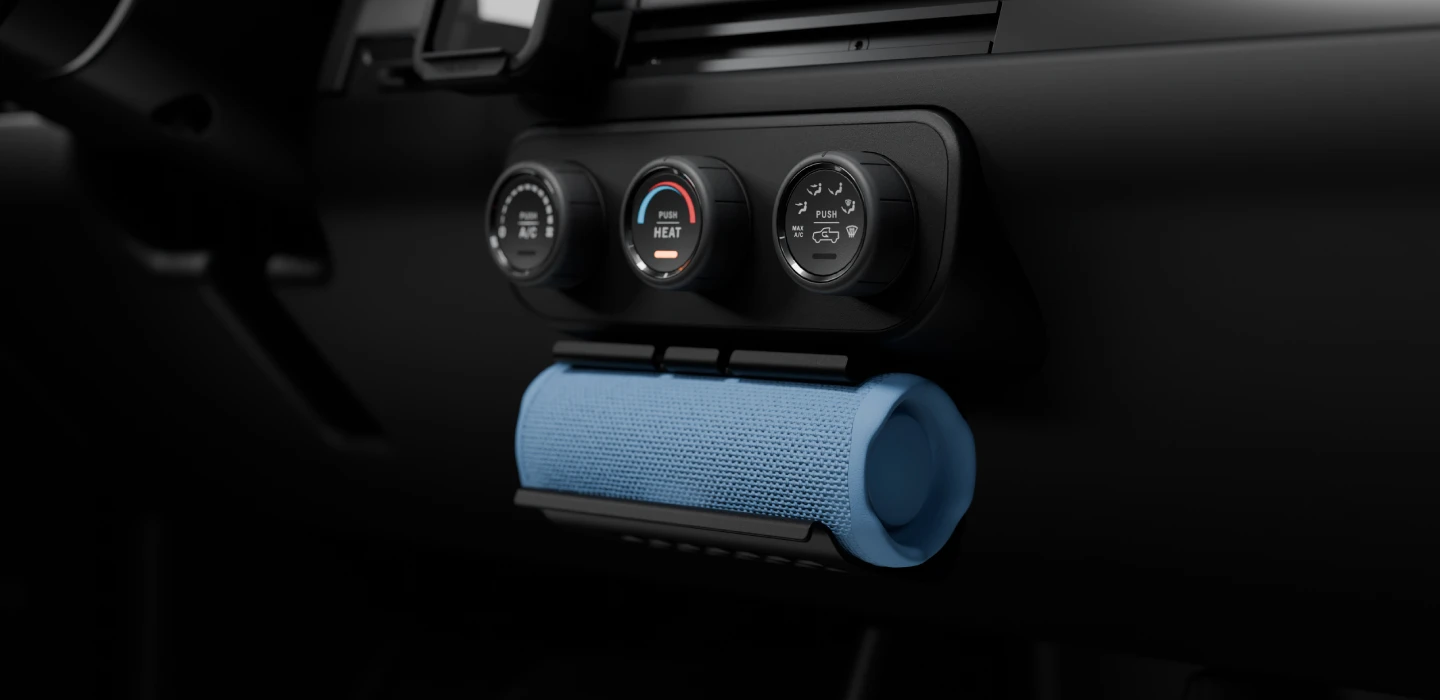
Slate says mounting and charging for a phone are included. A bracket for a larger tablet is optional, while sound can come from a portable Bluetooth speaker or accessory audio fitted to the dashboard. There is no Apple CarPlay or Android Auto because there is no in-car infotainment screen onto which those interfaces need to be projected. Apps run directly on the owner's phone or tablet.
The approach has plausible benefits. Drivers keep a familiar interface and their existing subscriptions, and the device can be replaced independently of the vehicle. Mapping apps generally evolve faster than an embedded head unit, while the cabin can retain direct physical climate controls. Slate also argues that removing an integrated system avoids making every customer pay for hardware that may become dated during the vehicle's life.
It transfers responsibilities to the user, however. The phone must be securely mounted, visible without blocking the road and connected to power. Heat, notifications, mobile coverage and the chosen app's data practices become part of the driving experience. Downloaded offline maps may address a coverage gap, but that ability belongs to the app and device, not to the truck. A printed atlas is a useful fallback only if the driver knows how to read it and accepts that its information is static.
The truck is still a pre-production vehicle
The Blank Slate is a two-seat, rear-wheel-drive electric pickup with a rear-mounted 135 kW motor. Slate currently projects about 330 km of range from the standard battery. The company says that estimate is based on an approximation of the EPA test cycle and is not yet an official EPA value. Its June 2026 announcement placed the base price at the equivalent of roughly €22,575, excluding destination, taxes, registration, documentation and options. That euro figure is for context; US customers are charged in dollars.
Slate said first deliveries were expected in the fourth quarter of 2026. Its current preorder page gives new customers a July-to-September 2027 delivery window. Those statements do not necessarily conflict: early reservation holders can receive vehicles before people entering the queue now. They do show why “available” needs care. The company is accepting preorders and running demonstration events, but the truck remains in pre-production and final specifications can still change.
The lack of infotainment does not mean the vehicle lacks all modern equipment. Slate lists heating and air conditioning, a reversing camera, forward-collision warning, automatic emergency braking, pedestrian identification and electronic stability control. Manual window winders and unpainted composite exterior panels are part of the cost-focused formula. Buyers can add accessories later, including audio hardware and conversion kits that turn the pickup into a five-seat SUV.
A clever campaign does not settle the usability question
Selling an atlas does not prove that drivers want to abandon digital navigation. Nor does it establish that integrated displays are wasteful in every vehicle. It is a piece of merchandising that makes a missing feature feel intentional and memorable. In marketing terms, Slate has converted a cost decision into a visible brand position.
Daily use will provide the more meaningful evidence. Owners will be able to judge whether the phone mount remains stable, whether charging and glare are well managed, and whether separate navigation and audio devices are genuinely simpler. An integrated system can offer a clean connection to vehicle data and controls; a bring-your-own-device layout can be cheaper to update. Neither outcome follows from the atlas alone.
For now, the accurate description is narrow. Slate is selling a limited, branded edition of a printed 2027 US road atlas for the equivalent of about €27. It is not an electronic GPS, it is not included as standard equipment, and it is not a European product. The real navigation plan for the screen-free truck is the driver's own phone.
Sources
- Slate Auto FAQ — infotainment, phone use, price, range and US availability
- Slate Auto — personalisation and the bring-your-own-tech interior
- Slate Auto — current preorder delivery window
- Slate Auto — June 2026 price and delivery announcement
- Rand McNally — road-atlas features
- European Central Bank — 13 November 2026 reference rate
- InsideEVs — original report on the Slate-branded 2027 atlas