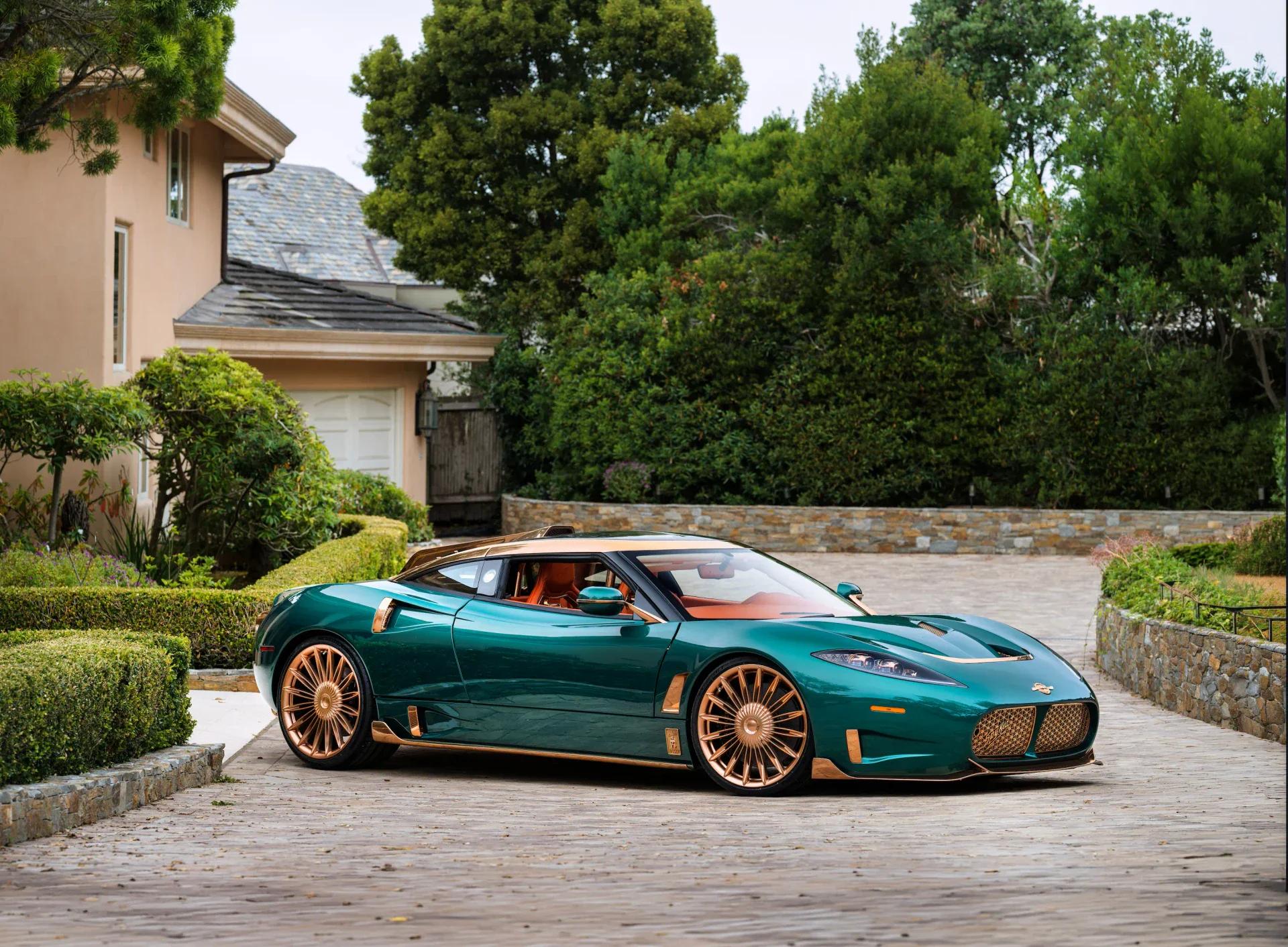
Spyker says customer deliveries of the C8 Preliator XXV Coupe will begin in the second quarter of 2027, with the full 25-car run scheduled to be completed by the end of that year. Founder and chief executive Victor Muller gave the timetable in an interview with CarScoops, three months after the car made its public debut at The Quail during Monterey Car Week.
The schedule is the clearest production commitment attached to Spyker's latest revival, but it remains a company target. No customer car has yet been publicly documented as delivered, and Spyker has not disclosed a base price, the number of signed orders or a month-by-month manufacturing plan.
A nine-month window for 25 hand-built cars
Starting in the second quarter leaves roughly nine months to finish the complete batch before 31 December 2027. That matters because Spyker describes each Preliator XXV as a labour-intensive commission rather than a conventional production car. The company puts the build time at about 2,100 hours per vehicle.
Coventry Prototype Panels in England forms the new aluminium exterior panels, while the car uses an in-house spaceframe that Spyker says was redesigned for this generation. Chassis numbers are stamped by hand. One craftsperson reportedly spends four hours stitching the steering wheel with two needles, and the visible screw heads in the cabin are aligned in the same direction.
Those details explain the low volume, but they do not by themselves prove the factory can meet the announced cadence. Muller says engineering is complete and funding is in place. He also says enough buyers are available to support the business. Spyker has not published deposits, contracts or a waiting-list total, so demand should be treated as a management statement rather than independently confirmed sales data.
Official performance figures remain manufacturer claims
The C8 Preliator XXV uses a 4.0-litre twin-turbo V8 rated at 800 hp and 1,000 Nm. Power goes to the rear wheels through a six-speed manual gearbox. There is no dual-clutch or automatic alternative in the specification presented by Spyker.
The manufacturer's product page lists a dry weight of 1,525 kg, a claimed 0–100 km/h time of 2.7 seconds and a maximum speed above 349 km/h. It also specifies six-piston Spyker brake calipers and carbon-ceramic discs. These numbers have not been presented as Carboratory test results, and no independent instrumented test of a customer-specification car has been published.
A roof-mounted intake feeds the V8, while the exhaust exits high on the rear bodywork. Spyker has moved the fuel tank from the sills to a compartment behind the seats and ahead of the engine. The rear luggage compartment has consequently moved to the nose. The entire rear body section can open in the company's so-called butterfly mode, exposing the engine bay.
The analogue pitch is more than a gearbox
Spyker is using the manual transmission as the most visible distinction between the XXV and many current hypercars. The shift linkage is exposed in the cabin and operates as a mechanical assembly rather than an electronic selector. Analogue instruments and physical switches dominate the dashboard; the head-up display is the only screen identified in the launch release.
The design repeats aviation references used by modern Spykers since 2000. NACA ducts form the air intakes, the rear lamps resemble jet afterburners, and a prominent fin refers to the 1919 Spyker C1 Aerocoque. An isogrid pattern appears in the grilles, pedals, exhaust mesh and seat upholstery. On the launch car, Quail Green paint contains rose-gold flakes, the exterior brightwork is finished in rose gold, and the cabin uses Tuscan Saddle leather.
That display specification should not be read as a standard trim level. Spyker says every one of the 25 cars will be individually commissioned. Without a published configurator or price list, buyers cannot yet compare the cost of those finishes or establish what equipment is included in a base car.
A 50-car annual ambition needs more models
Muller told CarScoops that Spyker could build 50 cars worldwide in a good year. The Preliator XXV run would account for only half that volume if all examples are completed in 2027. Reaching the wider target therefore depends on further body variants or models, none of which currently has a confirmed customer-delivery date.
Spyker's August announcement mentioned the proposed D8 Peking-to-Paris SSUV, new owner services and an ambition to return to GT3 endurance racing. Those are plans, not programmes with published homologation or production milestones. The company has also spoken about keeping its road cars analogue while using W Group's digital infrastructure around customer services.
Volodymyr Nosov became a co-owner of Spyker through the investment announced in 2026. Muller presents that funding and the W Group partnership as the foundation for the relaunch. The useful test will be completed cars, not the breadth of the plan: the first delivery window now begins between April and June 2027.
Pagani and Bugatti are a positioning claim
Muller says Spyker intends to sit at the top of the market alongside Pagani, Koenigsegg, Bugatti and Gordon Murray Automotive. The comparison describes the segment Spyker wants to enter. It is not evidence that the C8 matches those manufacturers in tested performance, residual value, production reliability or customer support.
Spyker's case rests on a different set of attributes: hand-formed aluminium rather than a carbon-fibre body, a conventional clutch pedal, a short production run and extensive owner specification. Price will be central to judging that proposition, yet the manufacturer still does not publish a starting figure. It also provides no market-specific warranty or service information on the model page.
For a prospective European buyer, the practical questions are therefore contractual. Delivery timing, road homologation, warranty coverage, servicing arrangements and the price of bespoke finishes need written answers before the visual specification is settled. An appointment form on Spyker's website is currently the public route into the purchase process.
The Q2 2027 date makes the comeback more measurable than it was at the August reveal. It also creates a straightforward deadline: Spyker plans to turn a single launch car and a set of engineering claims into 25 completed customer vehicles before the year closes.