
Stellantis is presenting more affordable cars as a growth opportunity, but the company is pursuing two different regional paths. In North America, its FaSTLAne 2030 strategy includes seven affordable products targeted below $40,000. In Europe, the key project is E-Car, a family of small fully electric vehicles planned for production from 2028 at Pomigliano d’Arco in Italy. Stellantis has not yet published an E-Car price, battery capacity, range, power output or final model names.
What Stellantis is changing
Chief executive Antonio Filosa has linked the group’s turnaround plan to a broader and more disciplined product range. The official FaSTLAne 2030 strategy calls for more than 60 launches and around 50 product refreshes through 2030. The plan covers electric, plug-in hybrid, hybrid and combustion-powered vehicles, reflecting the fact that customer demand and regulation differ by market.
North America receives the most explicit affordability target. Stellantis says it will launch 11 all-new vehicles, increase segment coverage by 50% and grow volume by 35%. Seven affordable products are planned with a target starting price below $40,000. That figure is a North American positioning target. It should not be treated as a European price, and it does not reveal what the future E-Car will cost in Europe.
For European customers, the company is focusing on the A and B segments. These are the parts of the market where exterior size, energy consumption, insurance and purchase price have an immediate effect on the ownership decision. An affordable electric car therefore needs more than a lower list price. Its battery, standard equipment, manufacturing cost and charging capability all have to fit the use case.
The E-Car project for Europe
Stellantis has officially described E-Car as a small, innovative and affordable fully electric project. Production is planned at the Pomigliano d’Arco plant, with the first E-Cars expected from 2028. The company says several brands and partners may be involved, but it has not announced the production models.
Pomigliano is a relevant location for this plan because the factory has a long history with small cars. Several generations of the Fiat Panda were built there. The site’s experience with compact vehicles could help Stellantis keep logistics and manufacturing costs under control, although the company has not released a detailed production timetable or investment breakdown for each model.
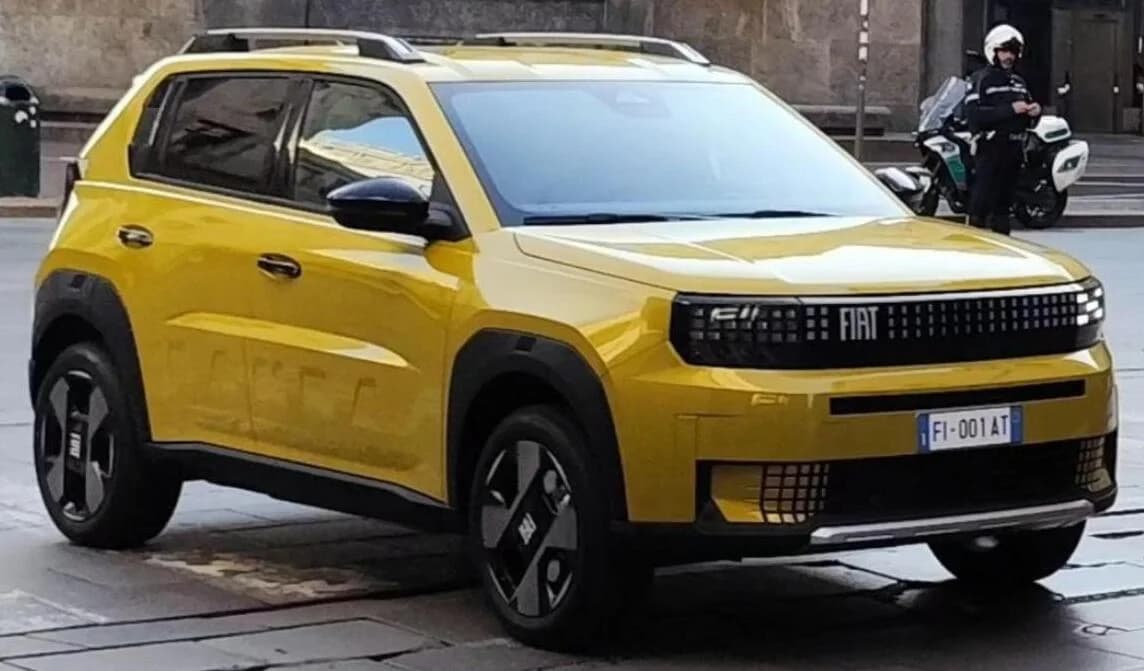
The image used with this article shows an electric Fiat Grande Panda photographed in Turin. It is a licensed illustration of the compact segment, not an E-Car prototype. The photograph does not confirm the design, battery or dimensions of any future Stellantis product.
The wording used by Stellantis also suggests that E-Car is intended to support more than one badge. Sharing a technical base across brands can spread development costs over a larger volume. That matters in the small-car market, where the price ceiling is lower but the engineering and safety requirements remain substantial.
Why small cars matter to Stellantis
Stellantis’ own EU30 figures show why the group is returning attention to smaller vehicles. In 2025, the Fiat Panda led the A-segment with a 24% share. In B-segment hatchbacks, the Peugeot 208, Opel/Vauxhall Corsa and Citroën C3 together represented 24.3% of the market, according to the company’s annual report.
Electrification is also building momentum in this area. Stellantis reports that B-segment battery-electric sales grew by 32.6% in 2025 and that nine of its vehicles were included in the category’s top 20. The challenge is that a battery can quickly make a small car expensive. A city-focused vehicle needs enough usable range for commuting, but an oversized battery would add weight and cost.
That is why the E-Car project is strategically important. If Stellantis can combine a small battery with efficient packaging, controlled equipment levels and high production volume, it may be able to offer an electric car that is closer to mainstream budgets. If it cannot, the result could remain a niche product despite the group’s manufacturing scale.
The wider FaSTLAne 2030 plan
The affordable-car initiative is only one part of the strategy. Stellantis says it plans more than €60 billion in investment through 2030 and expects to launch a mix of 29 battery-electric, 15 plug-in hybrid or range-extended, 24 hybrid and 39 combustion or mild-hybrid vehicles. The numbers describe a global programme rather than a single European model line-up.
For Europe, the group is targeting a 20% cost reduction for the STLA One generation and wants battery-electric and combustion vehicles to approach cost parity. That target is particularly important for compact EVs. The lower the production cost, the more room there is for a competitive retail price without removing equipment that buyers expect.
What buyers should expect next
There is no official European E-Car price and no confirmed Romanian launch date. The verified information is limited to the product description, the planned Italian production location and the 2028 timing given by Stellantis. Range, charging speed, motor output, battery chemistry and brand names remain unannounced.
For buyers, the project could eventually bring more realistic electric choices to European cities. Its success will depend on the final price, standard specification, charging access and the incentives available when the cars reach dealers. Until Stellantis releases those details, forecasts about range or affordability would be speculation.
Image: electric Fiat Grande Panda photographed in Turin by AbacRiot, Wikimedia Commons, CC BY-SA 4.0. The photograph illustrates the compact segment and is not an E-Car prototype.



