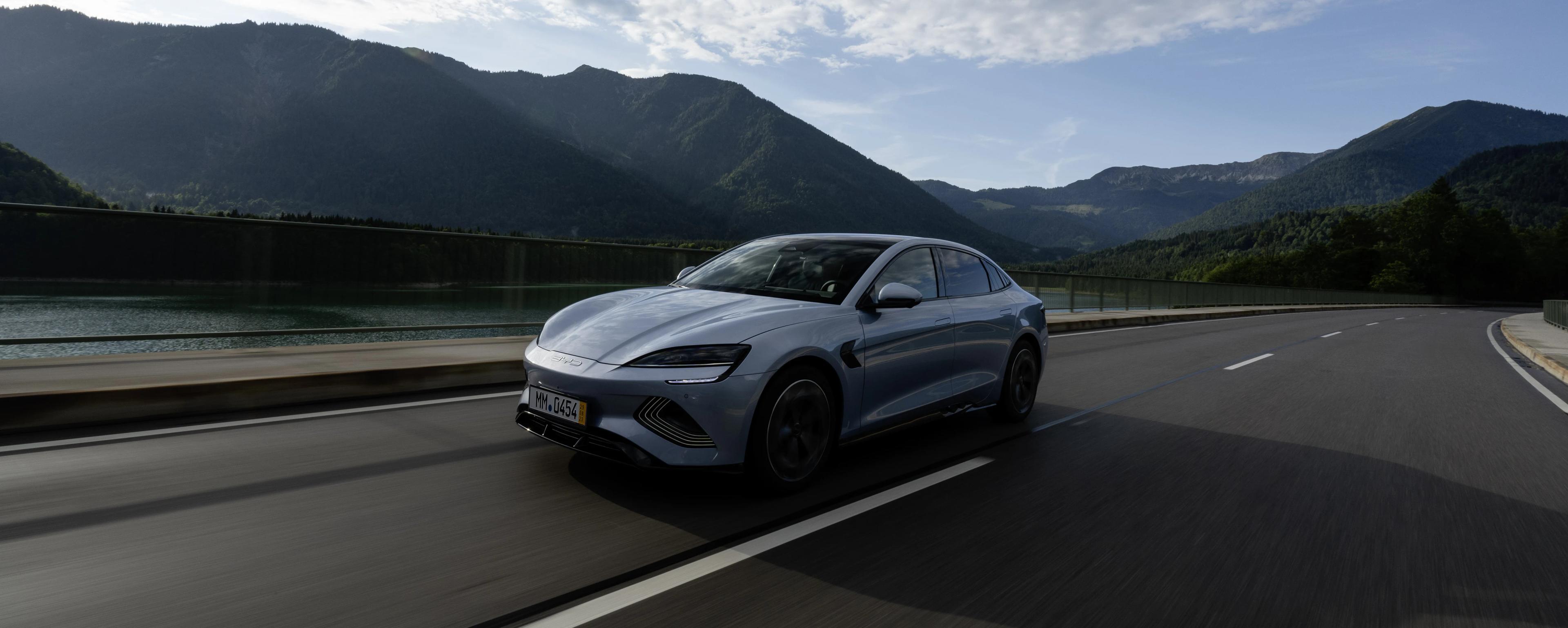
The BYD Seal uses a Blade Battery integrated into the body through Cell-to-Body construction. Official press image: BYD. Supplied for model communications; copyright remains with the company.
Structural EV batteries save parts, but complicate repair
A structural electric-vehicle battery does more than hang beneath the passenger compartment. Its enclosure contributes to body stiffness and vehicle load paths, allowing engineers to remove some of the floor, brackets and intermediate frames that a separately mounted pack requires. Tesla, BYD and BMW have put different versions of this principle into production.
The engineering attraction is straightforward: fewer passive parts can mean less mass, better use of space and fewer assembly steps. The difficult part appears later. If the battery enclosure also helps the body carry loads, impact diagnosis, sealing, replacement and end-of-life separation have to be considered as vehicle-structure work as well as battery work.
Structural pack does not mean every cell is a beam
Traditional EV architecture usually places cells in modules, modules in a sealed pack, and the pack under a complete body floor. The pack must protect its high-voltage components and support itself, while the body provides the main crash and torsional structure.
Cell-to-pack removes the conventional module layer and places cells or cell groups directly in the enclosure. Cell-to-chassis and cell-to-body go further by making that enclosure part of the vehicle structure. The labels are not perfectly standardised across manufacturers, so two systems described as CTB can differ in their top cover, cooling, adhesives and removal process.
Most production “structural batteries” are not structural-battery materials in the laboratory sense. Individual cells generally remain electrochemical components. Enclosures, bonding compounds, honeycomb panels and surrounding body members transfer the mechanical loads. Carbon-fibre composites that simultaneously act as electrodes and load-bearing material are a separate research field and are not what a current Model Y or BYD Seal uses.
Tesla combined a structural pack with large castings
Tesla reported that its first Austin-built Model Y vehicles with in-house 4680 cylindrical cells, single-piece front and rear castings and structural battery packs were delivered in April 2022. The pack links major body sections rather than sitting beneath a fully duplicated conventional floor.
Not every Model Y uses that layout. Tesla’s own 2022 filing said the Texas plant would be able to build both structural-pack cars with 4680 cells and non-structural cars with 2170 cells. Its service literature maintains separate procedures for structural and non-structural configurations. The model badge alone does not identify the pack architecture.
Structural also does not mean permanently bonded beyond removal. Tesla publishes a complete Model Y structural-pack replacement procedure. It calls for trained high-voltage technicians, discharge and shipping precautions, lifting equipment, seal inspection and the removal of numerous fasteners. The assembly can come out, but the job is tightly controlled and far removed from opening a conventional fuel tank.
A 2023 Tesla campaign bulletin illustrates the service consequence. For a VIN-specific group of Austin-built Model Y vehicles whose packs might not have met manufacturing specifications, the prescribed correction was complete structural-pack replacement because range could be reduced. Tesla classified it as a non-safety condition; it was not a statement about every structural Model Y.
BYD makes the Seal’s battery part of a sandwich floor
BYD calls the Seal its first production vehicle with Cell-to-Body technology. The Blade Battery’s top cover is integrated with the conventional body-floor function. Together, the upper cover, cells and lower tray form a sandwich structure, supplemented by a high-strength aluminium honeycomb-style panel.
The manufacturer quotes 40,500 Nm per degree of torsional rigidity for the Seal and says CTB contributes to that figure. This is a BYD claim for the complete vehicle, not a Carboratory measurement and not a figure that can automatically be assigned to every Blade Battery model. The European launch material also specified a pack height of 110 mm and an 82.5 kWh battery for the versions presented at the time.
Removing a separate upper floor can improve vertical packaging. It helps explain how a low saloon can preserve headroom while carrying a large battery below the occupants. Yet the final body stiffness also depends on sills, pillars, crossmembers, bonding and joint design. The pack is one part of the load path, not the entire safety cell.
BMW’s Neue Klasse battery closes an open body floor
BMW uses the phrase “pack-to-open-body” for its Gen6 Neue Klasse system. During assembly, the body has an open floor; installing the high-voltage battery structurally closes it. BMW says the approach removes the need for an additional floor, saves material and weight, and contributes to torsional stiffness.
Inside the pack, cylindrical cells are installed directly without first creating conventional modules. BMW calls this cell-to-pack. The distinction matters: cell-to-pack reorganises the battery, while pack-to-open-body reorganises the relationship between battery and body.
The manufacturer has described industrial production steps for Gen6 packs, including cell clustering, cooling elements, laser cleaning, welding and in-line quality monitoring. It has not published one universal mass reduction attributable solely to the structural function. Cooling, impact protection, seals and attachment points remain necessary even when a separate floor panel disappears.
Integration can improve system efficiency
A 2026 perspective in Nature Reviews Clean Technology reports that integrated designs have achieved system-level volumetric efficiencies above 70%. It cites system gravimetric energy densities approaching 255 Wh/kg for nickel-rich chemistries and about 160 Wh/kg for lithium-iron-phosphate systems. These are analytical benchmarks across architectures, not confirmed specifications for the three cars discussed here.
Removing module walls and duplicated structures can let a manufacturer reduce mass, fit more cells in the same envelope, lower the cabin floor or reshape crash structures. Higher body stiffness can also give suspension mounting points a more stable relationship to one another.
None of those gains is automatic. A pack may need a heavier underbody shield, more adhesive or complex manufacturing equipment. A carmaker might use the freed volume for additional energy, leaving vehicle mass similar but increasing range. “Structural battery” is therefore an architectural description, not proof that a particular EV is lighter than its predecessor.
Safety must be evaluated as a complete system
In a body-integrated design, an impact can affect the battery enclosure and the vehicle structure at the same time. Engineers have to manage side intrusion, underbody strikes, vibration, cooling, sealing and thermal propagation together. Integration is not inherently safe or unsafe; results depend on load paths, materials, cell spacing, thermal barriers and validation.
Tesla’s service documents explicitly require underside inspection for structural Model Y packs and provide dedicated collision-repair information. BYD promotes the Seal’s sandwich construction and high torsional stiffness as safety benefits. Those documents confirm that manufacturers treat the pack as part of the crash system, but manufacturer claims are not substitutes for model-specific independent crash and repair data.
Repair and recycling reveal the trade-off
A modular pack can, in principle, permit intervention at module level if the manufacturer supports it. A tightly bonded, module-free assembly may narrow access and make local defects more likely to result in whole-pack replacement. The Nature analysis warns that manufacturing savings can become small beside pack value, downtime and end-of-life processing costs.
Removal is only one part of repairability. Technicians need diagnostic data to establish whether an underbody mark is cosmetic, whether a seal has failed or whether a load-bearing enclosure has deformed. Insurers need approved limits and procedures. A removable pack can still be expensive to assess if the design offers little granularity below pack level.
Recycling has a related tension. Eliminating intermediate housings saves material at production, but extensive bonding and close integration may require more energy and labour during disassembly. The 2026 review argues that future metrics should include disassembly effort and material-recovery yield alongside energy density and cost.
What buyers should check
The acronym in a brochure is less useful than the service ecosystem behind it. Buyers should look for the battery warranty, official underside-damage procedure, availability of high-voltage repair centres, pack replacement policy and the way insurers classify structural battery damage.
There is no reason to reject an EV solely because its pack is structural. Tesla publishes removal procedures, BYD has sold the CTB-equipped Seal in multiple markets, and BMW designed Gen6 integration for series production. Nor should a structural label be accepted as proof of lower weight, greater range or cheaper ownership without whole-vehicle evidence.
The useful question is whether the manufacturer has successfully reassigned every function removed with the old boundaries. The battery still needs cooling, electrical isolation, impact protection, sealing, diagnosis and a route to recovery at the end of its life. Structural integration succeeds only when those tasks move into a lighter and simpler system without becoming an excessive repair burden.
Sources
- Tesla — Q1 2022 filing confirming the first 4680 structural-pack Model Y deliveries
- Tesla Service — Model Y structural-pack removal and replacement procedure
- BYD — European Seal introduction and Cell-to-Body construction
- BMW Group — Gen6 production and pack-to-open-body architecture
- Nature Reviews Clean Technology — trade-offs in structural battery integration